

Published by Osasere E.
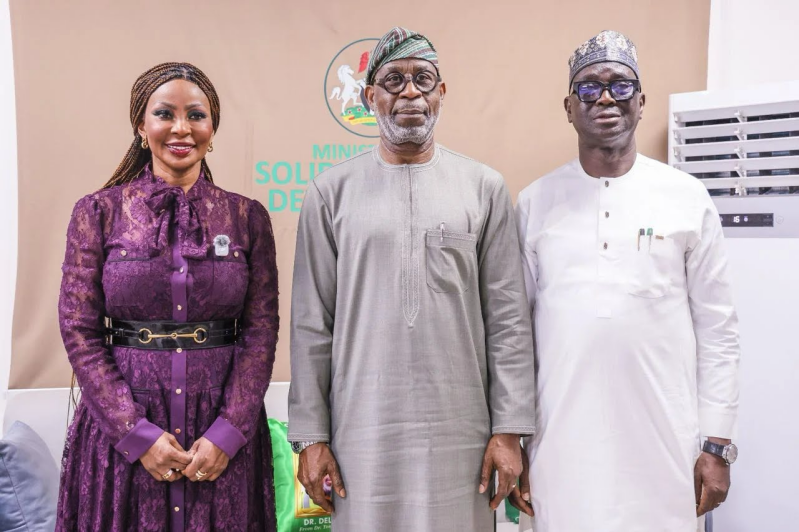
The Federal Government has formally thrown its weight behind the South-South Development Commission's ambitious plan to unlock the region's vast solid mineral deposits, signalling a strategic shift that could redefine the economic identity of Nigeria's traditional oil heartland. Minister of Solid Minerals Development, Dele Alake, made the commitment during a courtesy visit by the commission's Director-General, Usoro Akpabio, and her delegation to the ministry in Abuja. The minister declared that the South-South, long synonymous with crude oil, could no longer afford to rely solely on its hydrocarbon resources when significant deposits of solid minerals lay untapped across the region.
Alake framed the partnership as central to President Bola Tinubu's broader vision of using the six newly established geopolitical development commissions as engines for unlocking economic opportunities and accelerating development nationwide. He argued that the region is strategically positioned to contribute to the Federal Government's diversification agenda by developing its mineral resources in tandem with its established petroleum industry. The minister pledged the ministry's full support to the commission to harness these resources for investment, job creation, and sustainable development.
Central to the government's confidence in this new direction are the sweeping reforms Alake has championed within the mining sector. According to the minister, these reforms have already attracted more than $2.6 billion in foreign direct investment into Nigeria's mining industry. New mineral processing facilities have emerged across the country, creating employment opportunities and increasing revenue accruing to the Federal Government. The minister said the reforms are aimed at transforming mining into a major driver of industrialisation by encouraging local processing, responsible mining practices, and stronger regulation.
Alake urged South-South states to take full advantage of the Federal Government's framework that allows direct state participation in mining through State-owned Special Purpose Vehicles and properly obtained mining titles. He noted that several states had already secured mining licence approvals through this arrangement. However, the minister issued a firm warning to state governments against introducing unilateral policies that could conflict with federal mining regulations. He stressed that regulatory certainty remained critical to attracting long-term investments, and that inconsistent policies or multiple authorities could discourage investors who require a predictable environment before committing capital. "We have a commonality of objective; we just need to harmonise our strategies and tactics to achieve it," Alake said.
Earlier, Akpabio outlined the commission's vision for a practical partnership with the ministry, focusing on sustainable mining, environmental innovation, investment mobilisation, and job creation. She said the South-South Development Commission would align its programmes with the ministry's policies while working closely with state governments and security agencies to improve the mining environment. Particular attention, she noted, would be given to the training and formalisation of artisanal miners, many of whom currently operate outside the formal regulatory framework. The formalisation of this sector is considered crucial for improving government revenue, reducing unsafe mining practices, and curbing environmental degradation associated with unregulated operations.
The two sides also agreed on the need for regional stakeholder and investment engagements to showcase specific mineral opportunities in the South-South and connect investors with viable projects. Alake responded by saying the ministry would involve the commission in such investment engagements, describing it as a potential catalyst for deeper investment and development in the region.
The development comes as Nigeria intensifies efforts to position its vast critical mineral deposits—including lithium, copper, and bauxite—as the foundation for a new wave of industrial growth. In June 2026, the Council for Critical Minerals Development in the Global South presented a strategic roadmap to Alake on the sidelines of the African Natural Resources and Energy Investment Summit, identifying pathways for leveraging these resources to build local industries, deepen mineral beneficiation, and attract investment into green manufacturing. The roadmap is expected to guide policy reforms aimed at strengthening forward linkages between the mining sector and manufacturing industries, enabling Nigeria to retain more value from its natural resources.
The South-South's mineral wealth has long been overshadowed by its oil and gas production. But with global demand for battery metals and clean energy technologies rising sharply, the region's deposits of critical minerals are now being viewed as a strategic asset that could power Nigeria's energy transition while creating opportunities for local processing and manufacturing. Market analysts have suggested the strategy could significantly improve Nigeria's attractiveness to investors seeking reliable critical mineral supply chains.
However, the path to unlocking this mineral wealth is not without challenges. The warning from Alake about policy inconsistency underscores the delicate balance between federal authority and state ambitions. The formalisation of artisanal miners, while promising for revenue and safety, will require significant administrative and security coordination. And the ambitious targets—$2.6 billion in FDI already attracted, with more expected—will depend on sustained regulatory stability and infrastructure development.
Yet for a region that has long been defined by the boom-and-bust cycles of oil, the prospect of diversifying into solid minerals offers a new narrative. The Federal Government's backing of the South-South Development Commission's plan is not merely a policy endorsement; it is a recognition that Nigeria's economic future lies not in a single resource, but in the strategic development of all its natural endowments. As Alake put it, the objective is shared; what remains is the harmonisation of strategies to achieve it. For the South-South, that harmonisation could mark the beginning of a new era—one where its wealth is measured not just in barrels of oil, but in tonnes of lithium, copper, and bauxite processed and manufactured within its own borders.
📩 Stone Reporters News | 🌍 stonereportersnews.com
✉️ info@stonereportersnews.com | 📘 Facebook: Stone Reporters News | 🐦 X (Twitter): @StoneReportNew | 📸 Instagram: @stonereportersnews
Add comment
Comments