

Reported by: Oahimire Omone Precious | Edited by: Oravbiere Osayomore Promise.
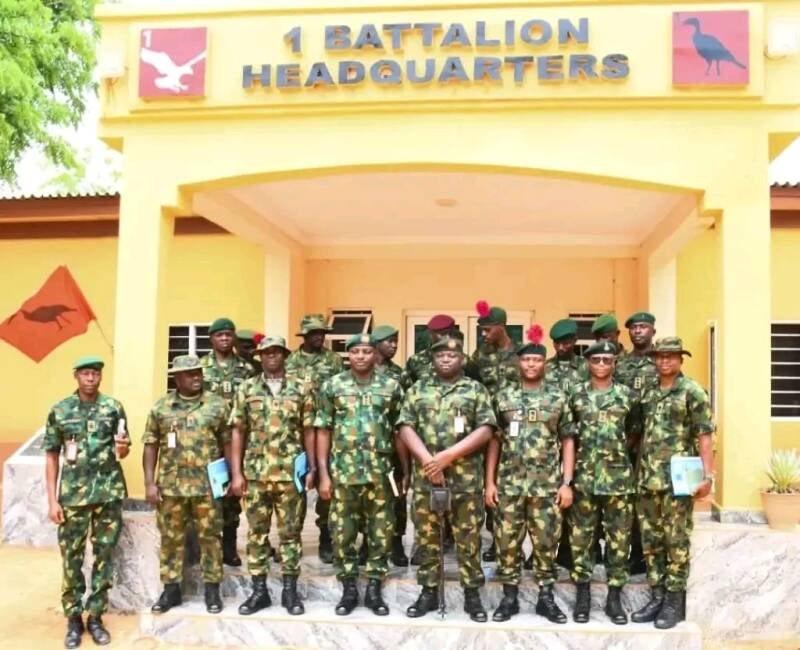
The Acting Commander of the 1 Brigade Nigerian Army, Colonel Joseph Umaru, has issued a direct and unambiguous charge to troops under his command in Kebbi State: intensify intelligence-led operations, deny bandits and other criminal elements the freedom to operate, and embrace a leadership philosophy that puts the welfare of the soldier at the centre of the mission. The directive was delivered during a two-day maiden familiarisation tour of units under the Brigade's Area of Responsibility from September 8 to 9, 2026, a visit that took the Acting Commander to 223 Light Tank Battalion in Zuru, the Chief of Army Staff Intervention Battalion III in Sakaba, and 1 Battalion in Birnin Kebbi.
The tour was not a ceremonial inspection. According to a post obtained from the Nigerian Army's official X handle, the visit was aimed at gaining first-hand knowledge of the operational environment, assessing troops' readiness and welfare, and strengthening command effectiveness in the ongoing fight against insecurity. At 223 Light Tank Battalion in Zuru, the Commanding Officer, Lieutenant Colonel SS Dadirep, briefed Colonel Umaru on the prevailing security situation, ongoing operations, operational readiness, and the challenges confronting the unit. The briefing provided the Acting Commander with a granular understanding of the threats and constraints facing troops on the frontline, setting the stage for the directives that followed.
Colonel Umaru's central message was that mission success depends on the welfare and motivation of the troops. He directed Commanding Officers to fully embrace the Chief of Army Staff's "Soldiers First" mantra by prioritising the welfare, motivation, training, and professional development of personnel. He stressed that troops who are properly led, motivated, and equipped are better positioned to sustain operational pressure and accomplish assigned tasks. The "Soldiers First" philosophy, championed by Chief of Army Staff Lieutenant General Waidi Shaibu, represents a shift in military leadership thinking, recognising that the physical and psychological well-being of soldiers is not a secondary concern but a prerequisite for combat effectiveness.
The operational dimension of Colonel Umaru's charge was equally direct. He instructed units to strengthen intelligence-led operations through enhanced intelligence gathering, information sharing, and cooperation with sister security agencies, local authorities, and other relevant stakeholders. The emphasis on intelligence reflects a hard-learned lesson from years of fighting banditry in Nigeria's North-West: kinetic operations alone, no matter how well-executed, cannot defeat an enemy that blends into civilian populations, exploits difficult terrain, and relies on local informants for survival. Intelligence-driven operations, built on credible human intelligence and seamless inter-agency coordination, are essential to locating, disrupting, and dismantling criminal networks.
Colonel Umaru also underscored the importance of professionalism and the protection of civilians. He directed commanders and troops to remain professional and adhere strictly to the rules of engagement, stressing that sustained, coordinated, and proactive operations to deny bandits freedom of action must not come at the expense of civilian safety or military discipline. The directive was clear: the fight against banditry must be conducted within the bounds of the law and with respect for the rights of the communities the military is sworn to protect.
The Acting Commander's charge comes at a critical juncture in Kebbi State's struggle with insecurity. The state has been a frontline in the battle against banditry, kidnapping, and cattle rustling, with attacks on communities in Yauri, Shanga, Ngaski, and Fakai Local Government Areas becoming a recurring nightmare for residents. The Yauri axis, in particular, has been described by Governor Nasir Idris as one of the state's major security flashpoints because of its proximity to Niger and Zamfara states, while Fakai shares a boundary with Sokoto State, and Kebbi also has an international border with the Republic of Benin, making parts of the state vulnerable to cross-border criminal activities. In August 2026, the Chief of Army Staff deployed additional troops to Kebbi to strengthen security operations against persistent kidnappings and bandit attacks, with the reinforcements deployed to Yauri, Shanga, and Ngaski LGAs.
The results of these deployments have been mixed but not insignificant. On September 2, 2026, troops of Sector 2, Operation FANSAN YAMMA, rescued six kidnapped victims following an intense firefight with suspected terrorists along the Wasagu-Ayu Road in Wasagu Local Government Area. The operation followed credible intelligence on suspected terrorist activity around Mehinua Village, and the troops engaged the terrorists with heavy fire, forcing them to flee and abandon the victims. The rescue underscored the critical importance of actionable civilian intelligence in combating asymmetric rural warfare. The rescued individuals and a recovered vehicle were handed over to relevant community authorities for debriefing, medical evaluation, and reunification with their families.
Just days later, on September 8, 2026, troops of Sector 1, Operation FANSAN YAMMA, foiled a major cattle rustling operation and recovered more than 500 cattle in Igabi Local Government Area of Kaduna State, following a distress call from residents over the activities of suspected terrorists at Rugar Mande Kurmin. The troops established blocking positions on the rustlers' withdrawal routes, engaged them from multiple positions, and forced them to abandon the cattle. The recovered livestock were later handed over to their owners. The operation demonstrated the military's ability to protect livelihoods as well as lives, and to disrupt the economic networks that sustain banditry.
But the challenges remain immense. On September 3, 2026, bandits attacked Girkau community in Kebbe Local Government Area of Sokoto State, killing five people and injuring three others, while also abducting residents and rustling unspecified animals. The attack came just days after bandits imposed a N40 million levy on Kebbe town, threatening to kill residents and burn the community if the money was not paid. More than 6,000 people were displaced from five communities in Kebbi State following recent attacks attributed to banditry, according to ThisDay. The scale of displacement and the brazenness of the attacks underscore the magnitude of the task facing Colonel Umaru and his troops.
The "Soldiers First" mantra is not a hollow slogan. In a conflict where troops are deployed to remote and dangerous areas for extended periods, often with limited access to basic amenities, the welfare of personnel is directly linked to their ability and willingness to fight. The Chief of Army Staff, Lieutenant General Waidi Shaibu, has made welfare a central pillar of his leadership, and Colonel Umaru's directive to Commanding Officers to prioritise the motivation, training, and professional development of personnel is a reaffirmation of that commitment. The Acting Commander's message was clear: a soldier who is properly fed, properly equipped, and properly led is a soldier who will fight with the commitment and discipline required to defeat a ruthless enemy.
The challenges ahead are daunting. Banditry in Kebbi and the wider North-West is not a simple problem with a simple solution. It is driven by a complex mix of factors, including poverty, unemployment, the proliferation of small arms, weak governance at the local level, and the exploitation of difficult terrain and porous borders by criminal networks. Military operations alone cannot resolve these underlying issues, but they are an essential component of any strategy to restore security and create the conditions for long-term development. Colonel Umaru's charge to his troops is a recognition that the military's role in this fight must be conducted with intelligence, professionalism, and a deep regard for the welfare of the men and women on the frontline.
As the Acting Commander concluded his tour and returned to his headquarters, the message he left with the troops was one of resolve and responsibility. The fight against bandits in Kebbi is far from over, but the renewed emphasis on intelligence-led operations, inter-agency cooperation, and the welfare of soldiers provides a framework for a more effective and sustainable campaign. The coming weeks and months will test whether this approach can deliver the results that the people of Kebbi State so desperately need. For now, the soldiers on the frontlines have their orders: deny the bandits freedom of action, protect the civilians, and look after each other. The rest will depend on the execution.
📩 Stone Reporters News | 🌍 stonereportersnews.com
✉️ info@stonereportersnews.com | 📘 Facebook: Stone Reporters News | 🐦 X (Twitter): @StoneReportNew | 📸 Instagram: @stonereportersnews
Add comment
Comments