

Reported by Ariajegbe Sylvia Esezobor
The Nigerian Air Force has taken delivery of five new helicopters, marking a significant boost to the country’s airpower as the Federal Government intensifies efforts to modernise the armed forces and confront a complex web of security threats across Africa’s most populous nation.
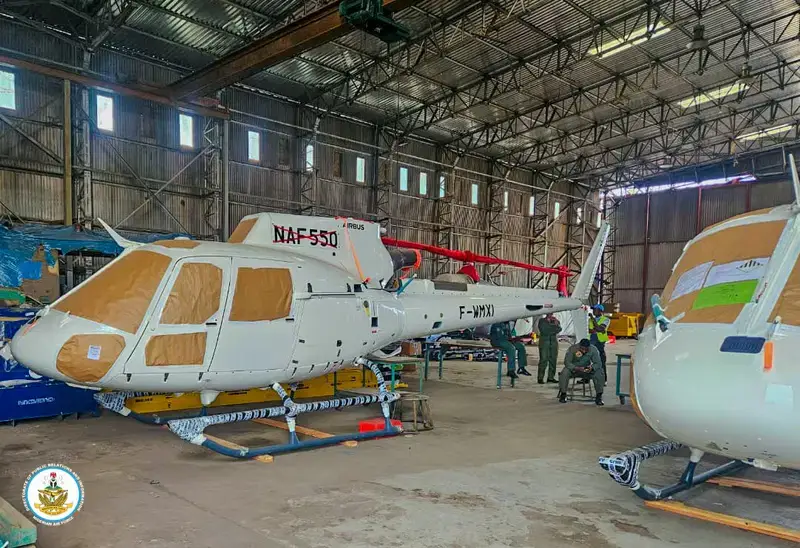
The newly acquired platforms comprise three AW-109 Trekker B helicopters manufactured by Leonardo Helicopters of Italy and two H-125 helicopters produced by Airbus Helicopters. The three AW-109s arrived in Lagos on Tuesday, September 15, 2026, as part of a batch of ten recently acquired by the Federal Government. The remaining seven helicopters are expected to be delivered before the end of 2026. The two H-125 helicopters had earlier been delivered to the service, bringing the total number of helicopters covered by the latest acquisition to five.
A statement by the NAF Director of Public Relations and Information, Air Commodore Ehimen Ejodame, said the acquisition was part of the Federal Government’s sustained investment in strengthening the operational capabilities of the service. The Chief of the Air Staff, Air Marshal Sunday Kelvin Aneke, described the acquisition as another milestone in the Federal Government’s ongoing investment in the modernisation and re-equipment of the NAF. He said the arrival of the helicopters would increase aircraft availability and give commanders greater flexibility in deploying airpower in support of ongoing military operations across the country.
The new platforms are expected to particularly strengthen the NAF’s ability to provide timely air support to ground troops operating in challenging environments. The AW-109 Trekker B helicopters will significantly boost the NAF’s rotary-wing capabilities, enhancing capacity for intelligence, surveillance and reconnaissance, close air support, armed escort and combat search and rescue, as well as other joint missions in support of ground forces. The versatility of the AW-109 platform is expected to provide commanders with additional options for rapidly deploying air assets in support of troops engaged in counter-terrorism, counter-insurgency and other internal security operations.
The two H-125 helicopters will complement the AW-109s by providing versatile light-helicopter capabilities for various operational requirements. Together, the platforms will expand the NAF’s flexibility and capacity to respond to changing operational demands, including moving personnel and equipment, conducting surveillance and supporting joint forces operating in difficult-to-reach areas. The Air Chief expressed appreciation to President Bola Ahmed Tinubu for his continued support for the transformation and modernisation of the NAF, saying the Federal Government’s investment was enabling the service to progressively develop the capabilities required to meet its operational responsibilities.
The newly delivered platforms are currently undergoing post-delivery assembly and other technical processes ahead of their formal induction and operational deployment. This process includes crew-readiness and technical preparations required to ensure that the helicopters are fully prepared for operational employment. Air Marshal Aneke stressed that the NAF’s responsibility went beyond acquiring new platforms, noting that the service must ensure that the Federal Government’s investment translated into measurable operational results. He said the service would continue to prioritise effective employment, maintenance and logistics sustainment so that every aircraft delivered adds measurable value to ongoing operations and the protection of the lives and property of Nigerians.
The acquisition comes at a critical time for Nigeria’s security landscape. The country continues to grapple with a multifaceted crisis that includes the Boko Haram and Islamic State West Africa Province insurgency in the North-East, armed banditry and kidnapping in the North-West, separatist agitations in the South-East, and farmer-herder conflicts in the Middle Belt. According to data from the Armed Conflict Location and Event Data Project, over 300 clashes involving Boko Haram and ISWAP were recorded in the Lake Chad region in the first quarter of 2026 alone, a 30 per cent increase from the last quarter of 2025, with a notable rise on both the Cameroon and Nigeria sides of the border.
Defence Minister Mohammed Badaru Abubakar has said that sustained military pressure on terrorist groups had forced some of their activities away from large-scale attacks towards kidnapping and abductions as a means of raising funds. He noted that attacks linked to Boko Haram and ISWAP had become less frequent compared with previous years, attributing the shift to the military’s efforts to choke the logistical and financial lifelines sustaining asymmetric warfare. However, rights groups have flagged a worrying resurgence of a faction of Boko Haram that has returned to targeting civilians directly, even as ISWAP concentrates on military targets.
The latest helicopter delivery is part of a broader fleet modernisation programme that has seen Nigeria invest heavily in new military hardware. In October 2025, Defence Minister Badaru inspected the production line of ten AW109 Trekker helicopters at Leonardo’s facility in Italy, where three units were fully completed and ready for delivery. The Federal Government has also initiated negotiations with the United States for the acquisition of twelve AH-1Z Viper attack helicopters, valued at approximately 455 million dollars, a deal that was first approved by the United States government in April 2022. Additionally, Nigeria has concluded the acquisition of twenty-four M-346 fighter jets from Italy as part of its ongoing fleet renewal strategy.
The 2026 defence budget reflects this commitment to military modernisation. The Air Force was granted 407.1 billion naira, with 27.6 billion naira set aside for attack helicopters and 15.6 billion naira for aircraft maintenance. The increased rotary-wing capacity is expected to strengthen support for joint forces conducting operations against terrorism, kidnapping and banditry, while improving the speed, reach and effectiveness of military responses on the ground. Military analysts say the addition of the AW-109 and H-125 platforms will provide commanders with greater operational flexibility, particularly in the vast and difficult terrain of Nigeria’s northern regions where road infrastructure is poor and ground troops often operate far from their bases.
The NAF said the acquisition was expected to improve the speed, reach and effectiveness of air support to troops on the ground. The service reaffirmed its commitment to ensuring that the new platforms are effectively maintained and deployed to support ongoing operations, adding that the increased rotary-wing capability would contribute to the protection of lives and property and the overall strengthening of Nigeria’s national security architecture. As the helicopters undergo final assembly and crew-readiness preparations, all eyes will be on how quickly they can be inducted into active service and whether they will make a tangible difference in the fight against insurgency and banditry that has plagued Africa’s largest economy for more than a decade.
📩 Stone Reporters News | 🌍 stonereportersnews.com
✉️ info@stonereportersnews.com | 📘 Facebook: Stone Reporters News | 🐦 X (Twitter): @StoneReportNew | 📸 Instagram: @stonereportersnews
Add comment
Comments