

Reported by: Oahimire Omone Precious | Edited by: Oravbiere Osayomore Promise.
The figures land like a thunderclap in a war that has often been defined by what has gone wrong. Major General Abdulsalam Abubakar, the outgoing Theatre Commander of the Joint Task Force North East, Operation Hadin Kai, has handed over command with a scorecard that is as remarkable as it is rare in Nigeria's long and often frustrating counter-insurgency campaign.
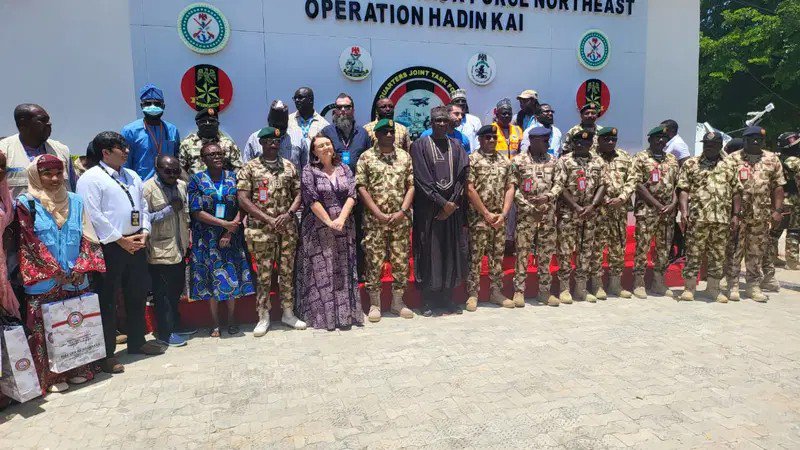
During his 17 months at the helm, troops under his command neutralised more than 1,106 Boko Haram and Islamic State West Africa Province fighters, arrested 758 suspected logistics collaborators, recovered 475 assorted weapons and 24,409 rounds of ammunition of various calibres, discovered and detonated 295 improvised explosive devices, and intercepted more than N300 million allegedly linked to terrorist financiers. He disclosed these figures on Tuesday, September 15, 2026, during the handing and taking-over ceremony at Maimalari Cantonment in Maiduguri, where he formally transferred authority to Major General Ibikunle Ajose.
The numbers alone are staggering, but they acquire a deeper meaning when placed in the context of the campaign that Abubakar inherited. When he assumed command as the 15th Theatre Commander of Operation Hadin Kai, the mandate was clear: to facilitate the restoration of normalcy in the North-East so that socio-economic activities could thrive. That mandate was not about body counts or weapons seizures. It was about creating the conditions for life to return to a region that had been shattered by more than a decade of insurgency. The operational statistics are, in that sense, the means to an end. The end itself is measured in something far more human: the reopening of markets, schools and farms, and the resettlement of families in their ancestral homes.
And by that measure, Abubakar's tenure produced results that are difficult to dismiss. More than 7,000 displaced families returned to their ancestral communities during the period. Communities that had been abandoned for years were reoccupied, with returned populations now present in every local government area of Borno State. The National Youth Service Corps Orientation Scheme returned to Maiduguri after more than 13 years. WAEC and NECO examinations were written in communities like Banki and Gwoza. Trade routes reopened, and local markets came back to life. More than 3,000 Nigerian citizens were voluntarily, safely and with dignity repatriated from Cameroon in an exercise coordinated by the Borno State Government, the Federal Ministry of Humanitarian Affairs and Poverty Reduction, and the United Nations High Commissioner for Refugees. These are not abstract achievements. They are the visible signs of a region clawing its way back from the abyss.
The military campaign that made these gains possible was both kinetic and non-kinetic. Troops killed more than 1,106 terrorists, including several senior commanders whose names had become synonymous with terror across the North-East: Abu Bilal Al-Muniki, also known as Abu Mainok, Malam Jidda, Amir of Ngorgore and Malumti villages, Abu Modu, Modu Dogo, Munzir of Dogon Chukun, Abu Aisha, Qaid of Tumbun Mota, and Abul Kaka. The elimination of these commanders disrupted Boko Haram and ISWAP cells and contributed to sustained pressure on insurgents across the theatre. At the same time, the military intensified operations against the financial and logistics networks that sustain terrorism. The interception of more than N300 million allegedly linked to terrorist financiers and the arrest of 758 suspected logistics collaborators represented a significant blow to the supply chains that keep insurgents in the field.
But perhaps the most significant indicator of the campaign's success is the wave of surrenders. More than 969 JAS and ISWAP fighters and their family members surrendered within the last year, driven by sustained military pressure and the offer of a dignified pathway out of the insurgency through the military's non-kinetic efforts. The surrender of nearly a thousand fighters and their families is not a sign of weakness on the part of the military. It is a sign of strength. It means that the terrorists themselves have concluded that the war is unwinnable, that the pressure is relentless, and that there is a way out that does not end in death or permanent captivity. The military also rescued 638 civilians from terrorist enclaves during the period, including the successful rescue of all 46 students abducted during an attempted attack on the Federal Government Girls College in Monguno. That rescue alone is a reminder of what is at stake in this campaign: the lives of innocent Nigerians, most of them children, whose only crime was to seek an education.
Operationally, the theatre was strengthened in ways that will outlast Abubakar's tenure. Sector 4 was activated to bridge the operational gap between Southern Borno and Northern Adamawa. Nigerian Army Aviation helicopters and the Nigerian Army Remotely Piloted Aircraft System Regiment were inducted, enhancing precision in air operations. The Military Command and Control Centre was linked to frontline surveillance cameras to improve situational awareness across the theatre. These are the kinds of structural and technological investments that turn a reactive military campaign into a proactive one, capable of anticipating threats rather than merely responding to them.
Abubakar was careful to attribute the achievements to the collective effort of the troops, the support of the Chief of Army Staff, Lieutenant General Waidi Shaibu, and the cooperation of stakeholders, including the Borno State Government led by Governor Babagana Zulum, humanitarian partners, and international organisations. He expressed appreciation to President Bola Tinubu and the Chief of Defence Staff, General Olufemi Oluyede. His insistence that the progress was not the achievement of a single individual was both gracious and accurate. Counter-insurgency is a team sport, and the successes recorded in the North-East belong to every soldier who patrolled a forest, every pilot who flew a mission, every intelligence analyst who pieced together a puzzle, and every community leader who provided information.
Now, the baton has passed to Major General Ibikunle Ajose. He inherits a theatre that is more stable, more secure, and more hopeful than it was 17 months ago. He also inherits a war that is not yet over. Boko Haram and ISWAP have been degraded, but they have not been destroyed. They retain the capacity to launch attacks, to ambush troops, and to terrorise civilians. The surrender of 969 fighters is encouraging, but thousands more remain in the bush. The reopening of markets and schools is a sign of progress, but it is not a guarantee of permanence. The next commander will need to build on Abubakar's gains, sustain the pressure on the insurgents, and continue the work of restoring normal life to a region that has suffered for far too long.
For the people of Borno State, the figures announced on Tuesday are more than just statistics. They are a reason to hope that the nightmare of the past decade may finally be coming to an end. For the troops of Operation Hadin Kai, they are a validation of their sacrifice. And for Major General Abdulsalam Abubakar, they are a legacy. He handed over command with his head held high, and the record speaks for itself.
📩 Stone Reporters News | 🌍 stonereportersnews.com
✉️ info@stonereportersnews.com | 📘 Facebook: Stone Reporters News | 🐦 X (Twitter): @StoneReportNew | 📸 Instagram: @stonereportersnews
Add comment
Comments