

Reported By Ariajegbe Esezobor Sylvia
The Independent National Electoral Commission has commenced a nationwide strategic engagement with the disability community, disclosing that it has captured 137,487 Persons with Disabilities in its voter database as it moves to ensure that no eligible voter is left behind in the 2027 general elections.
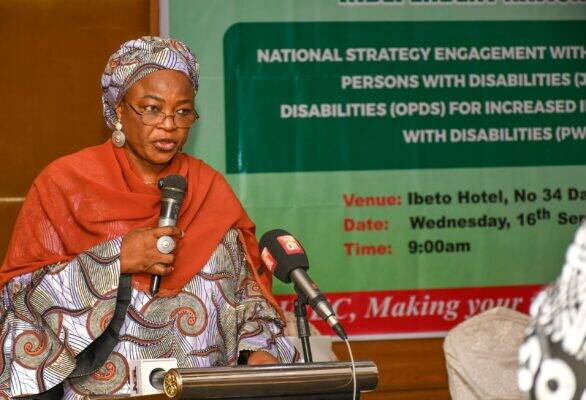
The engagement, held on Wednesday in Abuja, brought together the Joint National Association of Persons with Disabilities, Organisations of Persons with Disabilities, cluster heads, development partners and INEC officials under the theme of sensitisation and mobilisation of PWDs for increased participation in the 2027 polls. The INEC Chairman, Professor Joash Amupitan, who was represented by the Acting Chairman and National Commissioner, Professor Rhoda Gumus, said the meeting reflected the commission's commitment to an electoral process that is inclusive, accessible, participatory and responsive to the needs of all eligible citizens, including Persons with Disabilities.
Gumus said the participation of PWDs is anchored on Section 54 of the Electoral Act 2026, as amended, the Discrimination Against Persons with Disabilities (Prohibition) Act 2018, and INEC's Framework on Access and Participation of Persons with Disabilities in the Electoral Process. She stressed that as preparations for 2027 gather momentum, INEC must strengthen its collaboration with JONAPWD, OPDs and other relevant stakeholders to ensure that no eligible voter is left behind. The commission's available data, compiled before the introduction of the Automated Fingerprint Identification System, records 137,487 Persons with Disabilities. The figure comprises 13,080 visually impaired persons, 9,299 hearing-impaired persons, 30,561 persons with albinism, 19,430 persons with physical impairment, and 54,941 persons in other categories of disability.
Gumus urged JONAPWD and OPDs to take ownership of the sensitisation process by reaching their members across the various disability clusters with information on voter registration, Permanent Voter Card collection, voting procedures, accessibility measures and other aspects of the electoral process. She said the engagement would enable stakeholders to identify barriers to participation, share successful strategies and agree on practical actions to be implemented before, during and after the elections. She also stressed the need for innovative approaches to voter education, including disability-specific communication channels, community-based organisations, radio, social media and other assistive formats.
The Director of the Gender and Inclusivity Department, Mrs Lakunuya Dorothy Bello, described PWDs as a critical constituency whose voices, choices and participation are essential to the credibility and inclusiveness of democracy. She listed persisting challenges to include access to voter information, voter education, mobilisation and accessibility of electoral facilities, and urged stakeholders to develop sensitisation strategies that are broad in reach but also targeted, accessible and responsive. She highlighted measures already introduced by INEC to improve accessibility, including Braille ballot guides, magnifying glasses, the EC30 PWD form and sign-language interpretation during collation activities. She added that the outcomes of the national engagement would be replicated at state level through Resident Electoral Commissioners, Electoral Officers and other relevant officials to translate strategies into grassroots interventions.
The Deputy Director in charge of Inclusivity, Mrs Habiba Abdulkareem Jatto, said the objectives of the meeting were to strengthen collaboration, develop practical mobilisation strategies, increase PVC collection and voter turnout among PWDs, and enhance voter education in accessible formats. Delivering the keynote address, the Executive Director of the Inclusive Friends Association, Grace Jerry, called for a mobilisation model built around mapping PWD networks and priority gaps, reaching communities through OPD and accessible media channels, delivering practical voter education in multiple accessible formats, supporting registration and referrals, monitoring and documenting barriers for escalation to INEC and JONAPWD, and sustaining follow-up engagement through cluster heads.
The National President of JONAPWD, Comrade Abdullahi Aliyu Usman, commended INEC for organising the engagement but called for broader and more strategic consultations involving more disability stakeholders. He said such engagements would enable Persons with Disabilities to communicate their needs, identify gaps and propose solutions that could improve their participation in elections, and stressed that more frequent engagements are needed before 2027. The Executive Secretary of the National Commission for Persons with Disabilities, Barrister Ayuba Gufwan Burki, said the exact number of Nigerians living with disabilities remained difficult to determine but noted that the population was substantial. He called for stronger collaboration among stakeholders to ensure that millions of Nigerians with disabilities could participate fully in the democratic process, and decried barriers of mobility and restricted movement during elections, saying that if fully mobilised, PWDs could determine electoral outcomes.
The Founder and Chief Executive Officer of TAF Africa, Jake Epelle, described the engagement as timely, stressing that an election that fails to include the voices of Persons with Disabilities cannot be regarded as fully democratic. He lauded INEC's priority voting for PWDs but urged improved accessibility of polling units and deeper grassroots mobilisation through cluster heads. "Any election that fails to count the voices of persons with disability is not a democracy, it is an exercise in exclusion," Epelle said. His organisation, TAF Africa, has separately commenced its own nationwide mobilisation of PWDs ahead of the 2027 elections, liaising with INEC and the Inspector-General of Police to address barriers to participation at polling units across the country.
The engagement comes against the backdrop of broader electoral reforms aimed at expanding access. INEC has announced that it will deploy approximately 1.4 million ad-hoc personnel across more than 176,000 polling units for the 2027 general election, and has committed to providing assistive devices for persons with disabilities, pregnant women, the elderly and nursing mothers to improve access to polling units. The commission is also set to introduce downloadable Permanent Voter Cards and a fully online voter registration system ahead of the polls, reforms that have been welcomed by disability advocates who argue that citizens should not lose their right to vote simply because a PVC is lost.
In April, INEC's Ogun State office assured that Persons with Disabilities, the elderly and pregnant women would be given priority during the 2027 elections. And in August, a stakeholder engagement backed by the European Union focused on improving the electoral inclusion of internally displaced persons ahead of the 2027 polls, with attention to INEC's IDP Framework and efforts to address barriers preventing displaced Nigerians from exercising their right to vote. The commission has also previously tested inclusive election measures during the Osun State Governorship Election, which provided an important test of Nigeria's evolving commitment to disability-inclusive elections ahead of 2027.
The 137,487 figure, while significant, is widely believed to understate the true number of Nigerians living with disabilities, given the absence of comprehensive national disability data and the fact that the data was compiled before the introduction of the Automated Fingerprint Identification System. The National Commission for Persons with Disabilities has acknowledged that the exact population of Nigerians with disabilities remains difficult to determine, even as it insists the number is substantial. With the 2027 general election less than a year away, INEC's engagement with the disability community marks a critical step in translating legal frameworks and policy commitments into practical action. Whether that translation reaches the polling units, where accessibility barriers remain a lived reality for millions of Nigerians, will determine whether the 2027 election is truly the inclusive exercise the commission has promised.
📩 Stone Reporters News | 🌍 stonereportersnews.com
✉️ info@stonereportersnews.com | 📘 Facebook: Stone Reporters News | 🐦 X (Twitter): @StoneReportNew | 📸 Instagram: @stonereportersnews
Add comment
Comments