

Reported by Ariajegbe Sylvia Esezobor
The Chancellor of Ekiti State University, Ado Ekiti, Dr. Tunji Olowolafe, has called for concerted efforts to reduce medical tourism and roll back the brain drain that has depleted Nigeria’s health workforce, urging the Federal Government to match investments in healthcare infrastructure with a corresponding commitment to human capital.
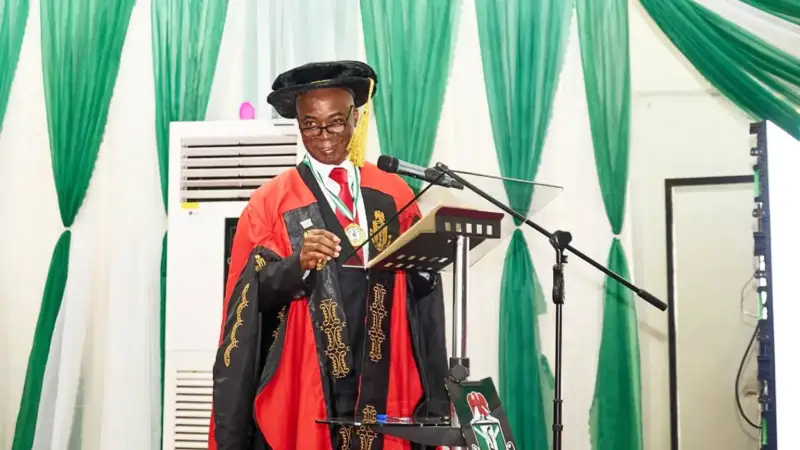
Olowolafe made the call on Thursday, September 17, 2026, at the annual convocation ceremony of New Specialists and Doctors of Medicine at the National Postgraduate Medical College of Nigeria in Lagos, where he was conferred with the institution’s most prestigious award, the Honorary Fellowship. He said the scale of the challenge demanded a deliberate strategy to retain and multiply skilled professionals. “Every year, Nigerians spend enormous sums travelling abroad for medical treatment. Our ambition should be to reverse that trend: first, by building a healthcare system that Nigerians do not need to leave home to access, and ultimately, by making Nigeria a destination for patients from across Africa,” Olowolafe said.
The Chancellor, who chairs the Tunji Olowolafe Foundation, described Nigeria as a country richly endowed with human resources capable of building world-class institutions. He stressed the need for Nigeria to maximise its pool of highly skilled and cerebral professionals to transform the healthcare system and strengthen its capacity to provide quality medical services. “Nigeria has the talent and capacity to build world-class institutions. And nowhere is that more important today than in healthcare,” he said.
Olowolafe, who trained as a medical doctor and obtained his MBBS from the University of Ilorin, expressed concern over the enormous sums spent annually by Nigerians on medical treatment abroad, noting that such expenditure contributes to the economies and healthcare systems of other countries. He emphasised that investments in healthcare infrastructure and facilities must be matched by a corresponding investment in human resources if the desired transformation is to be achieved. “We are already seeing signs of that future. But hospitals and equipment alone cannot deliver it. People will,” he said.
The convocation ceremony saw 537 medical and dental specialists graduate from the college, an institution that has trained generations of Nigerian doctors since its establishment. In his address to the graduands, Olowolafe charged them to see themselves as agents of change. “You are those people. Keep learning, keep refining your craft, and help us build medical institutions in Nigeria that can stand alongside the best anywhere in the world,” he told them. He also expressed appreciation to the National Postgraduate Medical College of Nigeria for conferring the honorary fellowship, assuring the institution that he would continue to contribute meaningfully to the advancement of medical practice and education in Nigeria.
The call comes against the backdrop of a worsening health workforce crisis in Nigeria. Official figures obtained by Saturday PUNCH show that no fewer than 20,966 Nigerian health workers relocated abroad within one year, including 3,919 doctors, 7,487 nurses and midwives, 6,861 medical laboratory professionals, 702 pharmacists and 658 physiotherapists, according to the State of Health of the Nation Report 2025. The report revealed that only 60,551 of the country’s 95,456 registered doctors currently hold active practising licences, representing just 63 per cent, with only 51 per cent of licensed doctors actively employed within Nigeria’s health system.
The nursing and midwifery workforce, Nigeria’s largest health profession, has suffered substantial losses, recording the highest level of migration among all health professions. Although Nigeria has 267,951 registered nurses and midwives, only 113,123 currently possess active practising licences, representing an effective licensing ratio of 42 per cent. The data obtained from the United Kingdom’s General Medical Council showed that 4,691 Nigerian-trained doctors joined the UK medical register between May 2023 and April 2026, while 15,896 Nigerian-trained doctors are currently licensed to practise in the UK. The United Kingdom remains the leading destination for Nigerian health workers, driven by easier professional registration, better remuneration, structured specialist training and persistent workforce shortages within the National Health Service.
The financial dimension of the crisis is equally stark. The Federal Ministry of Health and Social Welfare said in 2025 that Nigeria could potentially retain an estimated N850 billion currently spent abroad on medical tourism annually, while the WHO-Africa Health Observatory Platform estimates that outbound health tourism costs Nigeria about one billion dollars annually. The Nigeria Sovereign Investment Authority said in September 2026 that its investments in healthcare had saved Nigeria about 200 million dollars in foreign exchange outflows associated with medical tourism, with treatment costs at its facilities remaining significantly below comparable international services.
Olowolafe’s own career straddles the worlds of medicine and infrastructure. He left clinical practice more than forty years ago to build a construction and investment career, serving as chairman of the Lekki Concession Company, which developed the Lekki-Epe Expressway. He recalled that experience during his address, describing it as an example of what could be achieved when the right expertise, people and capital were brought together. “My own career took me away from clinical medicine more than forty years ago. Perhaps there is some irony that medicine has found a way to bring me back today,” he said. He described the honorary fellowship as a deeply appreciated return to the profession he left behind.
The Tunji Olowolafe Foundation has continued to contribute to the revitalisation of hospitals, while also supporting medical education and specialist training. In July 2026, the Foundation, in partnership with the National Postgraduate Medical College of Nigeria and the Faculty of Ophthalmology at the Lagos University Teaching Hospital, commissioned the first ophthalmic surgical simulation centre in West Africa, named in memory of Olowolafe’s late wife. The facility is designed to enhance the training of eye surgeons and address the shortage of specialists in the field.
For Olowolafe, the solution to Nigeria’s healthcare challenges lies not only in buildings and equipment but in a deliberate strategy to retain, train and support the professionals who make the system work. His message to the 537 new specialists was clear: Nigeria needs you, and the country has the capacity to build institutions worthy of your talents. Whether that message translates into policy action that stems the exodus remains to be seen, but the Chancellor has placed the issue squarely before a government that has identified healthcare as a priority while grappling with the persistent departure of the very professionals it needs most.
📩 Stone Reporters News | 🌍 stonereportersnews.com
✉️ info@stonereportersnews.com | 📘 Facebook: Stone Reporters News | 🐦 X (Twitter): @StoneReportNew | 📸 Instagram: @stonereportersnews
Add comment
Comments