

Reported by: Ijeoma G | Edited by: Oravbiere Osayomore Promise.
The National Drug Law Enforcement Agency has announced a series of major operational breakthroughs across eight states and the Federal Capital Territory, intercepting more than 1.3 million pills and capsules of tramadol and other opioids, alongside about 6,000 kilogrammes of cannabis. The agency said the combined street value of the seizures exceeded N3.4 billion. The operations, which took place between September 15 and 18, 2026, also led to the arrest of a 49-year-old man who allegedly impersonated a senior police officer to evade security checkpoints while transporting illicit drugs, and a mechanic who allegedly used his auto-repair workshop as a front for storing narcotics.
The NDLEA's Director of Media and Advocacy, Femi Babafemi, disclosed the developments in a statement on Sunday, September 20, 2026. The operations spanned Lagos, Edo, Niger, Delta, Ondo, Gombe, Imo and the FCT, reflecting what the agency described as an intelligence-driven and coordinated approach to disrupting drug trafficking networks across the country.
A major highlight of the crackdown was the interception of 1,200 parcels of Canadian Loud, a potent synthetic strain of cannabis, weighing 603.75 kilogrammes and valued at N1.81 billion. The consignment was discovered at the Tin-Can Island Port in Lagos inside a 40-foot container shipped from Montreal, Canada. The container arrived on September 12 and was placed under intensive monitoring by NDLEA operatives based on processed intelligence. A joint physical examination with the Nigeria Customs Service and other security agencies on September 16 uncovered the drugs concealed in 31 black jumbo bags loaded inside two Toyota Sienna vehicles packed within the container.
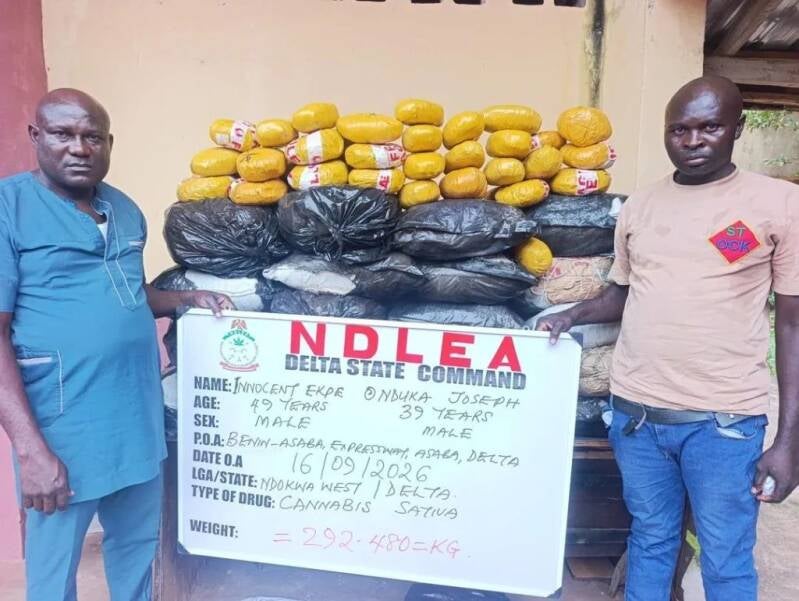
In Delta State, NDLEA operatives arrested Innocent Ekpe, 49, along the Benin-Onitsha Expressway in Asaba on September 16. He was found with 292.48 kilogrammes of skunk concealed in his silver Toyota Sienna bus. Preliminary investigation established that Ekpe had allegedly been parading himself as Godwin Emeka, a Deputy Superintendent of Police, using a forged police identification card to escape scrutiny at checkpoints while transporting illicit consignments across state lines. His alleged accomplice, 39-year-old Nduka Joseph, was also arrested. The agency said the arrest highlighted how drug traffickers were adopting deceptive methods to circumvent security checks along major transportation routes.
In Edo State, operatives acting on intelligence raided a location along Agbor Road in Benin City, where they arrested 45-year-old Matthew Ossai. The agency alleged that Ossai used his auto-repair workshop as a cover for storing illicit drugs. Officers recovered 48 kilogrammes of Canadian Loud, 152 grammes of methamphetamine, and a metal box allegedly used to store the substances. The arrest underscores the agency's focus on dismantling not just trafficking networks but also the storage and distribution infrastructure that sustains them.
The operations also yielded a significant seizure of pharmaceutical opioids in Niger State, where NDLEA operatives arrested two suspects along the Abaji-Abuja Highway on September 18. More than 1.1 million assorted tramadol tablets and capsules, codeine syrup, methamphetamine and Exol tablets were recovered from eight sacks. The drugs were allegedly being transported from Onitsha, Anambra State, to Mararaba, Nasarawa State. Earlier, on September 15, three young suspects were arrested along the Abuja-Kaduna Expressway at Chachi in Tafa Local Government Area. They were found with two locally fabricated AK-47 rifles, a magazine, a locally made pistol with a magazine, and nine rounds of 9mm ammunition concealed in a black travel bag. The presence of firearms alongside narcotics in the possession of suspects as young as 18 highlights the dangerous nexus between drug trafficking and armed criminality.
In Lagos, operatives arrested Onyeka Ofor at his residence in Aguda, Surulere, where 48,900 pills of tramadol 225mg were recovered. Another 59 kilogrammes of cannabis sativa were intercepted at a logistics company, leading to the arrest of a suspect. At Apongbo, a 43-year-old suspect was arrested with 998.38 kilogrammes of nitrous oxide gas. The agency also reported the recovery of 154,480 capsules of tramadol from two suspects arrested in the Barunde area and at Gombe main market. In Imo State, a 25-year-old suspect was arrested along the Owerri-Onitsha Road with 43.85 kilogrammes of skunk.
The NDLEA Chairman, Brigadier General Mohamed Buba Marwa (retd.), commended the officers of the various commands for their professionalism and intelligence-driven operations, urging them to sustain the agency's balanced approach to drug control. Marwa has consistently emphasised that the agency's strategy combines enforcement with prevention, treatment, and rehabilitation. The scale of the latest seizures, however, raises questions about the resilience of the drug trafficking networks operating across Nigeria. Despite sustained pressure from the NDLEA, criminal syndicates continue to devise new methods to move narcotics across state lines and through the country's seaports.
The seizure of Canadian Loud at Tin-Can Island Port is particularly significant. It demonstrates the NDLEA's growing capacity to intercept drugs entering Nigeria through maritime routes, an area where surveillance has historically been weaker than at land borders. The use of a 40-foot container from Canada, with the drugs concealed inside vehicles, shows the sophistication of the networks involved. It also points to the international dimension of Nigeria's drug problem, which is not merely a domestic challenge but part of a global trafficking economy.
The arrest of a man allegedly impersonating a senior police officer is another reminder of the lengths to which traffickers will go to evade detection. The use of forged identification, fake ranks, and official-looking vehicles suggests a level of planning and investment that is difficult for law enforcement to counter without robust intelligence and inter-agency cooperation. The NDLEA's ability to see through the deception is a testament to the training and vigilance of its operatives.
The involvement of teenagers, some as young as 18, in armed drug trafficking is deeply troubling. It suggests that criminal networks are actively recruiting young people, exploiting their vulnerability and desperation. The recovery of AK-47 rifles alongside drugs indicates that these young suspects were not mere couriers but were prepared for violent confrontation. This reality underscores the need for a comprehensive approach that addresses not only the supply of drugs but also the socio-economic conditions that make young people susceptible to recruitment by criminal gangs.
The NDLEA's operations between September 15 and 18 represent a significant blow to drug trafficking networks operating across Nigeria. The arrests and seizures, valued at over N3.4 billion, disrupt the flow of illicit substances and send a clear message that the agency is determined to pursue traffickers wherever they operate. However, the sheer scale of the trade and the continued sophistication of the networks suggest that the battle is far from over. The NDLEA's success will depend on sustained funding, continued inter-agency collaboration, and the cooperation of communities across the country. For now, the agency has demonstrated its capacity to act decisively. The challenge is to maintain that momentum and translate operational victories into lasting reductions in drug supply and demand.
📩 Stone Reporters News | 🌍 stonereportersnews.com
✉️ info@stonereportersnews.com | 📘 Facebook: Stone Reporters News | 🐦 X (Twitter): @StoneReportNew | 📸 Instagram: @stonereportersnews
Add comment
Comments