

Reported by: Ijeoma G | Edited by: Oravbiere Osayomore Promise.
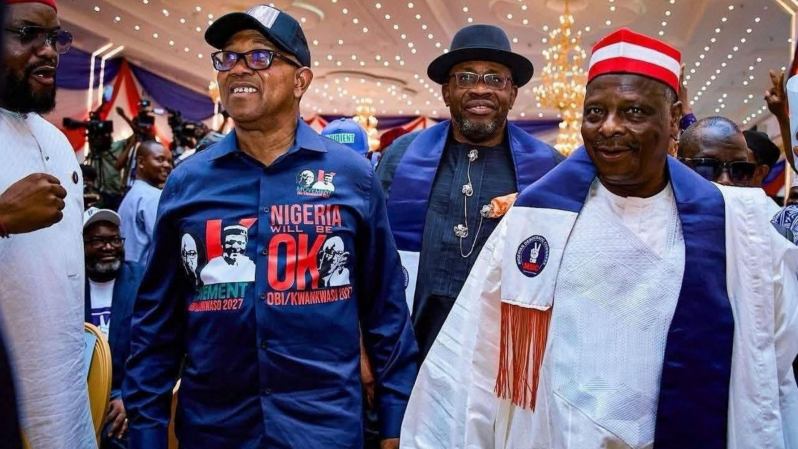
The internal crisis within the Obi-Kwankwaso Movement has deepened sharply following the resignation of its National Head of Operations, Hon. Engr. Francis Nnoli, who stepped down on Sunday, September 20, 2026, citing what he described as a widening disconnect between the movement and the Nigeria Democratic Congress ahead of the 2027 general elections. Nnoli's resignation is the most significant fallout yet from a simmering dispute over whether the OK Movement should function as an independent political platform or operate under the formal authority and discipline of the NDC, the party on whose ticket Peter Obi and Rabiu Kwankwaso are pursuing their joint presidential bid.
In a resignation statement made available to journalists in Abuja, Nnoli said he could no longer continue serving in a structure whose direction he no longer trusted. "I can no longer, in good conscience, continue to serve in a structure whose direction I no longer trust," he said. He stressed that his decision was driven by the need for political discipline, structural clarity and coordination between support groups, candidates and the party. "Every support structure established around a political ticket must operate with a clear understanding of its relationship with the political party, its candidates and the broader political mandate it seeks to advance," Nnoli said. He argued that where a movement exists primarily to mobilise support for candidates contesting under a political party, questions of coordination, authorisation and institutional responsibility cannot be dismissed. "We cannot build a credible campaign outside the authority of the political party," he stated. "There must be political discipline and structural clarity."
Nnoli was careful to distinguish his resignation from a rejection of the Obi-Kwankwaso project. "I remain committed to the Obi-Kwankwaso vision," he said. "This resignation is not a rejection of that project. It is a stand for structure, discipline, and credibility." He urged supporters of the movement to resist the temptation of establishing parallel structures, warning that such actions could create confusion and weaken the campaign. "Let us avoid parallel structures. Let us respect the authority of the political party. That is the only way we can build a coordinated and credible campaign for 2027," he said.
The resignation follows a public confrontation between the OK Movement and the NDC leadership over a 59-member Presidential Campaign Council announced by the movement earlier in September. The council, which included zonal and state coordinators, was unveiled to mobilise support for the Obi-Kwankwaso ticket. However, the NDC, through its National Chairman, Senator Moses Cleopas, issued a statement disowning the council, stating categorically that it did not emanate from the party and should be disregarded by the public and the media. "All candidates of the party must appreciate that they are not running as independent candidates," Cleopas said. "They are products of the party and remain subject to the authority and discipline of the party. Therefore, only the party's leadership can constitute and announce a Presidential Campaign Council."
Cleopas also announced disciplinary action against the OK Movement's Director-General, John Ugulu, whom he accused of repeatedly disregarding the party leadership's authority and committing "excesses" during the party's primary election in Lagos State. The NDC chairman warned that no individual or group would be permitted to establish or announce a campaign council or structure in the name of the party without prior approval from the National Working Committee.
The OK Movement, however, refused to back down. In a statement signed by its National Secretary, Saadatu Sani, the movement declared that it would not be intimidated by the NDC chairman's position. The group said it recognised the supremacy of political parties within their constitutional and statutory sphere and remained committed to campaigning for the NDC presidential ticket, but drew a clear line between supporting the party and being controlled by its leadership. The movement claimed its internal records contain about 2.5 million registered members and coordinators nationwide, describing itself as a grassroots organisation with a long-term political vision.
At the centre of the crisis is a fundamental disagreement over the movement's relationship with the NDC. Nnoli believed the OK Movement must operate with clear political discipline and structural alignment with the party. Ugulu, however, publicly maintained that the OK Movement is an independent organisation with no formal ties to the NDC. "We are an independent organisation. We do not require the endorsement or directives of any political party," Ugulu had said. That position, according to sources, did not sit well with Nnoli, who saw it as a recipe for confusion and weakened coordination ahead of 2027. Matters came to a head when the NDC publicly disowned the campaign council, leaving Nnoli with what associates described as an untenable position.
Nnoli's exit is not the first leadership shake-up to hit the OK Movement. In August 2026, former Director-General Peter Ameh resigned for personal campaign reasons, paving the way for Ugulu's emergence. The movement has also weathered reports of internal leadership disputes in recent months. Observers say the latest resignation raises fresh questions about the movement's internal cohesion and its ability to function as a credible support structure ahead of the next general elections. It remains unclear whether other officials sympathetic to Nnoli's position will follow him out the door.
The broader political implications are significant. The NDC is a relatively new platform that has become the vehicle for the Obi-Kwankwaso presidential ticket, and the OK Movement has been a key mobilisation network drawing on the nationwide grassroots structures that Obi and Kwankwaso built during their previous campaigns. The dispute over whether the movement operates independently or under the party's authority speaks to a deeper tension between the energy and autonomy of grassroots support groups and the need for a unified, disciplined campaign apparatus. If the crisis is not resolved, it risks fragmenting the opposition's campaign infrastructure at a time when the NDC needs every available network to compete effectively in the 2027 elections. For now, the NDC leadership has drawn a clear line in the sand, and Nnoli's resignation has sent a signal that the party's authority cannot be taken for granted. Whether the OK Movement will heed that signal or continue on its independent course remains to be seen.
📩 Stone Reporters News | 🌍 stonereportersnews.com
✉️ info@stonereportersnews.com | 📘 Facebook: Stone Reporters News | 🐦 X (Twitter): @StoneReportNew | 📸 Instagram: @stonereportersnews
Add comment
Comments