

Reported by Ariajegbe Sylvia Esezobor
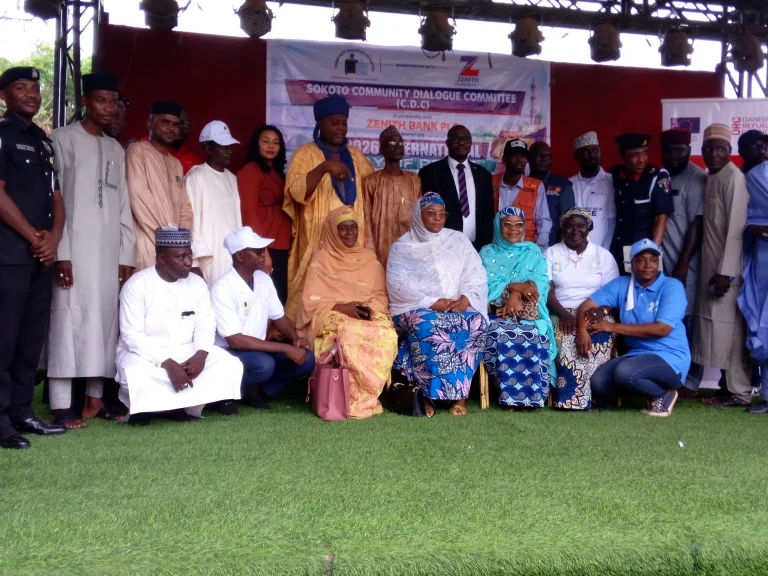
Stakeholders in Sokoto State have issued a powerful and timely call for greater inclusion, responsible journalism, and sustained collaboration among government, security agencies, communities, and civil society organisations to strengthen peace and prevent conflict in a region that has been deeply scarred by banditry, kidnapping, and communal tensions. The call came on Monday, September 21, 2026, at a one-day symposium organised by International Alert Nigeria to commemorate the 2026 International Day of Peace at Pinnacle Castle Hotel in Sokoto. The event, supported by the European Union, Action Against Hunger, and other partners, was held under the theme “Invest in Peace: For Everyone, Everywhere, Every Day,” and it brought together an unusually diverse gathering of traditional rulers, government officials, journalists, women mediators, youth leaders, religious representatives, and persons with disabilities. The symbolism of that gathering was not lost on those who spoke. As the representative of the Commissioner for Local Government and Chieftaincy Affairs, Ibrahim Adare, put it, the presence of participants from different cultural, religious, and linguistic backgrounds demonstrated that peaceful coexistence was not an abstract ideal but a lived reality in Sokoto.
Haliru Binji, the Director of Administration in the ministry, delivered the government’s message with a directness that matched the gravity of the moment. “As long as there is no peace, there is no existence,” he said. He pointed to the diversity of the room as proof that Sokoto could hold together, but he also acknowledged the forces pulling it apart. Kidnapping and banditry, he said, remained major threats to peaceful coexistence, and while the government, traditional leaders, and security agencies were making efforts to address insecurity, those efforts had not yet produced the peace that residents deserved. His words were a rare admission from a government official that the state’s security architecture, despite heavy investment, including the provision of more than 300 operational vehicles to security operatives at flashpoints, had not fully delivered. The recent visit of the Minister of Defence to Sokoto, during which additional vehicles were handed over to troops, was cited as evidence of coordinated federal and state efforts, but the atmosphere in the room suggested that stakeholders were looking for something more than hardware.
The most pointed interventions came from the media and traditional leadership. The Chairman of the Nigeria Union of Journalists, Sokoto State Council, Comrade Usman Binji, used his address on “Hate Speech, Non-Violence, Shared Responsibility and Ethical Reporting During the Campaign Season” to draw a line that many journalists in Nigeria need to hear clearly. “Critical journalism is not hate speech. Holding government accountable is not hate speech. Investigating public projects is not hate speech. Questioning political leaders is not hate speech,” he said. With the 2027 general elections approaching, Binji warned that political competition, when accompanied by hate speech, misinformation, ethnic or religious profiling, and intimidation, could generate the kind of tension that turns elections into flashpoints for violence. He urged journalists to verify information before publication, distinguish facts from allegations and opinions, give affected persons the right of reply, and avoid sensational headlines. He specifically cautioned against publishing unverified claims from social media as facts, noting that artificial intelligence was making it easier than ever to create and circulate false content that could inflame communities. His message was not a plea for quiet journalism. It was a plea for disciplined journalism.
The District Head of Gagi, who also serves as the Sarkin Yakin Gagi and Founder of the Sokoto State Community Dialogue Committee, reinforced the theme of mutual respect. He called on Nigerians to recognise one another’s rights and dignity irrespective of political, religious, ethnic, or regional differences, noting that the Constitution guarantees every citizen the right to live and participate in social and political activities in any part of the country. He commended the organisers for bringing together women mediators, community dialogue groups, women and youth organisations, and other stakeholders, and he singled out the media for praise, acknowledging its role in promoting messages that strengthen unity. His endorsement of the press was significant. In a region where journalists sometimes face suspicion from traditional authorities, the District Head’s public appreciation of the media’s constructive role sent a signal that responsible reporting is valued, not feared.
The event was not merely a one-day talk shop. It built on months of sustained investment in conflict-sensitive journalism and community-based peacebuilding in Sokoto. In August 2026, International Alert, in partnership with the Centre for Journalism Innovation and Development, trained approximately 150 journalists and media practitioners in the state on conflict-sensitive reporting, the Do-No-Harm approach, narrative framing, disinformation and rumour management, artificial intelligence-generated disinformation, and the sensitive reporting of sexual and gender-based violence. The training, funded by the European Union under the RECAP Project, was informed by a Peace and Conflict Analysis that identified unemployment and poverty as the dominant drivers of conflict in Sokoto, along with rumours, identity-based narratives, and politicised interpretations circulated through digital and broadcast platforms. The analysis was a reminder that conflict in Sokoto is not simply a security problem to be solved with troops and vehicles. It is a problem of information, opportunity, and trust. The European Union’s broader 18-month project, “Countering Disinformation and Empowering Democracy in Northwestern Nigeria,” extends this work across Sokoto, Zamfara, Katsina, Kebbi, and Niger states, recognising that the crisis is regional and cannot be addressed in isolation.
The inclusion agenda has also advanced on the ground. In May 2026, International Alert inaugurated the Sokoto Women Mediators Network, bringing together thirty women mediators drawn from government institutions, the justice sector, traditional and religious institutions, civil society, and development partners. The network is designed to amplify women’s voices in peace processes at the grassroots level, where women often play vital but unrecognised roles in resolving disputes and fostering unity. The RECAP Consortium Coordinator, Ms Ayuba Remikat Blessing, captured the philosophy behind this work when she said peace should not be defined merely as the absence of conflict. “For me, peace is an opportunity where people feel safe, included in decision-making and their dignity is respected,” she said. That definition challenges the instinct to measure peace by the absence of attacks. It insists that true peace requires inclusion, dignity, and the meaningful participation of communities in decisions that affect their lives.
The Sokoto State Government has acknowledged the scale of the challenge. The Commissioner for Local Government and Chieftaincy Affairs, through his representative, noted that global conflicts, including the Russia-Ukraine war and tensions between the United States and Iran, as well as local challenges of insurgency, kidnapping, and banditry, pose serious threats to peace. He said the government under Governor Ahmed Aliyu has been investing heavily to restore peace to troubled communities and is ready to collaborate in whatever direction is needed. But the government’s emphasis on operational vehicles and security hardware, while necessary, does not address the underlying drivers that the RECAP analysis identified: unemployment, poverty, and the weaponisation of identity through information. Those drivers require a different kind of investment, in jobs, education, media literacy, and inclusive dialogue. The symposium was a reminder that peace is not just a security outcome. It is a social contract, and it must be renewed every day, in every community, by every stakeholder. The media has a role. The government has a role. Traditional rulers, women mediators, youth leaders, and civil society all have roles. On Monday in Sokoto, they all sat in the same room. Whether they leave that room and act is the question that will determine whether the peace they talked about becomes a reality or remains a theme on a banner.
📩 Stone Reporters News | 🌍 stonereportersnews.com
✉️ info@stonereportersnews.com | 📘 Facebook: Stone Reporters News | 🐦 X (Twitter): @StoneReportNew | 📸 Instagram: @stonereportersnews
Add comment
Comments