

Reported by Ariajegbe Sylvia Esezobor
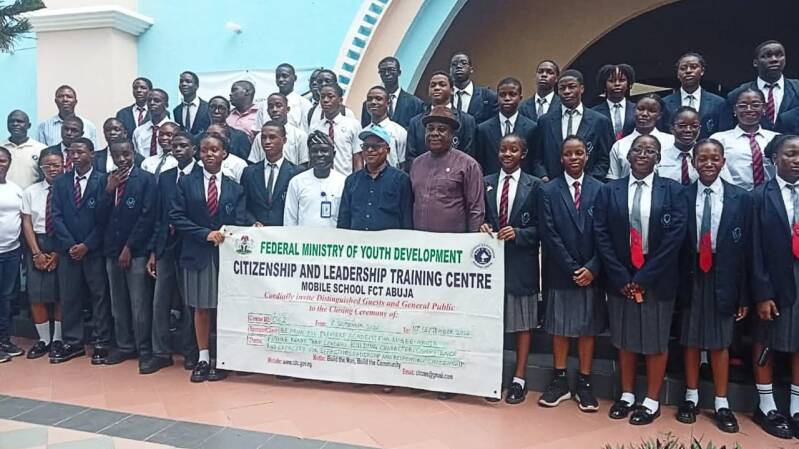
A civic education and leadership development centre has trained students of Premiere Academy, Lugbe, Abuja, on leadership principles, citizenship responsibilities and character formation, in a programme designed to prepare young Nigerians for active and ethical participation in national life.
The training, held at the school premises on Tuesday, September 22, 2026, was facilitated by the Centre for Leadership and Citizenship Development, a non-governmental organisation that works with secondary schools across the Federal Capital Territory to instil civic values in young people. The programme brought together students from Junior and Senior Secondary classes, who participated in sessions covering leadership ethics, civic duties, volunteerism, conflict resolution and the role of young people in democratic governance.
The Executive Director of the Centre, Mrs Amina Bello, said the initiative was informed by the growing disconnect between young Nigerians and the institutions and values that underpin democratic citizenship. "Leadership is not about titles. It is about character, service and the courage to do what is right even when no one is watching. We are here to remind these students that they are not just the leaders of tomorrow; they are citizens with responsibilities today," she said. Bello explained that the programme was structured around three pillars: self-awareness and personal development, community engagement and civic responsibility, and ethical leadership. She said the centre had trained more than 4,000 students across 15 schools in the FCT since its establishment in 2023.
The Principal of Premiere Academy, Mr Godwin Onyeike, welcomed the initiative and said it complemented the school's commitment to producing well-rounded students. "Academic excellence is important, but it is not enough. A student who graduates with distinction but has no sense of responsibility to his community is a half-formed citizen. This training is an investment in the character of our students," he said. Onyeike noted that the school had consistently integrated civic education and leadership training into its extracurricular programmes, and that the partnership with the Centre would deepen that effort.
Facilitators at the training used interactive methods, including group discussions, role-playing exercises, case studies and scenario-based problem-solving, to engage the students. One session examined the qualities of effective leaders, drawing on examples from Nigerian and international history to illustrate the difference between leadership that serves and leadership that exploits. Another session focused on the rights and responsibilities of citizens, including the importance of voting, paying taxes, obeying the law and holding leaders accountable. A third session addressed the challenges of peer pressure, cyberbullying and examination malpractice, linking personal integrity to broader societal outcomes.
A facilitator from the Centre, Mr Chukwudi Eze, told the students that leadership begins with self-discipline. "You cannot lead others if you cannot lead yourself. The habits you form now, the choices you make in small things, will determine the kind of leader you become. Your certificate will not lead anyone. You will lead, and you will lead with the character you have built," he said. He urged them to see themselves as ambassadors of positive change in their communities and to resist the temptation to cut corners or compromise their values for short-term gain.
The students responded positively to the training, with several saying it had broadened their understanding of what leadership entails. A Senior Secondary Two student, Adaeze Nwosu, said the session on civic responsibility had made her reconsider her attitude toward community service. "I always thought leadership was for politicians and people in government. But now I understand that I can be a leader in my class, in my church, in my community. It starts with me," she said. Another student, Ibrahim Musa, said the discussion on ethical leadership had challenged him to reflect on the importance of honesty. "It is easy to say you are honest, but the real test is when it is difficult. I want to be the kind of person who does the right thing even when nobody is watching," he said.
Teachers who observed the sessions described the training as timely and relevant. Mrs Funke Adeyemi, a teacher at the school, said many students were navigating complex social pressures and needed guidance. "Our students are exposed to a lot of information, some of it false, some of it dangerous. Programmes like this help them to think critically, to ask questions and to make informed choices," she said. She urged the Centre to extend the programme to other schools in the area, saying the need was widespread.
The Centre for Leadership and Citizenship Development said it plans to expand the programme to more schools across the six area councils of the FCT and eventually to other states. It said it would also establish leadership clubs in the schools it trains, providing a structure for students to continue engaging with the values and skills they acquire during the workshops. "We do not want this to be a one-off event. We want to build a movement of young Nigerians who are committed to integrity, service and democratic values," Bello said. She said the centre was seeking partnerships with the Federal Ministry of Education, the National Orientation Agency and private sector sponsors to scale up the programme.
The training comes amid growing concern over the erosion of civic values in Nigeria, where political apathy, voter disillusionment and cynicism about governance have become widespread. Young people, who make up a significant portion of the population, are particularly affected, with many expressing a sense of powerlessness and disconnection from the political process. Programmes that engage students early and inculcate a sense of agency and responsibility are seen by educators and civil society organisations as critical to reversing this trend. The National Universities Commission and the Federal Ministry of Education have both emphasised the need for civic education to be strengthened in the school curriculum, although implementation remains uneven.
For the students of Premiere Academy, the training offered not only practical skills and knowledge but also a renewed sense of possibility. As Nwosu put it, the most important lesson she took away was that leadership is not a position to be occupied but a responsibility to be embraced. "I used to think I had to wait until I was older to make a difference. Now I know I can start now, from where I am, with what I have," she said. Whether that conviction will translate into sustained civic engagement as the students advance in their education and enter adulthood remains to be seen. But for one afternoon in Lugbe, the Centre for Leadership and Citizenship Development planted a seed that it hopes will grow into a generation of Nigerians who see citizenship not as a burden but as an opportunity.
📩 Stone Reporters News | 🌍 stonereportersnews.com
✉️ info@stonereportersnews.com | 📘 Facebook: Stone Reporters News | 🐦 X (Twitter): @StoneReportNew | 📸 Instagram: @stonereportersnews
Add comment
Comments