

Reported by Ariajegbe Sylvia Esezobor
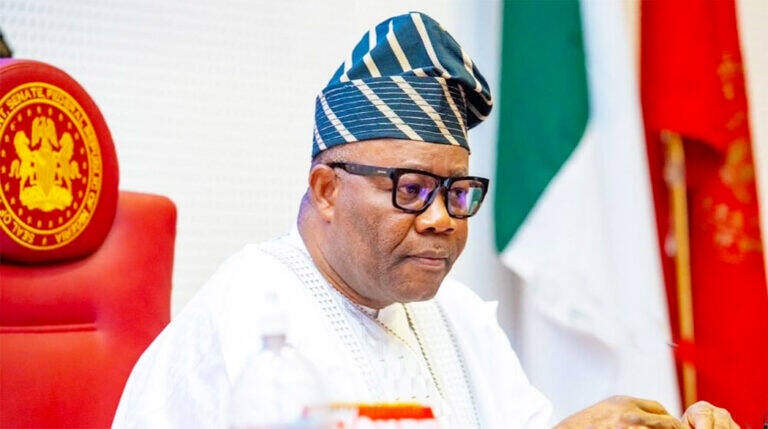
Senate President Godswill Akpabio has declared that there is no vacancy in Nigeria’s presidency and rejected suggestions that he was acting as President, insisting that President Bola Ahmed Tinubu remains fully in charge of the country’s affairs despite his extended working vacation in Europe and the simultaneous absence of Vice President Kashim Shettima.
Akpabio made the declaration on Tuesday in Akwa Ibom State, where he commissioned road projects executed by Governor Umo Eno, addressing mounting public and political concern over who is exercising presidential authority while both the President and Vice President are outside Nigeria. “I need to correct an impression. I am the Senate President and Chairman of the National Assembly. By your grace, the grace of God, and the support of President Bola Ahmed Tinubu, I am not the acting President of Nigeria because the President is still in power,” Akpabio said. “The President is on a working leave. So, there is no absence in Aso Rock. What he cannot do here, he is doing abroad.”
The Senate President said he was the only person constitutionally positioned to declare a vacancy in the presidency, and that no such condition currently existed. “I am the only person, as Chairman of the National Assembly, that can speak the voice of the National Assembly and say there is a vacancy and there will be a vacancy. Right now, there is no vacancy. Asiwaju Bola Ahmed Tinubu is still in power, and he is still running the affairs of Nigeria,” he said. He dismissed concerns about the President directing government business from abroad, arguing that modern communications technology had rendered physical location irrelevant. “The world has become a global village. You can give instructions even from the internet, anything. So why are people complaining?” he asked.
Akpabio cited Tinubu’s recent diplomatic engagements in France as evidence that the President remained active, including discussions with French President Emmanuel Macron on bilateral relations and a meeting with businessman Vincent Bolloré focused on investments in Nigeria’s creative and digital economy. He also explained Tinubu’s absence from the 81st United Nations General Assembly in New York, where Shettima is leading Nigeria’s delegation. “Because he could not make it to the UNGA, his Vice President went,” Akpabio said. He added that Tinubu remained in contact with officials at home and would return to commission presidential projects. “His Excellency, the President, is very proud of you and sends his greetings. He said I should assure you that as soon as he comes back into Nigeria, he will give you a date that he will come and commission those presidential projects.”
The controversy stems from Tinubu’s departure on August 30 for what the Presidency described as a three-week working vacation, initially in London before moving to Paris. The 21-day period expired around September 20, and the Presidency announced on Monday that the President had extended his stay by a few days and would return to Nigeria at the weekend. The extension coincided with Shettima’s travel to New York for the UN General Assembly, creating a situation in which both the President and Vice President were outside the country simultaneously.
Former Vice President Atiku Abubakar, the presidential candidate of the African Democratic Congress, seized on the development to demand constitutional clarity. In a statement titled “Who is in charge of Nigeria?” Atiku cited Section 145 of the 1999 Constitution, which requires the President to transmit a written declaration to the President of the Senate and the Speaker of the House of Representatives when proceeding on vacation, whereupon the Vice President performs the functions of President as Acting President. Section 145(2) provides that where the President fails to transmit the declaration within twenty-one days, the National Assembly may, by a simple majority of each chamber, mandate the Vice President to perform the functions of President. “Twenty-one days have come and gone since President Tinubu left Nigeria. Today, Nigerians are entitled to ask a very simple constitutional question: Who is in charge of Nigeria?” Atiku said. He demanded that the Presidency publish any letter transmitting authority, or that the National Assembly explain its position if none was sent. “This is not a matter of political convenience. It is a matter of constitutional order.”
The Presidency rejected Atiku’s framing, with the Special Adviser to the President on Policy Communication, Daniel Bwala, asserting that Tinubu’s powers are not limited by geography. “For avoidance of doubt, the power of the President to govern Nigeria is not limited to geography. As commander in chief of the armed forces, he can order, direct, delegate and/or administer the constitution of Nigeria anywhere in the world,” Bwala wrote on X. He described the opposition’s questions as politically motivated and pointed to Section 5 of the Constitution, which vests executive powers in the President.
The dispute has drawn in other opposition figures. Omoyele Sowore, the presidential candidate of the African Action Congress, called on the National Assembly to invoke Section 145(2) and mandate Shettima to act as President, arguing that Tinubu’s initial three-week vacation had expired without public confirmation that the required declaration was transmitted. He specifically challenged Akpabio and House Speaker Tajudeen Abbas to disclose whether they had received such a declaration. The African Democratic Congress also weighed in, saying Nigeria cannot be governed by presidential social media posts from Europe and demanding transparency on the constitutional instrument, if any, that governs the current arrangement.
Akpabio’s intervention is significant because it places the Senate President, the constitutionally designated recipient of any Section 145 declaration, squarely behind the President’s position. By asserting that no vacancy exists and that he alone can declare one, Akpabio has effectively closed the door on any legislative move to mandate a transfer of power to Shettima. His remarks also signal a united front within the ruling All Progressives Congress aimed at quelling speculation about a leadership crisis ahead of the 2027 general elections, scheduled for January 16.
The episode has nonetheless exposed a tension between the letter of the Constitution and the realities of modern governance. Section 145 was drafted to provide clarity when a President is unable to discharge his functions, but it does not explicitly address the scenario of a President working remotely while on vacation. The Presidency’s argument that the President remains in charge and can direct affairs from anywhere is politically coherent, but it does not resolve the legal question of whether the Constitution requires a formal transfer of authority after twenty-one days of absence. As Akpabio put it, the world has become a global village. Whether the Constitution has kept pace with that village is a question that will continue to generate debate long after Tinubu returns to Nigeria at the weekend.
📩 Stone Reporters News | 🌍 stonereportersnews.com
✉️ info@stonereportersnews.com | 📘 Facebook: Stone Reporters News | 🐦 X (Twitter): @StoneReportNew | 📸 Instagram: @stonereportersnews
Add comment
Comments