

Reported by Ariajegbe Sylvia Esezobor
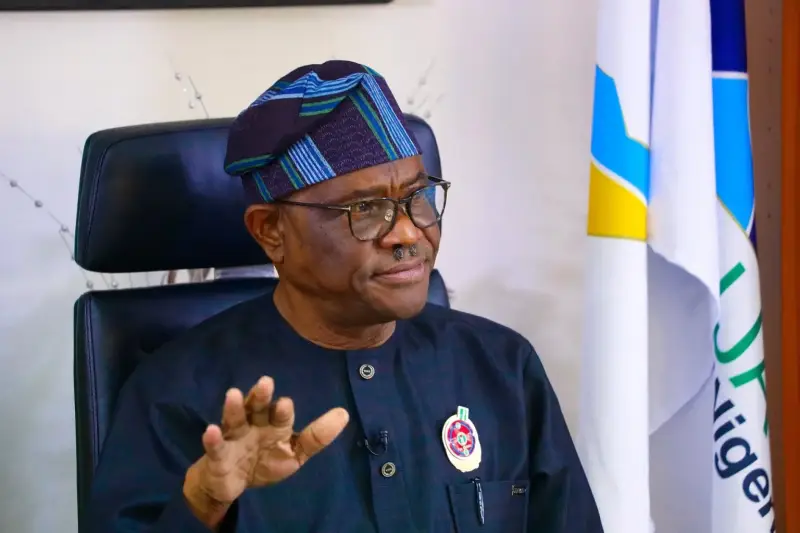
The Minister of the Federal Capital Territory, Mr Nyesom Wike, has dismissed allegations that he rigged the 2023 presidential election in the South-South in favour of President Bola Tinubu, insisting that the outcome was the product of a deliberate political strategy by the G5 group of governors aimed at denying the Peoples Democratic Party candidate, Atiku Abubakar, the region’s votes.
Wike, who addressed journalists in Abuja on Wednesday, described the rigging claims as a “baseless narrative propagated primarily on social media”. The rebuttal followed widespread criticism that erupted after his appearance on TVC’s Journalists’ Hangout on Monday, where he disclosed that the G5 governors deliberately allowed Peter Obi of the Labour Party to win in parts of the South-South to weaken Atiku’s chances. Critics, public commentators and opposition figures argued that Wike’s statement amounted to a public confession of voter manipulation, prompting the minister to clarify that the results were achieved through political strategy rather than illegal interference.
At the heart of Wike’s defence is a simple argument: no individual could single-handedly manipulate results across Nigeria’s vast electoral infrastructure. “People who don’t understand, how can they say I rigged the election? How would I have done it? So, I just took the result sheets, wrote it, and gave it to INEC?” he asked. He emphasised that social media projections often fail to reflect reality across the country’s roughly 176,000 polling units, noting that seeing results from a few hundred polling units and rushing to conclusions does not determine election outcomes. Wike also pointed to the fact that opposition parties failed to substantiate rigging claims in court, asking why nobody tendered any result from Rivers State at the tribunal to prove they won.
Detailing the G5’s strategy, Wike explained that the group identified Atiku as its primary threat because the South-South was traditionally a PDP stronghold. “We felt that Atiku was more of a factor in that election than Obi. So our strategy was that, make sure that you vote for Obi to win in order to deny Atiku the votes,” he said. “South-South was purely a PDP state and so if we had voted for PDP all through, then Atiku would have won. That was a threat”. He revealed that the strategy was applied in Edo and Cross River, where the PDP was considered strong enough to boost Atiku if the party won, but Rivers State was excluded. “It was only Rivers that said, ‘No, we have a problem here in Rivers. Obi will not win here because if he wins, he sends a signal somewhere, people may not understand it.’ And we stopped it,” Wike said.
Wike downplayed Obi’s broader national appeal, arguing that the Labour Party candidate was a threat only on social media and that even a victory in Rivers would not have altered the presidential outcome. “Assuming Obi won Rivers, add it for him. Would he have won the election?” he asked. He attributed Obi’s 2023 performance in certain states to the controversy over the ruling party’s Muslim-Muslim presidential ticket, a factor he said no longer exists. “Under 2023 there was this campaign of Christianity, there was this campaign of Muslim-Muslim ticket. There was, seriously,” Wike said. “It’s no longer there now. No more like Muslim-Muslim ticket. Well, it doesn’t work. Tinubu has been able to kill that”.
The G5 governors were a group of five PDP governors who opposed Atiku’s presidential candidacy, arguing that the party’s ticket should have been zoned to the South after eight years of northern presidency under Muhammadu Buhari. The group comprised Wike of Rivers, Seyi Makinde of Oyo, Samuel Ortom of Benue, Okezie Ikpeazu of Abia and Ifeanyi Ugwuanyi of Enugu. Makinde has since broken ranks with the group after falling out with Wike over the FCT minister’s support for Tinubu’s second-term bid.
The controversy has drawn sharp reactions from opposition figures and political commentators. A chieftain of the Labour Party, Yunusa Tanko, said Wike’s admission confirmed what the party had always known about the 2023 election. “This is a confirmation of what we have been saying. The G5 governors colluded with the APC to deny the Labour Party victory,” he said. “But what Wike fails to understand is that Nigerians have moved on. The 2027 election will be different.” A spokesperson for the Atiku campaign described Wike’s remarks as an admission of anti-party activity that should attract disciplinary action from the PDP. “If a member of the PDP openly admits to working against the party’s candidate, what does that tell you about his loyalty? The party should act,” the spokesperson said.
Wike has also faced criticism from within his own party. A former National Chairman of the PDP, Prince Uche Secondus, described the minister’s statements as reckless and capable of damaging the party’s prospects ahead of the 2027 elections. “Wike is playing a dangerous game. He is not just opposing Atiku; he is undermining the entire party,” Secondus said. “He should remember that he is still a member of the PDP and should conduct himself accordingly.”
The political landscape has shifted significantly since the 2023 election. Atiku has since joined the African Democratic Congress, while Obi has aligned with the Nigeria Democratic Congress, setting the stage for a three-way contest in 2027. Wike has openly campaigned for Tinubu’s re-election, arguing that the President deserves a second term. He has dismissed suggestions that the G5’s strategy could be replicated in 2027, insisting that the conditions that favoured Obi in 2023 no longer exist. “What people need now, Obi does not have it and he would never have it. So for 2027, leave it for Tinubu. Come back in 2031,” he said.
As Nigeria moves closer to the 2027 general elections, Wike’s remarks have reignited debates about the integrity of the 2023 polls and the role of political strategy in shaping electoral outcomes. The minister’s insistence that the G5’s actions were strategic rather than criminal has done little to quiet critics, who argue that openly admitting to manipulating voter choices, whether through political strategy or otherwise, undermines public confidence in the democratic process. For Wike, the matter is settled: the G5 had a strategy, it worked, and the results speak for themselves. For his critics, the questions remain unanswered, and the 2027 election will be the ultimate test of whether Nigerian voters are swayed by political calculations or the ballot.
📩 Stone Reporters News | 🌍 stonereportersnews.com
✉️ info@stonereportersnews.com | 📘 Facebook: Stone Reporters News | 🐦 X (Twitter): @StoneReportNew | 📸 Instagram: @stonereportersnews
Add comment
Comments