

Reported by Ariajegbe Sylvia Esezobor
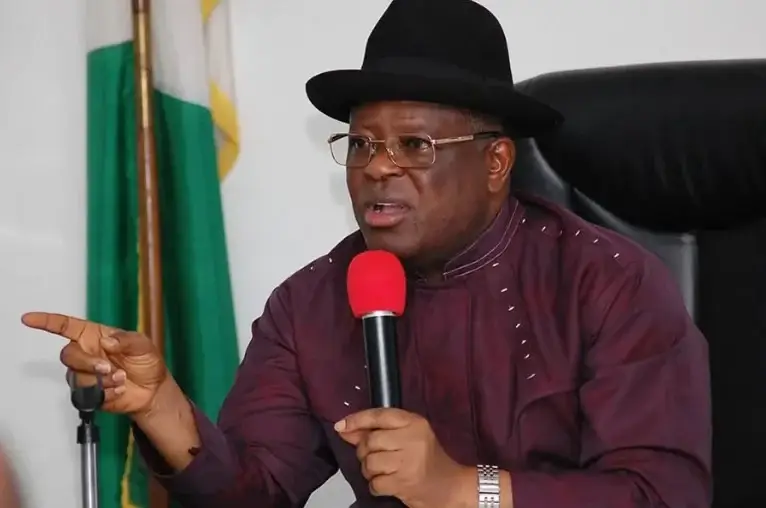
The Federal Government has announced plans to mobilise 4,000 social media influencers to showcase its infrastructure projects and communicate the achievements of President Bola Tinubu’s administration to Nigerians ahead of the 2027 general elections, a move the Minister of Works, Senator David Umahi, described as a necessary escalation in what he called a social media war.
Umahi disclosed the initiative on Tuesday in Abuja while receiving a report from the leadership of the National Association of Nigerian Students following the students’ inspection of federal road projects across Kano, Jigawa, Kaduna and Sokoto states. The minister said the network would help the government communicate directly with Nigerians, particularly young people, about projects being executed across the country. “We have to fight this social media war. So, we have to launch 4,000 social media influencers to tell our stories, and I want you to advise me on how to do it,” Umahi said. “You know I am proud of what the President is doing in infrastructure. I’m proud of all the gains we have made in various sectors of the economy, so we have to tell our stories. If you don’t say ‘I am’, nobody will tell you who you are.”
The announcement has sparked immediate debate across Nigeria’s political and media landscape. Critics have described the plan as a government-funded propaganda machine designed to drown out legitimate criticism and manufacture consent ahead of an election year. Supporters argue that the government has a right, and indeed a duty, to communicate its achievements to the public, particularly in an environment where opposition voices dominate social media. The opposition Peoples Democratic Party has yet to issue a formal statement on the matter, but social media commentators have already begun questioning the timing, the cost and the criteria for selecting influencers. The minister did not disclose how much the initiative would cost, how the influencers would be recruited, whether they would be paid or when the programme would commence.
Umahi’s remarks came at a sensitive moment in Nigeria’s political calendar. With the 2027 general elections less than eighteen months away, political parties and their supporters have intensified their online activities, and the government has faced mounting criticism over the state of the economy, insecurity and the rising cost of living. The minister’s framing of the initiative as a response to a “social media war” suggests that the administration believes it is losing the online battle for public opinion. “Tell me any way in this country, any region that is not a construction site,” Umahi said. “And so, we have enough to campaign for the President. We have enough.”
The immediate context for the announcement was the presentation of findings by NANS leaders who had completed the Northwest leg of their Nationwide Federal Roads Project Tour. The students inspected major roads including the Kano-Kwanar Danja-Hadejia Road, the Kano Northern Bypass, the Kano-Maiduguri Road, the Kano-Katsina Road, the Kaduna-Kano Road, the Abuja-Kaduna-Zaria-Kano Road, the Zaria-Funtua-Sokoto Road, the Sokoto-Badagry Road and the Illela-Dukamaje Road. NANS President Comrade Babatunde Akinteye said the tour was designed to physically inspect the projects, assess their condition and progress firsthand, and examine their importance to Nigerian students, particularly roads serving as major access routes to campuses and student communities.
The students’ report was largely positive. NANS commended the quality, durability and pace of construction on the projects visited, singling out the use of durable pavement technology, improved drainage systems, road expansion and the integration of safety infrastructure such as solar-powered street lighting. The association also recommended the construction of a pedestrian bridge at the Federal Co-operative College in Kaduna along the Abuja-Kaduna-Zaria-Kano route to improve students’ safety. Umahi responded by directing his officials to take note of the recommendation and promising that the bridge would be constructed. He also said the ministry would increasingly consider direct access to tertiary institutions in future road projects and cited ongoing pedestrian bridge projects at the University of Abuja and Nnamdi Azikiwe University, Awka, as examples.
On the Lagos-Calabar Coastal Highway, Umahi said the main pavement of the first 105 kilometres would be completed by November. He described the pace of work as unprecedented and noted that construction was still ongoing on bridges along Sections One and Two of the project. But he also expressed deep frustration over vandalism along the highway, particularly around the Apapa axis. “I wept when I saw the level of destruction under the bridge in Apapa axis. People even pass through the piers, with trailers high over them, to get from one point to another. This mind-boggling damage, this is unacceptable,” he said. He warned that the destruction of infrastructure, including the cutting of metals and damage to block works, could undermine the benefits of major government investments and stressed that public infrastructure represents the country’s future.
The minister’s disclosure of the influencer plan has also drawn scrutiny because of his own history with social media criticism. In August, Umahi filed a defamation suit against blogger Linda Ikeji and two others at the Federal Capital Territory High Court in Abuja, seeking N3 billion in damages over what he described as false and defamatory publications. The lawsuit underscored the tension between the government’s desire to shape the online narrative and its sensitivity to criticism. Critics have pointed to the defamation suit as evidence that the administration is more interested in suppressing unfavourable coverage than in engaging with legitimate public concerns. Supporters counter that the government has every right to defend itself against misinformation.
The broader question raised by the 4,000-influencer plan is whether government-funded content creators can ever be credible messengers. Influencers derive their authority from perceived independence and authenticity. Once they are seen as paid agents of the state, their ability to persuade audiences may be undermined. Yet the government appears to be betting that the sheer volume of content it can generate through a coordinated network will shift public perception, particularly among young Nigerians who consume most of their information through social media. Whether that bet pays off will depend on how the initiative is executed, how transparent the government is about its mechanics, and whether the influencers themselves are willing to risk their credibility by becoming spokespeople for a political administration.
For now, the announcement has achieved one thing: it has placed the government’s infrastructure record at the centre of public conversation, even as critics question the cost and intent of the plan. The students who inspected the roads have delivered their verdict. The government now wants 4,000 more voices to amplify it.
📩 Stone Reporters News | 🌍 stonereportersnews.com
✉️ info@stonereportersnews.com | 📘 Facebook: Stone Reporters News | 🐦 X (Twitter): @StoneReportNew | 📸 Instagram: @stonereportersnews
Add comment
Comments