

Reported by: Ijeoma G | Edited by: Oravbiere Osayomore Promise.
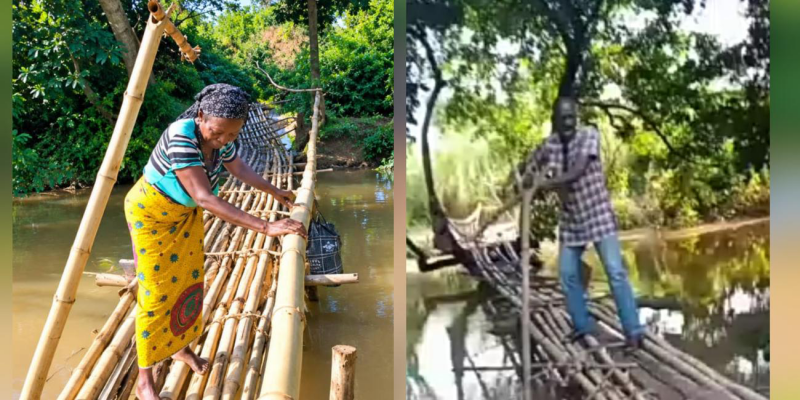
A makeshift bamboo bridge across the Ọtọ River in Adum-Oye community, Oju Local Government Area of Benue State, has become a death trap that has claimed the life of a teacher and left a man with serious injuries, while forcing hundreds of children to abandon their education until the dry season. The bridge, constructed from bamboo stalks tied together with local ropes, is the only crossing for residents travelling to the other side of the river, where the community's only hospital, secondary school, and nearby market are located.
The condition of the bridge was highlighted again on Tuesday, September 22, 2026, when Odehe Andrew Agbo, a 54-year-old member of the community, fell from the structure into the river and sustained serious injuries. Images obtained by SaharaReporters showed Agbo with a heavily swollen and gashed foot and a bandaged head following the incident.
Agburu Sunday Eje, a community member who spoke to SaharaReporters, said the dangerous crossing had become an annual ordeal, particularly during the rainy season. "From this September till this River dries up or recedes, our children will not attend school again," Eje said. "If you go to my community right now as I am speaking with you, they have stopped schooling till dry season. And this is what our children are passing through every year."
The tragedy is not new. Eje recalled the death of a teacher identified as Otor Igo, who was about 58 years old when he fell from the same bridge and drowned. "He could not be rescued because nobody was around," Eje said. The latest accident involving Agbo has further heightened concerns among residents. Eje said he rushed to the community after receiving a call that his uncle had fallen from the bridge, but the journey back exposed him to another danger caused by the area's poor infrastructure. "I had an accident on the way because of the bad road. I have a knee dislocation and minor injuries," Eje told SaharaReporters.
The bamboo bridge is rebuilt every year during the rainy season, only to be swept away by floods. Residents have no alternative. The river separates them from the basic services that define modern life—education, healthcare, and commerce. When the bridge collapses or becomes too dangerous to cross, the community is effectively cut off. Children miss school for months. Pregnant women cannot reach the hospital. Farmers cannot take their produce to market.
Residents say the combination of the unsafe bridge and poor roads has left the community increasingly isolated and vulnerable. They are calling on the Benue State Government, federal authorities, non-governmental organisations, philanthropists, and other well-meaning individuals to intervene by providing a safe and permanent bridge across the Ọtọ River. For the residents, such an intervention would not only prevent further deaths and injuries but also enable children to attend school throughout the year and improve access to healthcare and markets.
Adum-Oye is not an isolated case. Across Nigeria, rural communities depend on precarious makeshift crossings that become deadly during the rainy season. In Ebonyi State, youths from Azuoto Okpuitumo have repeatedly urged the government to build a bridge across the Oto River, revealing that they construct a makeshift bamboo bridge during the rainy season, but once the flood comes, it sweeps it away. "Many of our children have drowned while trying to cross the river to go to school," a community representative said. In Abia State, the collapse of the Omenuko Bridge in Abam, Arochukwu LGA, led to the deaths of 17 students who were commuting to school. These tragedies share a common thread: the absence of safe, permanent infrastructure in rural areas and the devastating consequences for children and families.
The death of Otor Igo and the injury of Odehe Andrew Agbo are not accidents. They are the predictable outcomes of decades of neglect. The bamboo bridge is not a solution; it is a symptom of a government that has failed to provide even the most basic infrastructure to its citizens. The children of Adum-Oye are not dropping out of school because they do not value education. They are dropping out because the alternative is drowning.
As the rainy season continues and the waters of the Ọtọ River rise, the community waits for a government that has, so far, left them to fend for themselves. Residents are asking whether anyone in authority is listening. They are asking whether their children's lives and education matter. They are asking whether they will have to bury another teacher, another father, another child before the government finally builds a bridge that will not wash away.
The Benue State Government has yet to issue an official statement on the incident or announce any plans to address the community's infrastructure needs. For the people of Adum-Oye, the silence is deafening. They have done what they can with what they have, constructing a bridge from bamboo and hope. But hope is not a building material, and bamboo cannot withstand the flood. They need concrete, steel, and a government that sees them. Until then, the Ọtọ River will continue to claim lives, and the children of Adum-Oye will continue to lose their education, one rainy season at a time.
📩 Stone Reporters News | 🌍 stonereportersnews.com
✉️ info@stonereportersnews.com | 📘 Facebook: Stone Reporters News | 🐦 X (Twitter): @StoneReportNew | 📸 Instagram: @stonereportersnews
Add comment
Comments