

Reported by Ariajegbe Sylvia Esezobor
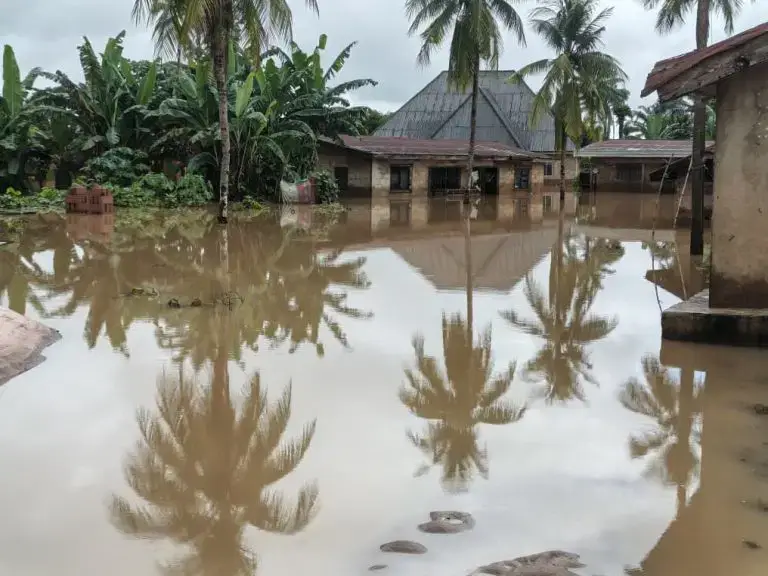
No fewer than 60 houses have been destroyed and about 300 residents displaced following a devastating flood that ravaged Amaegbu community in Akaeze, Ivo Local Government Area of Ebonyi State, destroying farmlands and property worth millions of naira and leaving families, including children, homeless.
The flooding, triggered by torrential rainfall that began on Tuesday, September 22, 2026, caused the river around the community to overflow, submerging houses, farmlands and household belongings. Chief Michael Uzor, one of the victims, told journalists that the flood washed away his farmlands, television sets, vehicles, certificates and other valuables. “Many houses were destroyed in this axis and more houses are collapsing as a result of the flooding. In this particular place, Ndi Ibezeukwu, over 20 houses have fallen down since Tuesday when the disaster started,” he said. Uzor appealed to the government at all levels to urgently come to the assistance of the affected residents, saying many families had been rendered homeless.
Another victim, Mrs Joy Chikezie, said the number of houses destroyed in her area could not be ascertained due to the scale of the devastation. “As you can see, many houses are down here. You can’t count the number of houses that have been destroyed by this disaster. We are homeless now and our farmlands have been destroyed too. The losses are enormous. We are sad, we are helpless, we need assistance,” she lamented.
The Secretary of Amaegbu community, Prince Ette, said more than 50 houses had been demolished in the community, calling for urgent intervention to alleviate the suffering of the victims. “We are devastated, we are in pains because the damage the flood caused us is much. Some people didn’t salvage any item from the disaster,” he said. Abia Okoro Abia, Chairman of Amaegbu Village in Umuobor community, said the flood had never occurred on such a scale in the area. “This is Amaegbu community affected by the flood because we are nearer to the riverbank. Everywhere was filled up with flood. Even my own house, the water is still at the root. It has never happened since I was born,” he said, pointing to houses damaged by the flood. The affected residents appealed to the state and federal governments to urgently intervene by providing relief materials and taking measures to prevent a recurrence.
The disaster has drawn political attention ahead of the 2027 general elections. The Peoples Democratic Party governorship candidate in Ebonyi State, Chief Ifeanyi Chukwuma Odii, donated N5 million to the victims during a condolence visit led by the state PDP Chairman, Chief Chukwuma Igwe. “We came to tell you that what happened to you also happened to us; we are all affected by this disaster. We have over 54 families affected by this disaster in this axis, and we know that there are other families in other places in the community also affected. Our principal, Chief Ifeanyi Odii, has given us this token to give to you people, to show you that what happened to you also happened to him. He will do more for you,” Igwe said. The PDP candidate for Ohaozara, Onicha and Ivo Federal Constituency, Chief Felix Igboke, described the flood as unfortunate and said improved drainage and other environmental measures would be needed to address the problem, promising that the party would pursue a permanent solution if elected. “NEMA and other people will come for this intervention because it’s not a very small disaster,” Igboke said, appealing to the National Emergency Management Agency and the State Emergency Management Agency to assist the victims.
The Amaegbu flood comes amid heightened national concern over riverine flooding across Nigeria. The Nigeria Hydrological Services Agency had issued a high flood-risk alert for 15 states, including Ebonyi, warning of rising river levels and possible riverine flooding between September 19 and 25, 2026. NiHSA identified nine river stations requiring close monitoring, including stations along the Cross River, which flows through Ebonyi and neighbouring states. The agency urged state and local governments, emergency management authorities and residents of vulnerable communities to take precautionary measures, including relocating people, livestock and valuables to safer, higher ground and activating community-based early-warning systems.
NEMA placed its zonal directorates and operations offices on red alert, activating its National Emergency Operations Centre to enhance coordination and ensure effective response. The agency urged residents living on floodplains, riverbanks and low-lying areas to relocate to safer ground before conditions deteriorate, and warned against attempting to cross flooded roads, bridges and fast-moving water. The agency also advised communities to pre-position relief materials, safe drinking water and first-aid supplies, and to clear blocked drainage channels where safe to do so.
The scale of potential exposure in Ebonyi is substantial. NiHSA identified 2,574 communities in Ebonyi State as exposed to flooding, along with 1,064 schools, 422 healthcare facilities, 480 markets, 629 religious buildings and 1,882 hectares of farmland. The affected local government areas include Abakaliki, Afikpo, Afikpo South, Ebonyi, Ezza North and Ezza South. Across the 15 states covered by the alert, more than 8,000 communities and 4,500 schools are at risk, with Ebonyi recording the highest number of exposed communities, followed by Cross River with 2,471 and Anambra with 1,314.
The flooding in Amaegbu is the latest in a series of flood incidents that have affected Ebonyi State in 2026. In June 2026, flooding ravaged households and farmlands in the state, displacing over 3,000 households and destroying more than 800 farmlands. In July 2026, the Ebonyi State Government said it had intensified measures to mitigate flooding through improved preparedness, evacuation plans and public sensitisation campaigns, with temporary shelters designated in strategic locations to accommodate displaced persons. The government said relevant ministries, departments and agencies had been directed to coordinate emergency response efforts. Despite these preparations, the scale of the Amaegbu disaster has overwhelmed the community’s capacity to cope, and residents say they have received no relief materials from government agencies as of Thursday.
For the families of Amaegbu, the flood has erased homes, livelihoods and savings accumulated over years of labour. The farmlands that many depend on for food and income have been submerged, and the houses that provided shelter have collapsed or are at risk of collapsing. The community’s proximity to the riverbank, which made it fertile for farming, has also made it vulnerable to the kind of flooding that experts say will become more frequent and intense as climate change alters rainfall patterns across West Africa. As the residents wait for relief that has yet to arrive, the coming days will determine whether the intervention agencies NEMA and SEMA can mobilise quickly enough to provide shelter, food and medical support to the displaced, and whether the federal and state governments will treat the Amaegbu disaster as a warning of the larger flood emergency that NiHSA has warned could unfold across Ebonyi and 14 other states in the coming weeks.
📩 Stone Reporters News | 🌍 stonereportersnews.com
✉️ info@stonereportersnews.com | 📘 Facebook: Stone Reporters News | 🐦 X (Twitter): @StoneReportNew | 📸 Instagram: @stonereportersnews
Add comment
Comments