

Reported by: Ijeoma G | Edited by: Oravbiere Osayomore Promise.
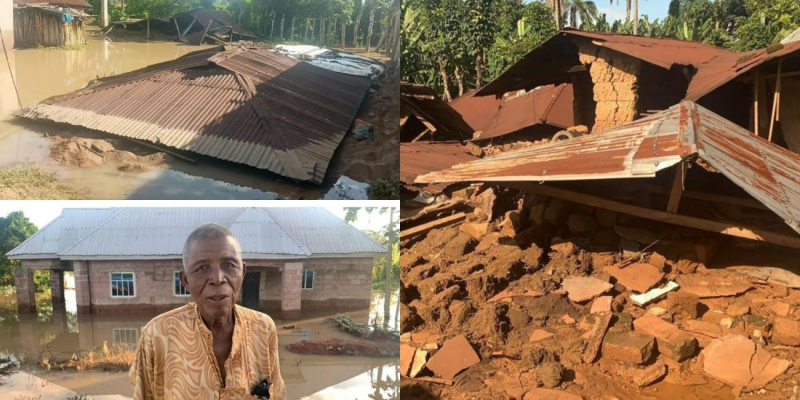
The water came on Tuesday. It did not knock. By the time it left, Amaegbu community in Akaeze, Ivo Local Government Area of Ebonyi State, looked like a war zone. Houses had collapsed. Farmlands were submerged. Vehicles, televisions, certificates, and household belongings worth millions of naira had been swept away. At least 134 families lost their homes. About 300 residents were displaced. And the flood warnings from the National Emergency Management Agency, issued two days earlier, had done nothing to stop the deluge.
Premium Times reported that the flooding began after heavy rainfall caused a river near the community to overflow its banks. Mud houses collapsed shortly after floodwaters surrounded them. A video circulating on Facebook showed one building partially collapsing as surging water overwhelmed it. The Sun quoted Chief Michael Uzor, one of the victims, who said the flood destroyed his farmlands, television sets, vehicles, and certificates. “Many houses were demolished in this axis and more houses are collapsing as a result of the flooding. In this particular place, Ndi Ibezeukwu, over 20 houses have fallen down since Tuesday this disaster started,” he said.
Another victim, Mrs Joy Chikezie, could not count the number of destroyed houses in her area. “As you can see, many houses are down here. You can’t count the number of houses that have been destroyed by this disaster. We are homeless now, and our farmlands have been destroyed, too. The losses are enormous. We are sad, we are helpless, we need assistance,” she said. Prince Ette, Secretary of the Amaegbu community, said more than 50 houses had been demolished. “We are devastated; we are in pain because the damage the flood caused us is much. Some people didn’t salvage any item from the disaster,” he lamented.
The Chairman of Amaegbu Village in Umuobor Community, Abia Okoro Abia, described the flooding as unprecedented. “Everywhere was filled up with flood. Even in my own house, the water is still at the roof,” he told SaharaReporters. “It has never happened since I was born”. Residents appealed to the state and federal governments for urgent relief materials and measures to prevent a recurrence.
The political response was swift, if limited. The Peoples Democratic Party governorship candidate in Ebonyi State, Ifeanyi Chukwuma Odii, donated N5 million to the victims. A delegation led by the state PDP Chairman, Chukwuma Igwe, visited the community on Thursday. Igwe told reporters that over 134 families were severely affected and called on well-to-do individuals and organisations to help. “We are here to commiserate with you. It’s quite unfortunate, even though it is avoidable and can be corrected,” said Igboke Felix, the PDP candidate for Ohaozara/Onicha/Ivo Federal Constituency. Igboke promised that if elected in 2027, the party would seek a permanent solution to the flooding rather than relying on emergency interventions.
But the political promises rang hollow for families who had just lost everything. The flood did not discriminate between PDP and APC members. It took from everyone. And the government agencies that were supposed to protect these communities had ample warning. On September 21, the Nigeria Hydrological Services Agency issued an alert forecasting high risk of riverine flooding in 15 states, including Ebonyi, due to rising river levels. NEMA activated its operations offices and directed them to pre-position relief materials and remain on standby. Two days later, the flood hit Akaeze. The warning was there. The preparedness was not.
Akaeze is not an isolated case. The Enugu flood, which struck Mpu and Okpanku communities in Aninri Local Government Area just 48 hours before the Ebonyi disaster, killed two children from the same family and submerged 14 villages. Over 2,000 houses were affected. These are not natural disasters in the purest sense. They are the predictable consequences of poor drainage, unregulated construction, and a failure to act on early warnings. The communities along the riverbanks of the South-East have known for years that the rains would come. What they did not know was whether anyone in government would be ready when they did.
The N5 million donation from a governorship candidate is a gesture, but it is not a solution. It will not rebuild 60 houses. It will not recover lost certificates or replace swept-away vehicles. It will not restore the farmlands that families depend on for their next meal. And it will not prevent the next flood. The residents of Amaegbu need more than sympathy and campaign donations. They need drainage systems that work, embankments that hold, and a government that treats flood warnings as calls to action rather than press releases.
As the waters recede and the community begins the long task of rebuilding, the question is not whether another flood will come. The question is whether anyone in authority will have learned anything. The people of Akaeze are waiting. They have been waiting for years.
📩 Stone Reporters News | 🌍 stonereportersnews.com
✉️ info@stonereportersnews.com | 📘 Facebook: Stone Reporters News | 🐦 X (Twitter): @StoneReportNew | 📸 Instagram: @stonereportersnews
Add comment
Comments