

Reported by: Ijeoma G | Edited by: Oravbiere Osayomore Promise.
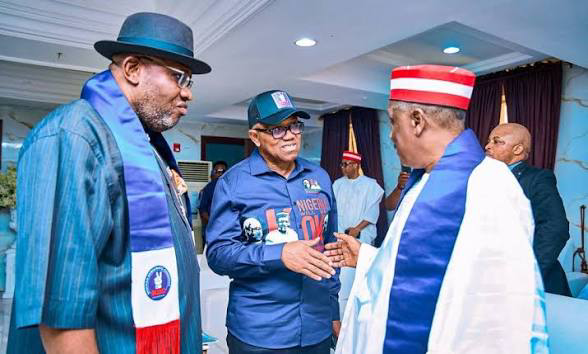
The Nigeria Democratic Congress has moved swiftly to assert its authority over the constellation of support groups backing its presidential ticket, as candidate Peter Obi publicly disowned a 59-member Presidential Campaign Council unveiled by the Obi-Kwankwaso Movement and threw his weight behind the party's National Leader, Senator Seriake Dickson, in the escalating internal rift.
Speaking on Arise Television's Prime Time programme on Thursday, September 25, 2026, Obi was unequivocal in his rejection of the parallel structure. "I'm not involved," he said. "The NDC is the political party we all belong to, and I agree entirely with the position of the leader." He stressed that the OK Movement, the Obidient movement, the Kwankwasiyya organisation and other affiliated groups are support groups and must restrict themselves to that role. "They must play their role as supporting groups supporting the party. They should not play the role of the party," Obi declared.
The controversy erupted on September 17 when the OK Movement, led by John Ughulu, announced a 59-member Presidential Campaign Council comprising zonal and state coordinators as well as directors overseeing mobilisation, women's affairs, strategy, security, legal matters and other portfolios. The NDC immediately distanced itself from the council, stating that it did not originate from the party and that only the party's leadership has the constitutional authority to constitute and announce its official campaign machinery.
Dickson, a former Bayaro State governor and the party's national leader, had earlier described the OK Movement's action as "nonsensical" and "uncalled for." Receiving former Secretary to the Government of the Federation, Babachir Lawal, into the NDC, Dickson drew a sharp line between support groups and political parties. "Support groups don't compete with political parties that are sponsoring candidates. They don't compete for supremacy or space," he said. "They don't play the role of a political party; they don't sponsor candidates. They only provide grassroots mobilisation support." He warned that no support group, including those affiliated with the ruling party, has ever claimed the right to establish a presidential campaign council. "It is unheard of, nonsensical! Those who have the duty to call people to order should do so," he stated.
Obi's intervention was unambiguous. When asked whether the OK Movement's campaign council had been constituted with his knowledge or approval, he was categorical. "Not at all. And I say it here, it is wrong. You are supporting—OK Movement is Obi and Kwankwaso. So whatever you do must have express approval of both of us," he said. He acknowledged that some individuals entrusted with managing support structures sometimes act contrary to directives, adding, "I was not aware, and that's why I'm disapproving it here."
The OK Movement, however, has refused to back down. In a series of statements, its leadership maintained that it is an independent political organisation, not an appendage of the NDC, and rejected any attempt to subordinate its structures to the party. The movement declared it would not collapse, merge or surrender its national, state, local government and ward structures to the party. It described its collaboration with the NDC as a partnership rooted in shared support for the Obi-Kwankwaso ticket, not a merger that erases its identity.
The NDC has responded by granting Obi and his running mate, Rabiu Kwankwaso, the authority to nominate key officials of the party's official Presidential Campaign Council in consultation with the party leadership. This move is widely seen as an attempt to reassert the party's primacy and prevent competing centres of power from emerging around influential support groups ahead of the 2027 elections. The party's national leadership has also reiterated that the official campaign council will be inaugurated under its own authority, with nominations from the presidential and vice-presidential candidates.
The dispute lays bare a fundamental tension that has plagued Nigeria's opposition politics for years: the relationship between formal party structures and the informal, often more energetic, grassroots movements that spring up around popular candidates. Support groups like the Obidient movement and the Kwankwasiyya organisation were instrumental in mobilising millions of voters during the 2023 elections. Yet their autonomy has also created friction with the political parties that host the candidates they support. The NDC's decision to rein in the OK Movement reflects a determination to avoid the fragmentation and parallel authority that contributed to the opposition's defeat in the last general election.
Obi's stance, however, carries its own risks. The Obidient movement, in particular, has cultivated a fierce sense of independence and a deep suspicion of traditional political structures. By siding with the party leadership against the movement, Obi may alienate some of his most passionate supporters. Yet he has chosen to prioritise party cohesion over grassroots autonomy, arguing that the NDC is the only platform through which his presidential ambition can be realised.
The NDC's National Publicity Secretary, Mallam Bolaji Abdullahi, has framed the party's position as a matter of constitutional necessity. "The party is the only body with the legal and constitutional authority to sponsor candidates and conduct campaigns," he said. "Support groups are welcome, but they must operate within the framework of the party's rules and regulations." The party has also made it clear that it will not tolerate any group, no matter how popular, using the NDC's name or insignia without authorisation.
For the OK Movement, the coming days will test its willingness to accept a subordinate role. Its leaders have spoken of their commitment to the Obi-Kwankwaso ticket, but they have also insisted on their independence. The NDC's decision to grant Obi and Kwankwaso the authority to nominate campaign council officials may offer a face-saving compromise: the movement's members could be absorbed into the official structure, provided they accept the party's authority. Whether the OK Movement will agree to such an arrangement remains uncertain. What is clear is that the NDC is determined to enter the 2027 campaign with a single, unified command structure. The question is whether the support groups that helped build the movement will march under that flag or resist the party's attempt to bring them to heel.
📩 Stone Reporters News | 🌍 stonereportersnews.com
✉️ info@stonereportersnews.com | 📘 Facebook: Stone Reporters News | 🐦 X (Twitter): @StoneReportNew | 📸 Instagram: @stonereportersnews
Add comment
Comments