

Reported by: Oahimire Omone Precious | Edited by: Oravbiere Osayomore Promise.
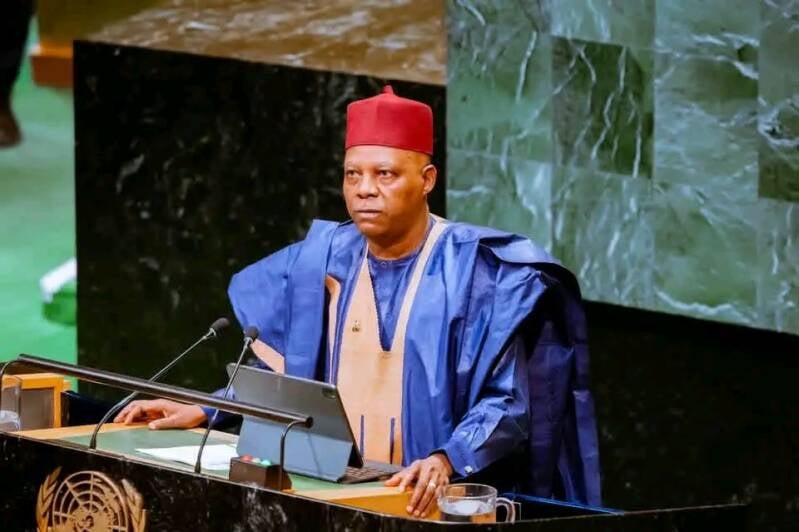
The world of 2026 cannot be governed by a power structure designed in 1945. That was the message Vice President Kashim Shettima delivered to the United Nations General Assembly on Thursday, September 24, 2026, as he demanded at least two permanent seats for Africa on the UN Security Council, complete with veto power, and five non-permanent seats for the continent. The demand, delivered on behalf of President Bola Tinubu at the 81st session of the UNGA in New York, is in line with the Ezulwini Consensus and the Sirte Declaration, Africa's long-standing common position on Security Council reform. But the applause that greeted the speech in New York will not drown out the questions that will be asked in Abuja, Maiduguri, and the hundreds of communities across Nigeria where the state's authority is contested daily by bandits, terrorists, and kidnappers.
Shettima was unequivocal in his framing of the demand. "The reform of this institution must begin with the reconstitution of the Security Council, for the world of 2026 cannot remain captive to the distribution of power in 1945," he declared. "Africa cannot continue to fill the Council's agenda while remaining absent from its permanent membership." He argued that the Council's present configuration no longer reflected contemporary geopolitical realities and weakened the legitimacy of global decision-making. "The authority to speak for humanity carries an obligation to represent it," he said. Nigeria's position, he noted, is consistent with the Ezulwini Consensus adopted in 2005, which calls for "not less than two permanent seats" for Africa with all the rights and privileges of permanent membership, including the veto, for as long as it exists. Africa currently holds no permanent seats on the 15-member Council and has only three of the ten non-permanent seats.
Shettima anchored Nigeria's claim to a permanent seat on the country's contributions to international peace and security. He recalled Nigeria's peacekeeping missions in Liberia, Sierra Leone, Darfur, Mali, and The Gambia, where "we committed personnel and resources when international solidarity required action." He added that Nigeria continues to work through ECOWAS, the African Union, and its Gulf of Guinea partnerships to advance mediation, democratic governance, counter-terrorism, and maritime security. "Nigeria stands ready to assume greater responsibility on the strength of obligations honoured and sacrifices made over decades in the service of peace," he said. The argument is familiar and not without merit. Nigeria has been a leading contributor to UN and regional peacekeeping operations for decades, and its population and economic weight make it a natural candidate for permanent representation.
But the demand carries an uncomfortable contradiction that Shettima did not address. How can Nigeria credibly demand a permanent seat on the body responsible for global peace and security when it is struggling to guarantee security within its own borders? The UN Security Council is, at its core, a security body. Its permanent members are expected to be capable of projecting power, maintaining internal stability, and contributing meaningfully to the maintenance of international peace and security. Nigeria today is a country where bandits control territories in the North-West, where Boko Haram and ISWAP continue to launch attacks in the North-East, where kidnappers operate with impunity on major highways, and where the military is fighting a multi-front war against non-state actors that has stretched its resources thin. The Nigerian government has repeatedly claimed victories against these groups, but the reality on the ground tells a different story.
The criticism has been swift and sharp. The African Democratic Congress has consistently argued that Nigeria's push for a UNSC seat is absurd while bandits slaughter Nigerians at home and take control of some of the nation's territories. "It is absurd for the Tinubu administration to be requesting a permanent seat on the United Nations Security Council even as bandits ravage the country," the party said in a statement. Analysts have made the same point in less partisan terms. Professor Abiodun Adeniyi of Baze University has argued that Nigeria's push for a permanent seat will remain elusive unless the country strengthens its domestic stability and governance. "We have called for the democratisation of the seats, and Nigeria, considering our population, is right to continue to advocate for it," he said. "But we must first fix our own house."
The question is not whether Africa deserves permanent representation on the Security Council. It does. The Council's current structure, with five permanent members who hold veto power and ten elected members who rotate every two years, is a relic of a post-World War II order that no longer reflects the world it governs. Africa, with 54 member states and a population of 1.4 billion, is the only continent without permanent representation. As Kenyan President William Ruto told the Assembly, "The equality proclaimed in this assembly ends at the doors of the Security Council." That is an injustice that must be corrected. But the question of which African country or countries should occupy those seats is a separate matter. Nigeria, South Africa, Egypt, and others have all laid claim to permanent representation. The competition for Africa's seats will be fierce, and Nigeria's domestic challenges will not help its case.
Nigeria's foreign policy establishment has long argued that the country's size, economy, and peacekeeping record make it the natural candidate for a permanent seat. Nigeria has served five terms as a non-permanent member of the Security Council, most recently between 2014 and 2015. It has contributed troops to peacekeeping missions across Africa and beyond. It has played a leading role in ECOWAS and the African Union. These are real achievements, and they should be recognised. But they are not sufficient. A permanent seat on the Security Council is not a reward for past service. It is a position of immense responsibility, and it comes with the expectation that the holder will be a net contributor to global security, not a net recipient of international assistance.
The timing of the demand is also worth noting. It comes just weeks after the abduction of more than 500 worshippers from mosques in Niger State, an attack that exposed the failure of Nigeria's security architecture on its own soil. It comes amid a nationwide crisis of confidence in the government's ability to protect its citizens. And it comes as the Nigerian military continues to fight a war against insurgency that has lasted more than a decade and claimed tens of thousands of lives. In this context, the demand for a permanent seat on the world's most powerful security body risks sounding hollow. It is not just about whether Nigeria deserves a seat. It is about whether Nigeria can carry the weight of the responsibility that comes with it.
Shettima's speech also touched on other global issues, including climate finance, artificial intelligence, and the need for a renewed commitment to the UN Charter. He called for an end to global conflicts and warned against the rising tide of nationalism. "The persistence of conflict across the world recalls the purpose for which the United Nations was founded: to spare succeeding generations the devastation of war," he said. He called on world leaders to return to the founding principles of dialogue, mutual respect, and collective responsibility. "Nigeria stands by the Charter and its promise of a world in which diplomacy prevails over coercion, cooperation over isolation, and international law over the arbitrary exercise of power." These are noble sentiments, and they deserve to be taken seriously. But they will be judged not by the eloquence of the speech but by the actions of the government that delivered it.
The demand for a permanent UN Security Council seat is not just a diplomatic manoeuvre. It is a statement of ambition. It reflects Nigeria's desire to be recognised as a major player on the global stage, a country whose voice matters in the decisions that shape the world. That ambition is legitimate. But it must be matched by domestic reality. A country that cannot secure its own territory, protect its own citizens, or guarantee the safety of its own children cannot credibly demand a permanent seat on the body responsible for international peace and security. The Nigerian government must understand that the path to a permanent UNSC seat runs through Abuja, Maiduguri, and the hundreds of communities where the state's authority is still contested. Until Nigeria can secure itself, its demand for a seat at the global table will remain just that: a demand, not an achievement.
📩 Stone Reporters News | 🌍 stonereportersnews.com
✉️ info@stonereportersnews.com | 📘 Facebook: Stone Reporters News | 🐦 X (Twitter): @StoneReportNew | 📸 Instagram: @stonereportersnews
Add comment
Comments