

Reported by: Oahimire Omone Precious | Edited by: Oravbiere Osayomore Promise.
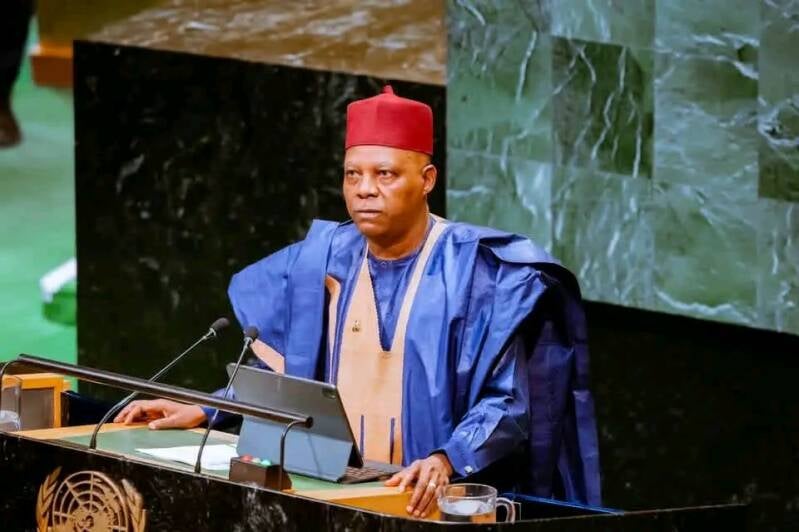
Nigeria has told the United Nations that no country, no matter how formidable its defences, can protect itself from terrorism, cyber threats, and other dangers that are sustained across international borders. Vice President Kashim Shettima delivered the warning on Thursday, September 24, 2026, while presenting President Bola Tinubu's national statement at the 81st session of the UN General Assembly in New York. Drawing from Nigeria's prolonged battle against Boko Haram, the Islamic State West Africa Province, and other armed groups, Shettima called for stronger international cooperation against transnational security threats.
"No nation, however formidable its defences, can secure itself completely against dangers sustained beyond its borders," Shettima told the Assembly. "Terrorism, organised crime, cyberattacks and illicit finance exploit the gaps between our national responses, drawing strength from the divisions that weaken collective action." He argued that modern threats exploited the gaps between countries and could not be effectively defeated through isolated national responses. Nigeria's experience, he said, demonstrated that security challenges sustained across borders required corresponding regional and global cooperation.
The Vice President outlined a four-point framework for collective action that he said was essential to defeating transnational threats. "We must exchange intelligence, strengthen institutional capacity, interrupt the financing of violence, and prevent weapons from crossing borders that our responses too often fail to cross," he declared. The framework reflects Nigeria's long-standing position that military action alone cannot defeat terrorism and that a coordinated, multi-dimensional approach is required. Shettima told the Assembly that military operations remained necessary but could not, by themselves, deliver lasting victory over violent extremism. He said sustainable security must also rest on education, economic opportunity, accountable governance, and respect for human rights.
The speech comes as Nigeria continues to grapple with a security crisis that has stretched its military across multiple fronts. Boko Haram and ISWAP remain active in the North-East, bandits and kidnappers operate with impunity across the North-West and North-Central regions, and the Federal Government has effectively lost control of significant portions of its territory to non-state actors. Just weeks before Shettima's address, more than 500 worshippers were abducted from mosques in Niger State in a single attack. The Nigerian government has repeatedly claimed victories against these groups, but the reality on the ground continues to challenge those assertions.
Shettima linked Nigeria's experience to the broader instability in the Sahel, which he said demonstrated how insecurity in one country could threaten neighbouring states, displace populations, and undermine regional integration and democratic governance. "The turmoil in the Sahel illustrates how insecurity in one territory can imperil its neighbours, displace populations and frustrate commerce, regional integration and democratic governance," he said. He warned world leaders against assuming that distant wars carried no costs for countries geographically removed from them. "Conflict can disrupt trade, increase humanitarian pressures, drive displacement, strengthen extremist networks and create wider economic and security shocks," he said.
The Vice President recalled Nigeria's long record of contributing personnel and resources to peace operations across Africa, citing engagements in Liberia, Sierra Leone, Darfur, Mali, and The Gambia as examples of Nigeria responding to instability beyond its national borders. "Nigeria stands ready to assume greater responsibility on the strength of obligations honoured and sacrifices made over decades in the service of peace," he said. Through ECOWAS, the African Union, and Gulf of Guinea partnerships, he said Nigeria continued to participate in mediation, counter-terrorism, maritime security, and efforts to strengthen democratic governance.
Shettima also used the occasion to renew Nigeria's call for the reform of the UN Security Council, demanding at least two permanent seats for Africa with veto power and five non-permanent seats for the continent. "The reform of this institution must begin with the reconstitution of the Security Council, for the world of 2026 cannot remain captive to the distribution of power in 1945," he declared. "Africa cannot continue to fill the Council's agenda while remaining absent from its permanent membership." The demand is in line with the Ezulwini Consensus and the Sirte Declaration, Africa's long-standing common position on Security Council reform.
The speech was delivered as the General Assembly's 81st General Debate entered its third day, with Shettima speaking fourth during Thursday's afternoon session. The 81st UNGA, which began on September 22 and will run until September 28, has the theme, "Restoring trust, managing transformation: A United Nations that delivers for all".
Shettima's address was a strong voice for Nigeria and Africa on the world stage. But the world is watching, and the world is asking a question that the Vice President did not address: if Nigeria cannot secure its own backyard, how can it be trusted to help secure the world's? The Nigerian government must understand that the path to a permanent UNSC seat runs through Abuja, Maiduguri, and the hundreds of communities where the state's authority is still contested. Until Nigeria can secure itself, its demand for a seat at the global table will remain just that: a demand, not an achievement.
📩 Stone Reporters News | 🌍 stonereportersnews.com
✉️ info@stonereportersnews.com | 📘 Facebook: Stone Reporters News | 🐦 X (Twitter): @StoneReportNew | 📸 Instagram: @stonereportersnews
Add comment
Comments