

Reported by Ariajegbe Sylvia Esezobor
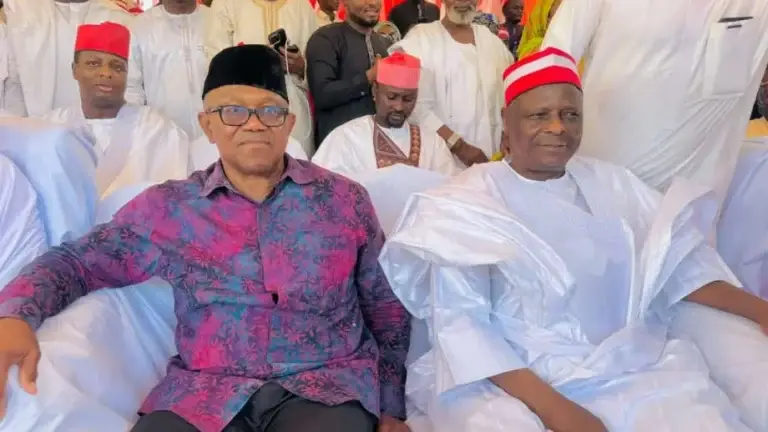
The Obi-Kwankwaso Movement on Friday said it does not receive financial support from the Nigeria Democratic Congress presidential candidate, Peter Obi, or the party to run its affairs, as its Director-General, John Ughulu, moved to draw a clear line between the movement’s independent organisational structure and the party that hosts the ticket it supports.
Ughulu said the movement’s operations are founded on its own principles and values, and that it has never required money from Obi or the NDC to establish or operate its structure. “The mechanism through which the OK Movement operates is founded upon its established principles and values,” he said in a statement issued in Abuja. “Consequently, the movement does not and has not required any financial support from His Excellency, Peter Obi, the NDC presidential candidate, or the NDC to establish or operate its own organisational structure.” He said the movement was built deliberately so that its leadership would not become financially dependent on Obi, his running mate, Rabiu Kwankwaso, or the party.
At the heart of the dispute is the 59-member Presidential Campaign Council the movement unveiled last week, which the NDC leadership subsequently disowned, saying only its National Working Committee had the authority to constitute a presidential campaign council. Ughulu insisted the council remains valid and operational. He argued that neither the Nigerian Constitution nor the NDC constitution, as presented to the movement, automatically vests exclusive authority in a political party or its candidate to determine the internal organisational structure of an independent political organisation. “The NDC Party is entitled to constitute its own campaign structures, just as the OK Movement is entitled to organise and manage its own affairs within the limits of applicable law,” he said.
The statement came hours after the NDC announced the commencement of registration for support groups ahead of the 2027 elections, a move that has triggered fresh disagreement with groups backing its presidential ticket. The party’s National Publicity Secretary, Osa Director, said the registration was free and exclusively handled by its Directorate of Support Groups at the national headquarters in Abuja. Director noted that the decision followed reports that some state chairmen were demanding registration fees from support groups. He warned that no state chapter, officer or official of the party was authorised to register support groups or collect money for the exercise, adding that violators would face disciplinary action. The registration exercise, according to the party, is intended to bring order to the often chaotic ecosystem of support groups that operate around presidential campaigns.
Ughulu used the occasion to reiterate that the movement does not claim superiority over the NDC, describing the party as a political organisation with its own constitutional structures while the movement has its own principles, leadership and organisational framework. He said the movement’s position is not about confrontation but about clarity, institutional respect and the protection of organisational independence. “If the party chooses to work with the principles, values and structures of the OK Movement, we remain prepared to engage constructively,” he said. “However, the movement cannot be compelled to abandon its principles or dissolve its structure.”
The disagreement has been building since the movement unveiled its campaign council, prompting the NDC to issue a statement dissociating itself from the council. The NDC had argued that no individual, candidate or support group was authorised to create a parallel structure in the party’s name without approval from the National Working Committee. The party’s National Leader, Senator Seriake Dickson, has also weighed in on the dispute, maintaining that the party’s constitution vests the authority to constitute a presidential campaign council in the NWC. The movement has challenged Dickson directly, saying its internal structure and leadership decisions do not require the approval of the National Leader or any other individual within the party leadership.
The dispute raises a fundamental question about the relationship between political parties and the independent movements that organise support around their candidates. The NDC’s position is that support groups must operate under the party’s formal structure and comply with its established procedures. The OK Movement’s position is that it can maintain its own independent organisation while supporting the party’s ticket, and that the party has no constitutional basis to compel it to collapse its structure into the party’s machinery. The movement has said it recognises all candidates contesting under the NDC platform as potential beneficiaries of its grassroots mobilisation, and that no candidate should consider himself or herself superior to another because of political position or proximity to party leadership.
The OK Movement’s independence claim is unusual in Nigerian politics, where support groups typically function as appendages of political parties and are expected to defer to the party’s leadership on matters of campaign structure and strategy. The movement’s insistence on organisational autonomy, combined with its claim that it does not take money from the party or the candidate, places it in a category of its own. Whether the NDC will accept that arrangement or continue to press for control of the movement’s structure will determine whether the dispute escalates or is resolved through negotiation.
The NDC has not yet issued a formal response to Ughulu’s latest statement. The party has previously said it remains committed to an issue-based campaign and to its vision of a new Nigeria, and has urged members and support groups with concerns to use the party’s internal mechanisms for resolving disputes rather than resorting to public attacks. The movement has said it remains willing to engage constructively with the party, provided its principles, values and organisational structures are respected.
The 2027 general elections are scheduled for January 16, with the governorship and state assembly elections following on February 6. Obi is the NDC’s presidential candidate, with Kwankwaso as his running mate. The party is seeking to build a broad coalition capable of challenging the ruling All Progressives Congress, and the dispute with its most prominent support movement is a distraction it can ill afford. For the OK Movement, the fight is about preserving its independence and its claim to represent a grassroots structure that belongs to its members rather than to the party. As Ughulu put it, the movement’s structure remains as announced, its principles remain unchanged, and its mission remains clear: to mobilise Nigerians towards a better and transformed Nigeria.
📩 Stone Reporters News | 🌍 stonereportersnews.com
✉️ info@stonereportersnews.com | 📘 Facebook: Stone Reporters News | 🐦 X (Twitter): @StoneReportNew | 📸 Instagram: @stonereportersnews
Add comment
Comments