

Reported by Ariajegbe Sylvia Esezobor
The wife of the Lagos State Governor, Dr Ibijoke Sanwo-Olu, has appealed to residents to be patient with the government over delays in waste evacuation, describing the situation as a “teething problem” that will be resolved with time, as complaints mount over the irregular performance of Private Sector Participation operators across the state.
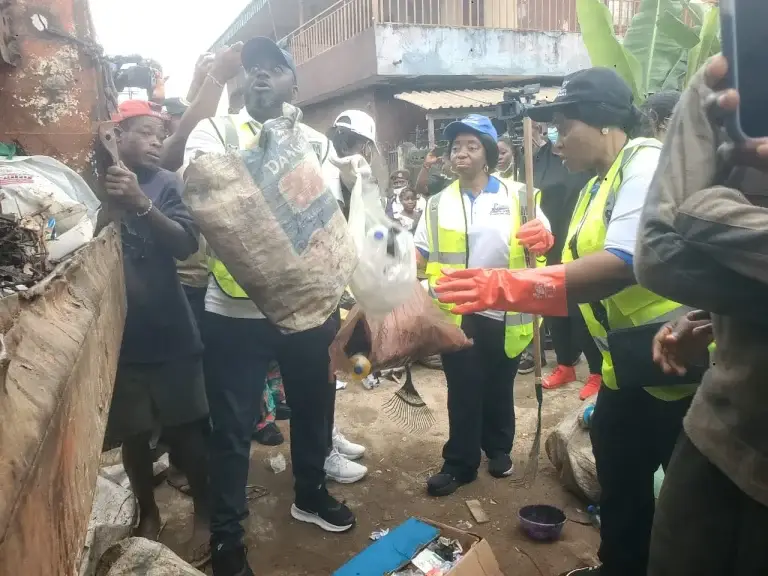
Sanwo-Olu made the appeal on Saturday while speaking with journalists during the monthly environmental sanitation exercise in the Mafoluku area of Oshodi-Isolo Local Government Area. Residents of the area had used the occasion to complain about delays in the evacuation of their refuse by PSP operators, a grievance that has become a recurring feature of the monthly exercise since its reintroduction. Engaging with the First Lady, a resident, Adebayo Agbalara, lamented the irregularity of the service. “The challenge we are facing is that the PSP operators are not coming regularly to pack our waste. Please help us to appeal to them,” Agbalara said.
Responding to the complaint, the First Lady identified two interlocking problems: the increase in charges by PSP operators, and the delays the operators themselves face in evacuating waste at dumpsites. “The turnaround time for the trucks to dump the dirt at the dumpsite, it takes a long time. They queue for like two or three days before they dump it, and then come out, because it’s just one way,” she said. She added that the government was working hard to develop another strategy and approach to waste disposal and waste management. “Our prayer to our people is that they should be patient. We know we have this teething problem; we will overcome our teething problem with time. They should just be patient.”
Sanwo-Olu acknowledged that some individuals were taking advantage of the situation, but said all relevant stakeholders were working to ensure that Lagos remained clean. Assessing the sanitation exercise in Mafoluku, she commended residents for bagging their refuse instead of dumping it beside drainage channels. She noted that a waste truck was already evacuating refuse in the area, although the process was not as fast as residents expected. “You can see that the truck is here; it’s already packing. We’re not as fast as the residents want us to pack, but they are already taking the waste away,” she said. She also called for greater separation of waste, noting that recyclable materials and other categories of waste were often mixed, and said schoolchildren were included in the exercise to instil environmental consciousness in them from an early age.
The First Lady’s appeal comes amid a waste management crisis that has prompted Governor Babajide Sanwo-Olu to declare what he described as a “small state of emergency” on waste management and order 160 new modern compactor trucks. The governor announced the intervention during an inspection of the Olusosun dumpsite in Ojota, where collection trucks were spending up to twelve hours, and sometimes an entire day, waiting to discharge their loads. The prolonged queues have reduced the number of trips trucks can make to neighbourhoods, worsening the accumulation of refuse. Lagos generates an estimated 13,000 metric tonnes of municipal solid waste daily, while recent reporting documented recurring refuse heaps across communities despite ongoing interventions by the Lagos State Waste Management Authority. LAWMA evacuated 418,500 tonnes of waste in May 2026 and cleared 173 refuse black spots, yet overflowing bins and roadside waste continued to be reported in parts of the state.
The operational challenges are not new. In May 2026, the Commissioner for the Environment and Water Resources, Tokunbo Wahab, monitored the sanitation exercise in Alimosho alongside the First Lady and acknowledged existing challenges with some PSP operators. He disclosed that the council had engaged additional contractors and directed officials to meet with operators responsible for waste collection in the area. Residents who spoke to journalists at the time described similar frustrations. “We have packed our waste and placed it where it can be collected, but the challenge is that the PSP operators do not come regularly. Sometimes, the waste remains there for days before it is evacuated,” one resident said. LAWMA has itself identified inadequate compactor capacity, unreliable service delivery and poor road infrastructure as weaknesses affecting the PSP waste collection system.
The monthly sanitation exercise, reintroduced by the Sanwo-Olu administration, has recorded what officials describe as improving public participation. The Special Adviser to the Governor on Environment, Olakunle Rotimi-Akodu, said residents were now voluntarily coming out to clean their homes and streets, unlike at the beginning of the exercise when officials had to encourage them to participate. “When we started, the awareness wasn’t this much. But today, you see people turning up, coming out to clean their environment, right from inside their house to the streets,” he said. The First Lady said Lagos had yet to reach the desired level of cleanliness but noted that public awareness and participation were gradually improving.
The waste crisis has also become a political issue. Critics have argued that the administration has failed to address the structural problems in the waste management system, pointing to the state’s heavy reliance on the PSP model and the absence of adequate investment in disposal infrastructure. The government has countered by pointing to the new compactors, the reopening of additional disposal sites including Solous 3 in Alimosho, Iwulepe in Ikorodu, Oke-Osho in Epe and Erikitte in Badagry, and plans to increase the number of tipping points at Olusosun from about two or three to four or five. The governor has also warned residents against indiscriminate dumping and urged households and property owners to pay for waste collection services, as the state steps up enforcement of environmental regulations.
For the residents of Mafoluku and communities across Lagos, the First Lady’s appeal for patience will be tested by their lived experience of overflowing bins, delayed collections and the health risks that accompany accumulated refuse. As Sanwo-Olu put it, the truck is already packing, but it is not as fast as residents want. The coming weeks will determine whether the government’s interventions translate into visible improvements on the streets, or whether the teething problem endures long enough to become a permanent feature of Lagos life.
📩 Stone Reporters News | 🌍 stonereportersnews.com
✉️ info@stonereportersnews.com | 📘 Facebook: Stone Reporters News | 🐦 X (Twitter): @StoneReportNew | 📸 Instagram: @stonereportersnews
Add comment
Comments