

Reported by Ariajegbe Sylvia Esezobor
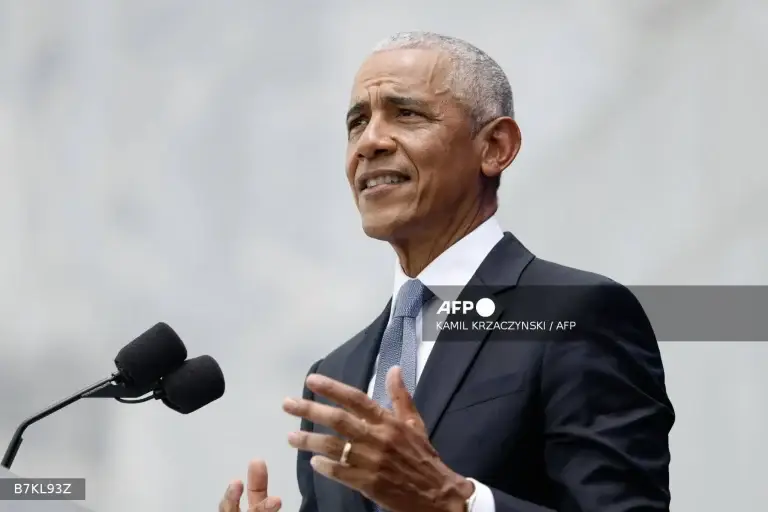
Former United States President Barack Obama has said he believes governments around the world would perform better if women were put in charge for two years, reviving an argument he first made in 2019 and triggering a fresh round of debate about gender and leadership.
Obama made the remarks during a conversation with historian Doris Kearns Goodwin at Salem State University in Massachusetts on Monday, September 21, 2026, with C-SPAN sharing a clip of his comments on Friday. The video has since circulated widely online, drawing renewed attention to the former president’s views on female leadership and generating mixed reactions across the political spectrum. “Even when I was president, I sometimes fantasised about if you put women in charge of every government for like two years and then just kind of saw, all right, how are things going?” Obama said. “I have a strong belief that things would — they wouldn’t be perfect. But they’d be better. I’m confident about that. I really do.”
The hour-long Salem State Series event attracted about 3,600 people to the university’s O’Keefe Sports Complex, with hundreds more watching from a satellite venue on campus. Obama was discussing leadership and the need to give younger generations opportunities to take on positions of influence when he recalled the thought he had while serving in the White House. The remarks echoed a similar argument he made in December 2019 during a leadership event in Singapore, where he said he believed countries would see improvements if women ran every country for two years, predicting gains “on just about everything,” including fewer wars and better care for children. At that event, he also said women were “indisputably better” than men as leaders, though he acknowledged they were not perfect.
The reaction to Obama’s latest comments has been swift and polarised. Fox News host Jesse Watters questioned whether Obama has a “fetish” over what he described as his “fantasy,” while conservative commentator Matt Walsh invoked a high-profile filicide case in response to Obama’s remarks. On the other side, supporters of the former president argued that his comments reflected a legitimate observation about leadership styles and outcomes, pointing to research suggesting that female leaders often adopt more collaborative and inclusive approaches. The remarks have also drawn attention to the broader question of female representation in leadership, particularly in the United States, where Hillary Clinton lost the 2016 presidential election and Kamala Harris was defeated in 2024.
The debate over women in leadership has been a recurring theme in American politics. In November 2025, former First Lady Michelle Obama said Americans were “not ready” to elect a woman to the White House, pointing to Clinton’s and Harris’s losses. Her comments drew a public disagreement from Michigan Governor Gretchen Whitmer, who said in January 2026 that she believed America was prepared for a woman president. The exchange reflected a deeper divide within the Democratic Party about whether the obstacle to a female presidency is structural, cultural or strategic.
Obama’s remarks also come amid a global picture of stalled progress on female political representation. According to UN Women, women hold just over 27 per cent of parliamentary seats worldwide and about 23 per cent of ministerial positions. Only a handful of countries have ever elected a female head of government, and the pace of change has been uneven. In Africa, where Obama’s remarks have been widely reported, women hold fewer than a quarter of parliamentary seats, and no woman has ever been elected president of Nigeria, Africa’s most populous nation. The 2027 general elections in Nigeria will feature two female presidential candidates out of 18, representing 11.1 per cent of the field.
The former president’s comments have also been interpreted in the context of his own administration’s record. During his presidency, Obama appointed two women to the Supreme Court, including Sonia Sotomayor and Elena Kagan, and had several women in senior roles, including Hillary Clinton as Secretary of State and Susan Rice as National Security Advisor and later UN Ambassador. However, critics have noted that his cabinet was initially criticised for being too male-dominated, and that the pace of female appointments in senior positions remained a subject of debate throughout his tenure.
Obama also used the Salem State appearance to address political divisions in the United States, saying the country was less divided at the grassroots level than its politics and media might suggest. “We’re not as divided as our politics or our media would indicate,” he said, adding that people across the country were still treating one another with respect. The observation reflected a recurring theme in Obama’s post-presidential public engagements, where he has consistently argued that polarisation is driven more by political and media incentives than by fundamental divisions among ordinary Americans.
The video of Obama’s remarks has been shared widely on social media, with clips circulating on X, TikTok and YouTube. The debate it has generated touches on questions that extend far beyond the former president’s personal opinion: whether leadership outcomes are determined by gender, whether the underrepresentation of women in politics reflects structural barriers or voter preferences, and whether hypothetical scenarios about women running every government advance or trivialise the cause of gender equality in leadership. Obama framed his remarks as a thought experiment, but the reaction suggests that the subject remains as charged as ever, particularly in a political environment where the question of who gets to lead remains one of the most contentious issues of the day.
For now, Obama has not issued any further comment on the reaction to his remarks. The former president has consistently used his public appearances to reflect on leadership, democracy and the challenges facing the next generation, and his comments at Salem State were consistent with that broader pattern. Whether the debate they have sparked will lead to a more substantive conversation about women in leadership or simply become another viral moment in a polarised media environment remains to be seen. What is certain is that the question Obama posed — what would happen if women were in charge — continues to resonate precisely because the answer remains contested.
📩 Stone Reporters News | 🌍 stonereportersnews.com
✉️ info@stonereportersnews.com | 📘 Facebook: Stone Reporters News | 🐦 X (Twitter): @StoneReportNew | 📸 Instagram: @stonereportersnews
Add comment
Comments