

Reported by: Ijeoma G | Edited by: Oravbiere Osayomore Promise.
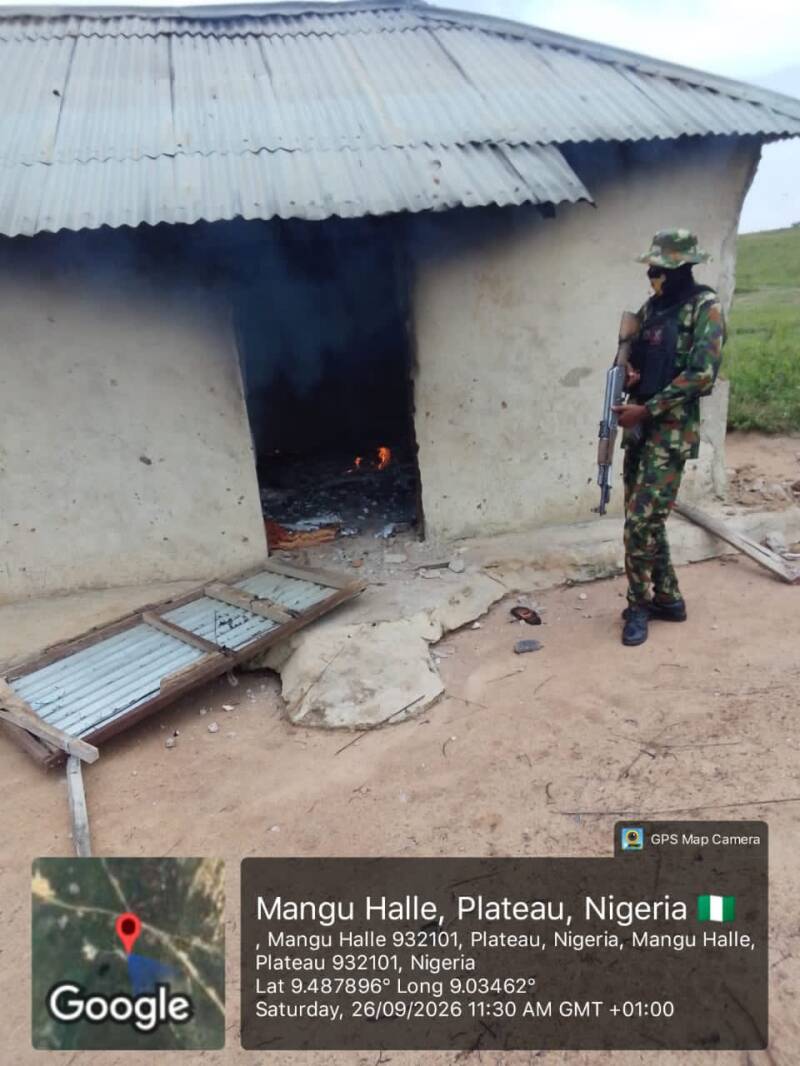
Six houses belonging to Fulani residents have been set ablaze in Kantoma community, Mangu Local Government Area of Plateau State, in what security sources have described as a reprisal attack by Mwaghavul militiamen. The incident occurred at about 10:21 a.m. on Saturday, September 26, 2026, following the earlier killing of two natives of the community by suspected Fulani elements. The attack is the latest chapter in a cycle of violence and revenge that has consumed Mangu and surrounding areas for years, leaving a trail of blood, ashes, and broken communities.
According to security sources who spoke with conflict reporter Zagazola Makama, troops of Sector 8, Operation ENDURING PEACE, responded to a report of the reprisal attack on Fulani settlements in the community. By the time the troops arrived, six Fulani houses were already engulfed in flames. The youths suspected to have carried out the attack had fled before the arrival of the security personnel. The troops subsequently succeeded in putting out the fire and stabilising the immediate area. No casualty was immediately reported in connection with the reprisal attack.
As part of efforts to prevent further escalation, an emergency stakeholders' meeting was scheduled to take place at the headquarters of Sector 8 OPEP. The meeting is expected to bring relevant stakeholders together to address the immediate tensions and strengthen measures to prevent further retaliatory attacks between communities. Security agencies are expected to sustain patrols and engagement with community leaders to prevent further attacks and protect residents irrespective of their ethnic or religious identity.
The attack on Kantoma is not an isolated incident. It is the latest in a long and bloody sequence of tit-for-tat violence that has defined Mangu for years. On September 24, two miners were killed at a mining site in Kworos Gangare, Barkin Ladi, while two others were killed at Nghar, Exland, in Gashish District. On the same day, three people were killed at Gassa, Barkin Ladi. On September 23, gunmen abducted Hon. Denty Laven, a member of the Plateau State House of Assembly representing Pankshin South Constituency. On September 14, gunmen stormed Ikn'gwakap community in Mushere Chiefdom, Bokkos LGA, killing six people including women and children. The cycle continues, each attack triggering a reprisal, each reprisal triggering another attack, and the security agencies caught in the middle, responding after the damage is done.
The pattern is depressingly familiar. A killing occurs. The community of the victims mourns. The perpetrators flee. Then, within hours or days, another community is attacked in retaliation. Houses are burned. More lives are lost. The security agencies arrive, put out fires, and schedule a stakeholders' meeting. The meeting is held. Promises are made. Everyone agrees to embrace peace. Then the next attack happens, and the cycle begins again. In Mangu, the stakeholders' meetings have become as regular as the funerals. Neither seems to break the cycle.
The Berom Youth Moulders Association, in a statement on Saturday, confirmed the killing of seven people in separate attacks across Plateau State within 48 hours, including the two miners, two residents at Nghar, and three community members at Gassa. The association accused security agencies of failing to protect communities despite a curfew imposed to stem the violence. "This raises serious questions about the effectiveness of existing security measures," the association said, demanding that authorities move beyond responding to attacks after they occur and instead conduct credible intelligence operations to identify and dismantle criminal hideouts and operational enclaves.
The Miyetti Allah Cattle Breeders Association of Nigeria has consistently accused local militias it describes as "Mangu militias" of orchestrating the killings of Fulani herders and the rustling of their cattle. The association has argued that its members are being targeted in a coordinated campaign of violence. Community leaders from both sides have called for impartial and transparent investigations by the Federal Government, the Plateau State Government, and security agencies to establish the circumstances surrounding the attacks, identify and prosecute anyone found responsible regardless of ethnic or religious affiliation, and strengthen security around vulnerable communities and livestock routes.
But the investigations rarely produce results. The arrests are few. The convictions are fewer. The perpetrators of the worst attacks often escape justice entirely. And the cycle continues, fed by impunity, by grief, and by a deep-seated conviction on all sides that the only way to be safe is to strike first. In this environment, the stakeholders' meetings become exercises in futility, opportunities for leaders to posture and for communities to vent, but not to resolve the underlying grievances that drive the violence.
The root causes are complex and deeply entrenched. Land disputes, grazing rights, political power, and historical grievances have all contributed to the violence in Mangu. Armed groups have exploited these tensions, sometimes for criminal gain, sometimes for political purposes, and sometimes simply for revenge. The failure of the state to provide security, to deliver justice, and to address the socio-economic conditions that make communities vulnerable to manipulation has created a vacuum that armed groups have filled. In this vacuum, the cycle of attack and reprisal becomes self-perpetuating.
For the residents of Kantoma, the burning of six Fulani houses is a tragedy. For the families of the two natives killed earlier, it is a painful reminder that their loved ones' deaths have not been avenged in the way they might have wanted. For the security agencies, it is another incident to investigate, another meeting to attend, another community to calm. But for the people of Mangu and Plateau State as a whole, it is another reminder that the cycle of violence is far from over. The houses will be rebuilt. The stakeholders' meeting will be held. The promises will be made. And then, inevitably, the cycle will repeat itself. Until the root causes are addressed, until the perpetrators are held accountable, and until communities find a way to break free from the cycle of revenge, the blood will continue to flow, and the ashes will continue to rise.
📩 Stone Reporters News | 🌍 stonereportersnews.com
✉️ info@stonereportersnews.com | 📘 Facebook: Stone Reporters News | 🐦 X (Twitter): @StoneReportNew | 📸 Instagram: @stonereportersnews
Add comment
Comments