

Reported by Ariajegbe Sylvia Esezobor
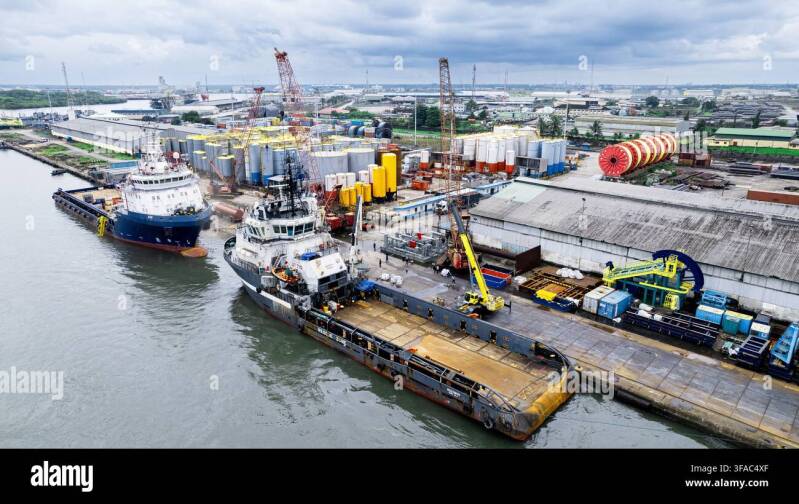
The Federal Government has approved the comprehensive modernisation and upgrade of the Onne, Rivers, Delta and Calabar ports, in a move aimed at expanding Nigeria's maritime infrastructure, reducing the concentration of cargo traffic around Lagos and developing a more balanced and globally competitive national port system.
The approval was announced on Sunday by the Minister of Marine and Blue Economy, Adegboyega Oyetola, in a statement posted on his official X handle. Oyetola said the decision builds on the earlier approval for the modernisation and upgrade of Apapa and Tin Can Island ports in Lagos, describing it as another important step in the Federal Government's determination to transform Nigeria's maritime infrastructure and unlock the economic potential of its ports. "This approval builds on the earlier approval for the modernisation and upgrade of Apapa and Tin Can Island Ports in Lagos, reaffirming our determination to develop a balanced, efficient and globally competitive national port system," he said.
The minister said the initiative aligns with President Bola Tinubu's Renewed Hope Agenda, which prioritises infrastructure renewal and economic diversification. "Modern and efficient ports are critical to this vision because they facilitate trade, support industry, attract investment and create jobs," Oyetola said. He explained that extending the modernisation programme beyond Lagos would complement ongoing investments in the state while helping to ease the concentration of cargo traffic around the commercial centre and provide additional gateways for international trade. "Upgraded infrastructure and improved operational efficiency at Onne, Rivers, Delta and Calabar Ports will enhance cargo handling, reduce vessel turnaround times, strengthen regional connectivity and make the movement of goods more predictable and cost-effective," he said.
The four ports occupy strategic positions in Nigeria's trade, industrial and regional development architecture. Onne Port in Rivers State is one of the country's largest and busiest ports, serving as a major gateway for imports and exports in the South-East and South-South. The Rivers Port complex in Port Harcourt, which includes the Port Harcourt and Onne facilities, has long been a critical hub for the oil and gas industry and general cargo. The Delta Port, located in Warri, serves the oil-rich Niger Delta and is a key point for petroleum products and industrial goods. Calabar Port in Cross River State, which dates back to the colonial era, serves the South-South and parts of the South-East and has the potential to become a major gateway for trade with Cameroon and other Central African markets. Together, the four ports represent a significant portion of Nigeria's non-Lagos maritime capacity.
The approval is part of a broader expansion of Nigeria's maritime infrastructure that includes the development of new deep seaports. The Federal Government has approved the development of the Ibom Deep Seaport in Akwa Ibom State, the Bakassi Deep Seaport in Cross River State, the Agge Deep Seaport in Bayelsa State, the Gateway Deep Seaport in Ogun State, the Ondo Deep Seaport in Ondo State and the Bonny Deep Seaport in Rivers State. Oyetola said the combination of modernising existing ports and facilitating new deep seaports would expand Nigeria's maritime capacity and create stronger economic corridors across the country. "Our approach is comprehensive. We are modernising existing ports while facilitating the development of new deep seaports. Together, these investments will expand Nigeria's maritime capacity, create stronger economic corridors and position our country as a major maritime and logistics hub in Africa," he said.
The minister also outlined a vision for an integrated maritime and logistics system in which ports, roads, rail, inland waterways and other transport infrastructure work together to enable the seamless movement of cargo. "Our vision is an integrated maritime and logistics system in which ports, roads, rail, inland waterways and other transport infrastructure work together to enable the seamless movement of cargo," Oyetola said. He said the government wanted to reduce the time and resources Nigerian businesses spend moving goods while creating an environment that encourages investment and supports job creation. "We want Nigerian businesses to spend less time and resources moving their goods, while creating an environment that encourages investment and supports job creation," he said.
The modernisation of the four ports follows a procurement process that began earlier in 2026. On April 3, 2026, it was reported that the Federal Government had commenced procurement processes for the modernisation of the Warri, Port Harcourt, Onne and Calabar ports, alongside the previously approved upgrades of Apapa and Tin Can Island ports, as part of efforts to strengthen maritime infrastructure nationwide. The latest approval consolidates that process and signals the government's intention to move from planning to implementation. The Federal Government had also secured a $746 million facility to modernise Apapa and Tin Can Island ports, underscoring the scale of the investment programme.
The decongestion of Lagos ports has been a longstanding priority for the Federal Government and maritime stakeholders. Lagos currently handles the overwhelming majority of Nigeria's seaborne trade, a concentration that has led to chronic congestion, delays in cargo clearance, high demurrage costs and inefficiencies that impose a heavy burden on importers, exporters and the broader economy. The concentration also creates vulnerabilities, as disruptions in Lagos have nationwide consequences. By upgrading and modernising ports in the eastern and southern corridors, the government hopes to redistribute cargo traffic, reduce pressure on Lagos, and provide businesses with alternative gateways that are closer to their operations.
The minister said the ministry would work closely with state governments, terminal operators, investors, shipping companies and other stakeholders to ensure that the projects deliver tangible improvements across the marine and blue economy. He reaffirmed the ministry's commitment to collaboration, saying the projects would translate into tangible benefits for the economy. "Our ambition is to build a port system that is efficient, transparent and globally competitive," Oyetola said. He added that Nigeria has the geography, market and maritime resources to become a leading maritime hub, and that the government's responsibility was to create the conditions for that potential to be realised.
For Nigerian businesses and consumers, the success of the port upgrade programme will be measured by whether goods move faster, cheaper and more reliably through the country's gateways. For the maritime sector, the approvals represent a significant vote of confidence and a potential catalyst for investment in terminal infrastructure, logistics services and the ancillary industries that support port operations. For the government, the challenge lies in implementation, ensuring that the projects are delivered on time, that the regulatory environment supports private-sector participation and that the benefits reach beyond the ports themselves to the communities and industries that depend on them. As Oyetola put it, the approach is comprehensive, modernising existing ports while facilitating new deep seaports to position Nigeria as a major maritime and logistics hub in Africa. The approvals have been granted. The work now begins.
📩 Stone Reporters News | 🌍 stonereportersnews.com
✉️ info@stonereportersnews.com | 📘 Facebook: Stone Reporters News | 🐦 X (Twitter): @StoneReportNew | 📸 Instagram: @stonereportersnews
Add comment
Comments