

Reported by: Ijeoma G | Edited by: Oravbiere Osayomore Promise.
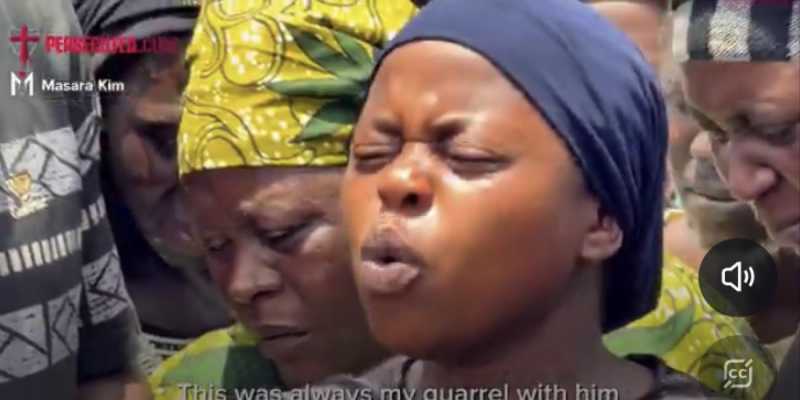
The viral video is short, barely a minute long. But in that minute, a young woman in Plateau State captures the grief of a generation. She is crying, her voice breaking as she speaks in Hausa. She is standing near a grave—not a single grave, but a mass grave—where her husband has just been buried alongside his colleagues. "You died a hero," she says. "I have lost everything."
Her husband was a community youth leader in Kassa community, Barkin Ladi Local Government Area of Plateau State. He was killed on Friday, September 25, 2026, when gunmen attacked a civilian watch post around 1 a.m. He was not a soldier. He was not a policeman. He was a volunteer, a man who had taken it upon himself to protect his neighbours from the violence that has turned Plateau State into a graveyard of dreams. His name is not mentioned in the SaharaReporters report, nor are the names of his colleagues beyond two first names: Barry and Danny. But his widow's tribute, posted online by conflict reporter Masara Kim on Monday, September 28, 2026, has made him a symbol of a crisis that the Nigerian state has failed to contain.
The widow described her husband as a man who chose to protect vulnerable residents despite the dangers. She said she had pleaded with him to step down, to abandon the role that she knew would one day kill him. "This was always my quarrel with him," she said. "I told him to quit his leadership. For three years we have been under siege by Fulani terrorists. I told him, 'Quit this role; I have lost everything, I can't keep up anymore.'" Her words reveal a grim truth about life in Plateau State: for many families, survival has become a daily negotiation with fear, and the decision to serve one's community is a decision that comes with a death sentence hanging over it.
But her husband refused to quit. "He said, 'My mummy, this is the work the Lord has called me to do. I cannot watch my community get annihilated. I would rather die protecting it,'" she recounted. Those words, as it turned out, were prophetic. He died doing exactly what he said he would do. He was buried in a mass grave with Barry and Danny, two other members of the civilian watch post who were killed in the same attack. The mass grave is not a new phenomenon in Plateau State. It has become the default burial option for communities that lose multiple people in a single attack, a grim necessity that speaks to the scale of the violence.
The attack on Kassa community was not an isolated incident. It was the latest in a series of assaults that have devastated Plateau State in recent weeks. On September 26, gunmen killed at least 54 people in Zikke village, Bassa Local Government Area. On September 24, two miners were killed at a mining site in Kworos Gangare, Barkin Ladi, while two others were killed at Nghar, Exland. On the same day, three people were killed at Gassa, Barkin Ladi. On September 23, gunmen abducted Hon. Denty Laven, a member of the Plateau State House of Assembly representing Pankshin South Constituency. The Nigerian Bar Association in Plateau State has alleged that terrorists are openly attacking communities observing government-imposed curfews, describing the situation as "an invitation to total anarchy." The Berom Youth Moulders-Association has confirmed the killing of seven people in separate attacks across the state within 48 hours. Amnesty International has condemned the violence as an "inexcusable security failure," warning that the government's security measures are not working.
The widow's tribute is a reminder that behind every statistic, every press release, every condemnation, there is a family. There is a woman who has lost her husband. There are children who have lost their father. There are colleagues who have lost their friends. The mass grave in Kassa community is not just a burial site. It is a monument to the failure of the Nigerian state to protect its citizens. It is a testament to the courage of ordinary people who stepped into the void left by that failure and paid the ultimate price.
The widow's words are simple, but they carry the weight of a tragedy that is repeated across Plateau State every week. "You died as a hero. You died as a legend. May your legacy inspire generations. Keep praying for me that the Lord will strengthen me. We are grateful." She prays for her husband's soul and for the souls of Barry and Danny. She says, "Together with your colleagues, Barry and Danny, may the Lord give you peace. You died for your land. God will fight for us till we come."
The protests that followed the Kassa attack saw women and youths block the Jos-Barkin Ladi highway to express their anger over insecurity in the area. The victims, including the community's youth leader, were killed while protecting the community. The highway blockade was a cry of frustration from people who have buried too many loved ones and seen too little accountability. The Plateau State Government has imposed curfews, deployed security personnel, and promised action. But the killings have continued. The mass graves have multiplied. And the widows have kept crying.
The widow in the viral video is not asking for much. She is not calling for revenge. She is not demanding compensation. She is simply mourning her husband and praying for strength. But her words carry an implicit demand: that her husband's death, and the deaths of Barry and Danny and the thousands of others who have been killed in Plateau State, should not be in vain. That the government should do what it was elected to do. That the violence should end. That no more mass graves should be dug.
For now, the widow is left with her grief, her children, and a legacy. Her husband died protecting his community. He died a hero. But heroes should not have to die because the state failed to protect them. The people of Kassa community have buried their youth leader and two of his colleagues in a mass grave. They have protested. They have prayed. They are waiting. And the question on everyone's mind is the same: how many more mass graves must be dug before the government finally acts? The answer, so far, has been silence. And the widow's tears continue to fall.
📩 Stone Reporters News | 🌍 stonereportersnews.com
✉️ info@stonereportersnews.com | 📘 Facebook: Stone Reporters News | 🐦 X (Twitter): @StoneReportNew | 📸 Instagram: @stonereportersnews
Add comment
Comments