

Reported by Ariajegbe Sylvia Esezobor
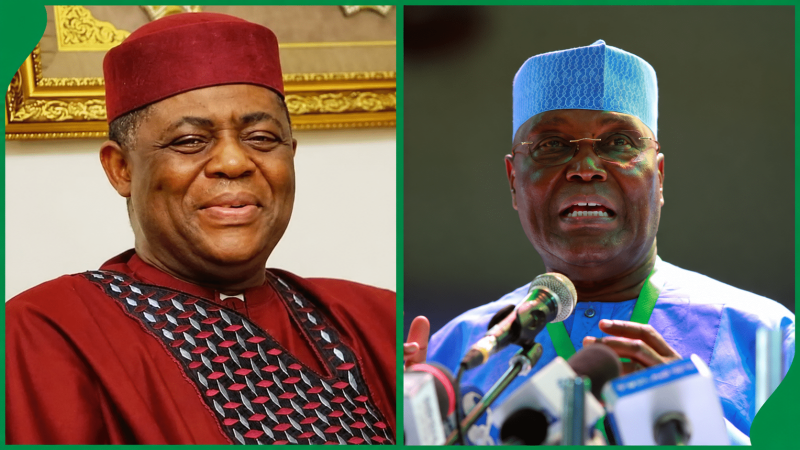
The political battle over how President Bola Ahmed Tinubu should be addressed has erupted into a bitter public confrontation between Femi Fani-Kayode, Nigeria’s Ambassador to South Africa and former Minister of Aviation, and Paul Ibe, the media adviser to former Vice President Atiku Abubakar, after Atiku repeatedly referred to the President simply as “Bola” during his October 1 Independence Day address.
Fani-Kayode, in a post on his Facebook page on Sunday, accused Atiku of disrespecting the office of the President and described the former vice president’s address as “intellectually-flawed, highly disrespectful” and lacking “decency, logic and rationality”. He said Atiku deliberately refused to address Tinubu as “President,” choosing instead to repeatedly call him by his first name. “Surely this level of pettiness is below even you. Yet despite this provocation I will not refer to you as ‘Kachalla’ and I will accord you the respect that I still think you deserve,” Fani-Kayode wrote, invoking a term Atiku’s critics have used to question his political reliability.
The former minister cited Akin Osuntokun, a former Special Adviser on Politics to former President Olusegun Obasanjo and former Director-General of the Peter Obi Presidential Campaign Organisation, who had also criticised Atiku’s use of Tinubu’s first name, saying Osuntokun was right to demand “decorum and decency”. Fani-Kayode then broadened his attack, raising a series of past political controversies involving Atiku, including his relationship with Obasanjo during their tenure as president and vice president between 1999 and 2007, his comments about former President Goodluck Jonathan, his exchange with Vice President Kashim Shettima, and his handling of the 2022 killing of Deborah Samuel in Sokoto. He alleged that Atiku’s political conduct demonstrated a lack of respect, restraint and loyalty, and accused him of being driven primarily by his ambition to become president. He concluded by warning that Atiku’s refusal to show respect for the presidential office could hurt his ambition to occupy it.
Responding on Sunday, Ibe dismissed Fani-Kayode’s criticism as a distraction from the substantive issues raised in Atiku’s Independence Day address, which focused on the rising cost of living, insecurity and the economic hardship confronting Nigerians. “His name is Bola. And that is not Nigeria’s problem,” Ibe said. He argued that Nigerians were more concerned about the cost of food, transport and energy than the form of address used for the President. “Nigeria is a republic, not a monarchy. The President is an elected public servant, not an emperor before whom opponents must genuflect,” he said. Ibe further argued that “President” was the title of an office and not a requirement that should shield its occupant from criticism.
The Atiku aide then launched a searing counter-attack on Fani-Kayode’s own record, accusing him of moral contradiction. He noted that Fani-Kayode had lectured Atiku about “decency,” “decorum” and “restraint” while his own essay called people “pit bull terriers,” “hungry wolves,” “fallen angels” and sufferers of “pathological obsession”. Ibe reminded Fani-Kayode of his public confrontation with a journalist, whom he allegedly called “stupid,” threatened, and declared, “I have marked you”. He also referenced accusations of ethnic stereotyping in Fani-Kayode’s writings about the Igbo and the domestic abuse allegations made against him by his estranged wife, saying, “Someone carrying such contested baggage should understand the wisdom of restraint before mounting the pulpit to judge another man’s character”. He concluded with a biblical injunction: “Femi, physician, heal thyself”.
Ibe also addressed Fani-Kayode’s foray into Atiku’s history with Obasanjo, stating that political disagreement was not treason and that Atiku was Vice President, not Obasanjo’s domestic servant. He said Atiku’s court victories from that era helped deepen Nigeria’s constitutional democracy and that the claim Obasanjo knelt before Atiku remained disputed history. On Goodluck Jonathan, Ibe said Atiku had offered a political assessment of his preparedness for office and that criticism was not disrespect. He also dismissed Fani-Kayode’s reference to Rotimi Amaechi, noting that political rivals can later become allies and that Fani-Kayode himself was now supporting a man he once vowed never to support.
The clash has drawn attention to the broader question of political decorum in Nigeria and the fine line between criticism and disrespect. Fani-Kayode’s argument rests on the premise that the office of the President deserves a measure of reverence and that addressing Tinubu by his first name diminishes that office. Ibe’s counter-argument is rooted in the republican principle that the President is a servant of the people, not a monarch, and that titles should not shield public officials from scrutiny. The exchange also reflects the personal and political animosities that have intensified ahead of the 2027 general elections, in which Atiku is seeking the presidency on the platform of the African Democratic Congress, with former Rivers State Governor Rotimi Amaechi as his running mate, while President Tinubu is seeking a second term on the All Progressives Congress ticket.
The timing of the controversy is significant. Atiku’s Independence Day address was intended to present his alternative vision for the country and to challenge the Tinubu administration’s economic record, but the debate over how he referred to the President has threatened to overshadow the substance of his message. Ibe’s response sought to redirect attention to the issues Atiku raised, arguing that the controversy over the President’s name was misplaced given the economic and security challenges facing Nigerians. Fani-Kayode, by contrast, used the occasion to mount a comprehensive attack on Atiku’s political record and character, suggesting that the former vice president’s conduct disqualified him from the office he seeks.
Neither Fani-Kayode nor Ibe has issued further statements since the exchange, and the Presidency has not commented publicly on the matter. The clash between the two spokesmen is likely to continue as the 2027 campaign intensifies, with both sides seeking to define the terms of the debate and to portray the other as unfit for power. For Nigerians, the exchange offers a glimpse into the rhetorical strategies that will shape the coming political season, in which questions of character, respect and the appropriate conduct of public officials are set to feature prominently. As Ibe put it, the President’s name is Bola, and that is not Nigeria’s problem. Fani-Kayode’s response suggests he believes the problem is precisely that Atiku chose to say so.
📩 Stone Reporters News | 🌍 stonereportersnews.com
✉️ info@stonereportersnews.com | 📘 Facebook: Stone Reporters News | 🐦 X (Twitter): @StoneReportNew | 📸 Instagram: @stonereportersnews
Add comment
Comments