

Reported by Ariajegbe Sylvia Esezobor
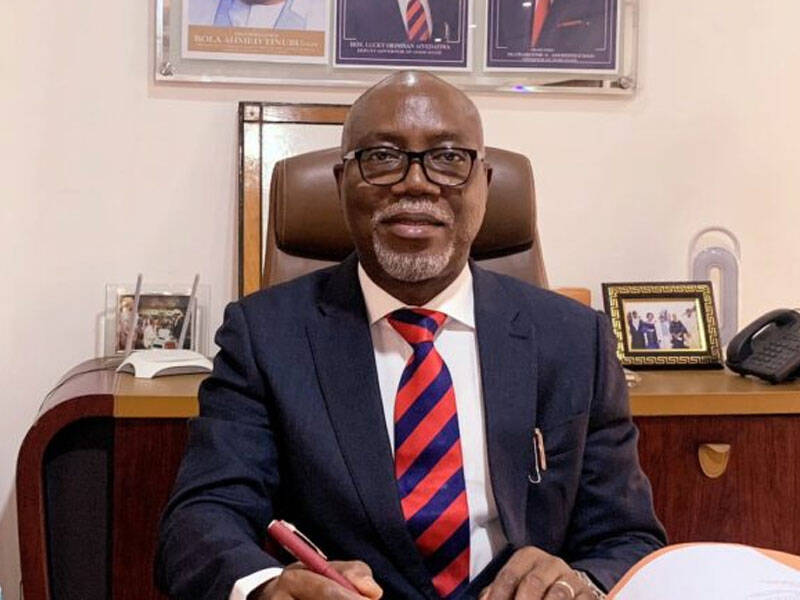
Ondo State Governor Lucky Aiyedatiwa on Wednesday visited the site of the Nigerian Air Force ATR-42 aircraft crash at Igbokoda in Ilaje Local Government Area and directed that search and recovery operations must continue without let-up until the victims and the main wreckage of the aircraft are recovered, describing the incident as a national tragedy and the scene as a “very gory sight” that would remain seared in the memory of all who witnessed it.
The governor, who received a briefing from personnel of the Nigerian Navy, the Air Force, the National Emergency Management Agency, the State Emergency Management Agency and local divers, said the state government had deployed two amphibious machines known as swamp buggies to open wider access to the crash location and facilitate the movement of larger boats and rescue equipment into the swamp. The machines, he said, were also being used to excavate the swamp in the search for the main body of the aircraft, which remained submerged and unlocated as of the time of his visit. He said divers from the Navy and local communities were continuing the search in deeper sections of the swamp and noted that the soft nature of the terrain had made the operation particularly challenging. “The main body of the aircraft has not been sighted,” Aiyedatiwa said. “It is believed to be submerged in the swamp.”
The aircraft, with tail number NGR 931, crashed on Monday, October 5, 2026, while on a routine mission from Benin City to Lagos. Initial reports indicated that 25 passengers and seven crew members were on board, though subsequent accounts from The Cable and other sources put the death toll at 25, comprising 20 passengers and five crew members. The Nigeria Air Force confirmed the crash and activated an immediate search and rescue operation, while President Bola Ahmed Tinubu ordered a thorough investigation into the cause of the incident and declared three days of national mourning, with the national flag ordered to be flown at half-mast in honour of the fallen personnel. Aiyedatiwa commiserated with the President, the Nigerian Air Force and the families of the deceased, describing the victims as young Nigerians who had dedicated their lives to defending the territorial integrity of the country.
The governor disclosed that the difficult terrain had compelled the state government to intervene with heavy equipment. “From construction experience and analysis of this area, for you to get to refusal level when you’re piling, it will get to about 30 metres deep,” he said, explaining the challenge of locating the aircraft in the swampy environment. He said thick mangroves, murky water and deep mud had made access difficult, while the main wreckage, including the cockpit and the black box, was yet to be located. Only fragments of the aircraft have been recovered so far, alongside body parts, clothing and jackets belonging to Air Force personnel, which have been preserved for further investigation. Aviation fuel was also observed flowing into the surrounding water, raising environmental pollution concerns at the site.
Perhaps the most striking revelation from the governor’s visit was his account of how the pilot may have prevented a far greater catastrophe. Aiyedatiwa said eyewitnesses reported that the aircraft appeared to be heading towards the community before the pilot manoeuvred it away. “From what the people told us, the aircraft was almost coming into the community, but the pilot managed to manoeuvre it away before it crashed about 200 metres from the community and went straight into the swampy area,” he said. Residents had also reported hearing a sound suggesting that the aircraft was experiencing engine problems before the crash. The governor described the pilot’s action as a final act of heroism that likely saved many lives. “Its only the pilot that could have been able to tell the efforts put in place to be able to manoeuvre,” he said. “Because people from the area could see the plane coming down, with a sound like a bad engine, almost landing within the community.”
The search operation has drawn a coordinated response from multiple agencies. The Nigerian Navy is leading the operation from its Forward Operating Base in Igbokoda, supported by the Air Force, NEMA, SEMA, the police, the army and local divers. NEMA deployed three swamp buggies to the site on the directive of its Director-General, Hajia Zubaida Umar, who is currently outside the country. The Director of Search and Rescue, Air Commodore Bature Usman, who briefed the governor at Government House in Akure before the site visit, said the agency was collaborating with the state government and local residents to coordinate resources for effective disaster management. He expressed confidence that the wreckage and other parts trapped at the crash site would be recovered soon. The military has also begun a sonar survey to locate the submerged aircraft, while technical personnel armed with specialised detection equipment have been deployed to pinpoint its exact location.
For the people of Igbokoda and the wider Ilaje community, the crash has brought grief and anxiety in equal measure. The traditional ruler of Igbokoda, the Olu of Igbokoda, Oba Afolabi Odidiomo, said he initially feared the crash involved a commercial aircraft because of the potential number of casualties, and expressed gratitude that the incident did not occur inside the town. Residents have assisted the operation by using smaller boats to navigate the narrow and shallow creeks, working alongside the Navy and other responders in efforts to reach the victims. Their role has been critical in a terrain where conventional vessels cannot operate, and their local knowledge has helped search teams navigate the complex network of waterways that surrounds the crash site.
The political context of the tragedy is significant. The 2027 general elections are less than four months away, and the crash has cast a pall over a state that is already navigating a charged political season. Aiyedatiwa, who assumed office in December 2023 following the death of Governor Rotimi Akeredolu, has consistently emphasised his administration’s commitment to security and emergency response. His decision to visit the crash site personally and to order the deployment of heavy equipment reflects both the gravity of the incident and an understanding that the state’s response will be scrutinised by a public that expects its leaders to be present in moments of crisis. The President’s declaration of national mourning and his directive for an investigation provide the framework for accountability, while the recovery operation on the ground remains the immediate priority.
As the search enters its fourth day, the focus remains on locating the main wreckage and the black box, which could provide critical information about the cause of the crash. For the families of the 25 personnel on board, the wait for news has been agonising, and the confirmation that no survivors have been found has brought a devastating certainty to a tragedy that has claimed the lives of young Nigerians in service to their country. Aiyedatiwa has promised that the state government will continue to support the relevant agencies involved in the search and recovery operation. “Every effort must be made to recover those involved in the tragedy,” he said. The coming days will determine whether the heavy equipment deployed to the site can overcome the challenges of the terrain and bring closure to a community and a nation in mourning.
📩 Stone Reporters News | 🌍 stonereportersnews.com
✉️ info@stonereportersnews.com | 📘 Facebook: Stone Reporters News | 🐦 X (Twitter): @StoneReportNew | 📸 Instagram: @stonereportersnews
Add comment
Comments