

Reported by Ariajegbe Sylvia Esezobor
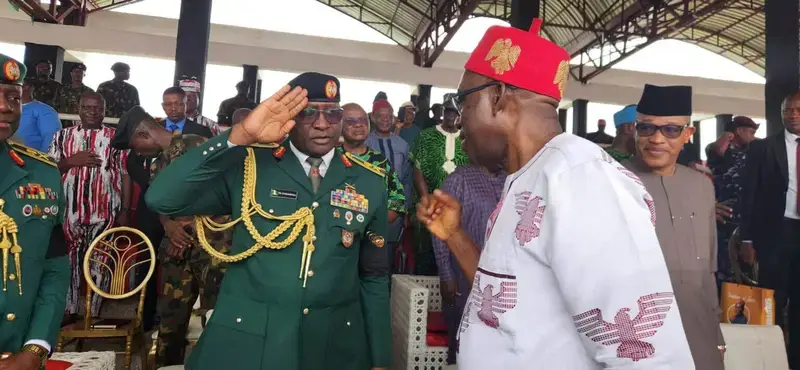
Anambra State Governor Chukwuma Soludo has said negative public perceptions of the military and other security agencies are discouraging young Nigerians from enlisting in the armed forces, warning that the country risks losing a generation of potential officers unless community leaders and elders step forward as role models. Soludo spoke on Friday at the memorial service for the late Lieutenant-General Chikadibia Obiakor (retd.) at Alex Ekwueme Square in Awka, where he described the late general as "Anambra's export to Nigeria and the world" and said his exemplary life should inspire younger generations to embrace military service and other forms of national service.
"The exemplary lives of officers such as Obiakor could inspire younger generations to embrace military service," Soludo said. He urged community leaders and elders to maintain close relationships with their people and to serve as examples for the young. "We must multitask and become the villager as a way of inspiring and motivating the younger ones," he said. He stressed that an individual's greatest achievement lay in the positive impact made on their immediate community. "The impact on the community is the most important impact; his people were able to testify that he was good," he said.
The governor's remarks come against a backdrop of persistently low enlistment from the South-East into the Nigerian Armed Forces, a trend that military leaders and political figures have described as a serious concern. In January 2026, at the Armed Forces Remembrance Day celebration in Awka, Soludo lamented that Anambra recorded one of the lowest turnouts in recent recruitment exercises into the Nigerian Army and Police Force. "Because our youths from the South East and particularly from Anambra, the last recruitment into the Army and even into the Police, Anambra and the South East are the lowest in the country," he said at the time. He urged youths in the region to stop clinging to the memory of the Nigerian Civil War and to participate fully in national affairs, warning that refusal to enlist would amount to self-marginalisation.
The figures bear out the concern. Out of about 38,000 recruitment slots nationwide, only 123 applicants were drawn from the South-East, according to data cited by the International Society for Civil Liberties and Rule of Law in April 2026. Imo State recorded only 671 applicants, while Ebonyi produced 428. Senator Emma Nwachukwu warned in October 2026 that continued reluctance by Igbo youths to enlist could leave the South-East with little or no military officers of Igbo extraction in the coming years. He said his interactions with young people revealed that fear of deployment to areas affected by Boko Haram insurgency was one of the reasons for their reluctance. The Chief of Army Staff, Lieutenant-General Waidi Shaibu, has repeatedly appealed to parents, guardians and traditional rulers in the South-East to encourage young men and women to enlist, saying the zone has continued to fall short of its recruitment quota. The Nigerian Army has intensified its enlistment campaign in the region, even establishing a depot in Ebonyi State where 2,989 soldiers graduated in July 2026, but the shortfall in applicants persists.
The reasons for the reluctance are complex and deeply rooted. The Nigerian Civil War, which ended in 1970, left a legacy of distrust between the South-East and federal institutions, particularly the military. Many Igbo communities remember the role of the military during the war and the years of marginalisation that followed. Contemporary experiences have reinforced that memory. The militarisation of the South-East in response to separatist agitation, including the activities of the Indigenous People of Biafra and the Eastern Security Network, has led to accusations of extrajudicial killings, arbitrary arrests and the profiling of young Igbo men. For many families, the military is not a career opportunity but a source of fear. The low enlistment is therefore not simply a matter of apathy; it reflects a calculated refusal to serve an institution that a significant portion of the population deeply mistrusts.
Soludo has consistently argued that this posture is counterproductive. In January 2026, he urged the Igbo to stop fighting a war that ended 56 years ago and to become co-owners of the Nigerian project. He said the absence of Igbo representation in the security architecture would leave the region without a voice in decisions that affect its security and future. His decision to use the memorial service for General Obiakor to return to the theme is significant. Obiakor was a highly decorated officer who served in international peacekeeping missions and rose to the rank of Lieutenant-General, and Soludo presented him as proof that the military can be a pathway to distinction, not marginalisation. The Chief of Defence Staff, General Olufemi Oluyede, who was represented by Major-General Tariweriye Gagariga, described Obiakor as a decorated veteran whose distinguished service brought honour and dignity to the Nigerian Armed Forces.
The political context of Soludo's remarks is significant. The 2027 general elections are less than four months away, with the presidential and National Assembly elections scheduled for January 16, and the governorship and state assembly elections for February 6. Security has emerged as a central issue in the campaign, and the question of who serves in the military, and who feels they belong to the national project, is inseparable from the broader debate about equity and inclusion in Nigeria. Soludo, who has endorsed President Bola Ahmed Tinubu for a second term, is using his platform to push a message of participation that aligns with his broader argument that the South-East must engage with the federal system rather than withdraw from it. Whether that message resonates with young people in Anambra and across the region remains to be seen. The coming months, as the elections approach and the security challenges continue, will test whether Soludo's call for role models and participation can overcome the distrust that has kept a generation of Igbo youths out of the armed forces.
📩 Stone Reporters News | 🌍 stonereportersnews.com
✉️ info@stonereportersnews.com | 📘 Facebook: Stone Reporters News | 🐦 X (Twitter): @StoneReportNew | 📸 Instagram: @stonereportersnews
Add comment
Comments