

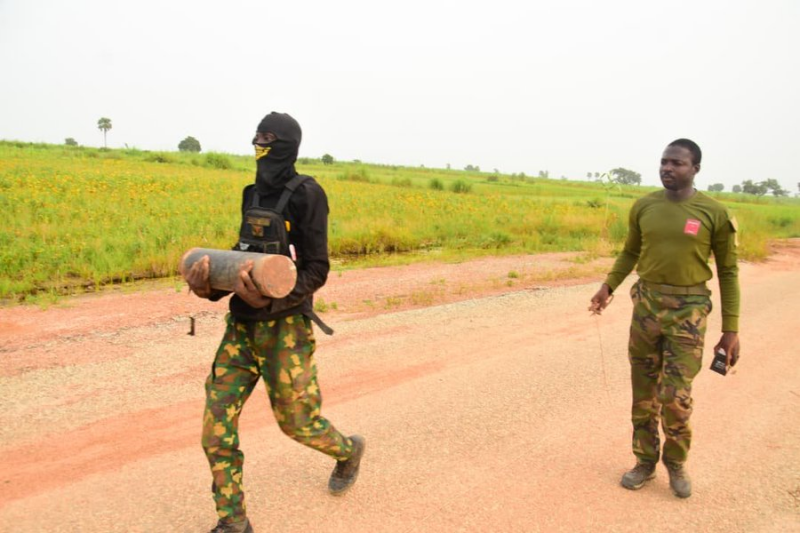
Troops of the Nigerian military have prevented a potentially deadly attack on motorists and other road users in Zamfara State after discovering and neutralising two explosive devices allegedly planted by terrorists along a major highway. The intervention, carried out under Operation FANSAN YAMMA, has renewed attention to the persistent danger facing travellers in northwestern Nigeria, where armed groups have increasingly employed explosives alongside kidnappings, ambushes and attacks on rural communities.
The development was reported on Friday, October 9, 2026, along the Magami–Hannutara–Dansadau road in Maru Local Government Area of Zamfara State. According to security analyst Zagazola Makama, troops attached to Sector 2 of Operation FANSAN YAMMA acted on credible intelligence indicating that suspected terrorists had planted explosive devices along the route. The soldiers secured the affected area, conducted searches and discovered two separate locations containing explosives believed to pose an immediate danger to commuters.
Following the discovery, an Explosive Ordnance Disposal team was deployed to examine and neutralise the devices. Security personnel successfully destroyed one explosive and recovered the second before rendering it harmless. The operation was completed without any reported casualties, although the precise number of motorists who might otherwise have encountered the devices could not be established.
The intervention demonstrates the importance of timely intelligence in preventing attacks before they occur. Rather than responding to an explosion after casualties had been recorded, the soldiers identified the threat, restricted access to the affected locations and allowed trained specialists to undertake the necessary disposal procedures.
Military personnel subsequently intensified patrols and surveillance along the highway to protect travellers and surrounding communities. The additional security measures are intended to identify further threats, discourage criminal activity and maintain access to a road that has experienced repeated security incidents.
Operation FANSAN YAMMA also appealed to residents and motorists to remain vigilant and promptly report suspicious objects, movements or activities to the nearest security agency. The appeal reflects the importance authorities place on cooperation between security personnel and communities in identifying potential threats.
The Magami–Dansadau corridor has previously experienced deadly attacks involving improvised explosive devices. On December 27, 2025, at least seven people were killed when an explosive detonated along the highway in Maru Local Government Area, according to reports confirmed by local authorities and security personnel.
That explosion occurred around communities along the Dansadau axis, where travellers and vehicles transporting agricultural produce were affected. Witnesses described severe consequences for motorists, while officials confirmed that an improvised explosive device had caused the blast.
Mustapha Jafaru Kaura, Senior Special Assistant to Zamfara State Governor Dauda Lawal on Broadcast Media and Public Affairs, attributed the December incident to explosives allegedly planted by fleeing armed bandits. The military's spokesperson at the time, Captain David Adewusi, also identified an explosive device as the cause rather than an aerial bombardment.
The earlier tragedy demonstrated the vulnerability of civilians travelling through areas where armed groups operate. Unlike attacks involving direct confrontation, explosives concealed along roads can endanger people who have no warning of an approaching threat.
Concerns about explosive attacks in Maru predate the December 2025 incident. In December 2024, residents reported that armed groups had begun planting explosives along routes used by security forces, vigilantes and civilians.
A resident, Bello Dansadau, described an incident involving an explosive planted near Yar Galadima village. According to his account, the device struck a commercial vehicle, killing its driver and destroying the vehicle. He expressed concern that the use of explosives represented a dangerous development in the methods employed by armed groups.
The military responded to related security threats through operations involving ground troops and aerial support. Lieutenant Colonel Abubakar Abdullahi, then associated with the Joint Media Coordination Centre of Operation FANSAN YAMMA, confirmed operations against armed groups around Yar Galadima in December 2024.
The latest discovery also follows other explosive-related security operations in Zamfara during 2026. On March 1, an Explosive Ordnance Disposal team neutralised a suspected improvised explosive device along the Dansadau axis after security personnel received information about its presence.
In August, troops recovered and safely disposed of another explosive device along the Gurusu–Gwashi road in Bukkuyum Local Government Area. The operation similarly followed intelligence received by Sector 2 personnel, who secured the location before specialists removed the danger.
On August 14, security personnel intercepted a suspected explosives courier during checks in Zamfara. Military authorities identified the suspect as 57-year-old Sani Umar and reported recovering 180 units of explosive materials allegedly being transported towards suspected terrorists operating in Katsina State.
Lieutenant Colonel Aliyu Danja, Media Information Officer of the Joint Task Force North West, disclosed details of that interception while explaining the military's continuing efforts to disrupt criminal supply networks.
Security operations have also focused on rescuing abducted civilians. On September 27, troops operating in Maru and Tsafe Local Government Areas rescued ten people during separate interventions against suspected kidnappers.
In Maru, soldiers responded to information that armed men had abducted villagers around Kade Daba in Kanoma District. The operation resulted in the rescue of four victims, while another intervention along the Tsafe–Funtua road accounted for six additional rescues.
These incidents demonstrate the range of threats confronting communities in Zamfara, including abductions, armed attacks and the placement of explosives along transport routes.
For residents of Maru and neighbouring communities, highway security is directly connected to everyday economic and social activities. Roads provide access to markets, farms, healthcare facilities and neighbouring settlements. Disruptions caused by violence can restrict movement and complicate the transportation of agricultural produce.
The discovery of explosives also highlights the risks faced by commercial drivers and passengers travelling through unfamiliar locations. A device concealed along a road may threaten several vehicles before security personnel identify its presence.
However, authorities have not disclosed the identities of those responsible for planting the two recently discovered devices. No arrests were announced in connection with the latest incident, and the precise time when the explosives were placed along the highway remains unconfirmed.
There has also been no independently verified information establishing the intended timing of an attack or identifying particular vehicles as targets. The available evidence supports the conclusion that the devices posed a serious danger, without establishing the attackers' complete operational plans.
Governor Dauda Lawal's administration has repeatedly identified insecurity as a major challenge affecting Zamfara communities. The government has supported security interventions while calling for sustained efforts to restore stability and enable residents to conduct their activities without fear.
The successful disposal of the two explosives represents an important preventive operation, particularly given the highway's history of fatal incidents. It also illustrates the continuing need for intelligence gathering, specialist explosive disposal capabilities and effective coordination between military personnel and local communities.
Although the immediate danger was removed, security agencies continue to monitor the affected route. For travellers and residents, the operation offers reassurance that a potentially deadly threat was detected before it caused casualties, while underscoring the continuing importance of sustained protection across Zamfara's vulnerable transport corridors.
📩 Stone Reporters News | 🌍 stonereportersnews.com ✉️ info@stonereportersnews.com | 📘 Facebook: Stone Reporters News | 🐦 X (Twitter): @StoneReportNew | 📸 Instagram: @stonereportersnews
Add comment
Comments