

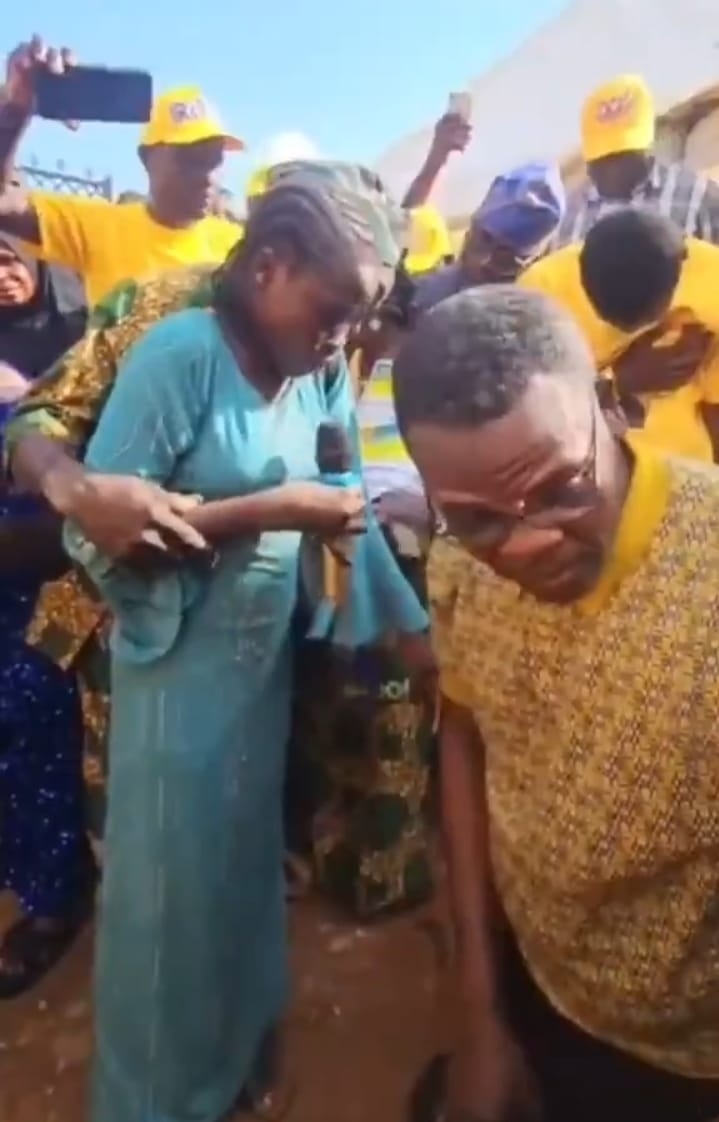
A reported encounter involving popular Ibadan broadcaster and Accord Party governorship hopeful Alhaji Oriyomi Hamzat kneeling to receive prayers from teenagers has attracted attention as preparations intensify for the 2027 governorship election in Oyo State. The development has brought renewed focus to the intersection of religion, public engagement and political ambition in Nigeria, where candidates frequently seek spiritual encouragement alongside the support of voters, community leaders and political organisations.
The reported incident concerns Hamzat, founder of Agidigbo 88.7 FM in Ibadan, who secured an Accord governorship nomination in May 2026. Although the account describes him kneeling before teenagers for prayers, the precise date, location, identities of those involved and circumstances of that particular encounter could not be independently verified. A separate, documented religious visit occurred in September 2026 at Baba Olowere's Church in Oke Agbara, where photographs showed Hamzat kneeling for prayers ahead of the election.
The September church appearance attracted considerable discussion because Hamzat, a Muslim, participated in a Christian religious gathering. Images circulated online showing him kneeling near the pulpit, prompting different interpretations of the gesture among social media users.
Some commentators welcomed the appearance as an example of engagement across religious boundaries, while others questioned the relationship between religious activities and political campaigns. Those reactions represented individual opinions rather than evidence establishing Hamzat's motives.
Hamzat's political ambition became public on January 17, 2026, when he announced his intention to contest the Oyo governorship election on the Accord platform during a gathering at the Liberty Stadium, also known as Obafemi Awolowo Stadium, in Ibadan.
The declaration marked a significant transition for the broadcaster, whose public profile had largely developed through radio broadcasting, social advocacy and philanthropic activities.
Addressing supporters at the event, Hamzat explained that entering partisan politics had not originally formed part of his career plans. He attributed his decision to what he described as a divine calling and encouragement from people who wanted him to seek public office.
He also acknowledged that his campaign would not enjoy the financial resources or political connections available to some established politicians, presenting his ambition as an opportunity to serve residents through a different form of leadership.
The broadcaster subsequently participated in Accord's governorship nomination process. On May 26, the party's National Deputy Secretary, Abdulraman Muhammed, announced Hamzat as its candidate after a primary election process involving three aspirants.
Muhammed explained that two aspirants had been screened out, leaving Hamzat as the successful contender. The broadcaster received a certificate of clearance and later thanked party members and supporters for their encouragement.
However, the nomination subsequently became the subject of an internal party dispute. Another Accord faction announced Olakunle Busari, popularly known as Gudugudu, as its preferred governorship candidate, creating competing claims over the party's legitimate nominee.
The faction associated with Professor Chris Imumolen rejected both nomination exercises. In a statement reported on September 28, 2026, factional National Secretary Abdullahi Muktar maintained that neither Hamzat nor Busari had emerged through a process recognised by his faction.
Muktar said the leadership disagreement was before the Federal High Court and called on the Independent National Electoral Commission to reflect the legally established position once the dispute was resolved.
The disagreement means Hamzat's political status must be considered alongside the continuing contest over Accord's leadership and nomination procedures. His emergence through one party process is documented, but rival claims have not disappeared.
Despite the dispute, Hamzat has continued engaging with residents and political stakeholders across Oyo State. His public activities have included consultations and messages addressing issues affecting teachers, young people and local communities.
The broadcaster's involvement in religious gatherings is therefore occurring within a broader programme of public engagement rather than representing the entirety of his political activities.
His campaign has also received public encouragement from political figures. During his January declaration, Adebukola Ajaja, a member of Governor Seyi Makinde's advisory council, expressed support for his ambition and described his entry into politics as an important development.
Ajaja said she had prayed about Hamzat's political involvement and welcomed his decision to seek the governorship. Her endorsement illustrated the support he had attracted from individuals beyond his immediate political organisation.
The governorship contest is particularly significant because incumbent Governor Seyi Makinde, elected on the Peoples Democratic Party platform, is completing his second term and cannot seek another consecutive term under Nigeria's constitutional provisions.
Consequently, the election will determine who succeeds Makinde and assumes responsibility for administering one of southwestern Nigeria's most populous states.
Issues including education, employment, healthcare, infrastructure, agricultural development and public accountability are expected to feature in discussions surrounding the election.
For residents, those subjects carry practical implications extending beyond campaign appearances. The next administration will inherit responsibility for public services, state finances and development programmes affecting communities across Oyo's 33 local government areas.
Hamzat's background as a broadcaster also distinguishes his political career from those of candidates whose experience has primarily involved elected office or government appointments.
Through Agidigbo FM, he developed a public identity associated with discussions of social problems and complaints from ordinary residents. His transition into politics creates an opportunity for voters to examine how his public advocacy translates into specific proposals for governance.
The reported prayer encounter also highlights the distinction between personal religious expression and electoral support. Religious participation may form part of a politician's public life, but it does not establish how participants or observers intend to vote.
In particular, the involvement of teenagers should not be interpreted as evidence of electoral endorsement. Nigeria's voting age is 18, meaning younger teenagers cannot participate as voters in the governorship election.
No independently verified statement from the teenagers involved in the reported encounter has established what they said, why the gathering took place or whether the prayers concerned Hamzat's electoral ambition specifically.
As the election approaches, Hamzat's campaign activities will continue to attract attention because of his established media profile and the ongoing disagreement within Accord.
For now, the confirmed record establishes his governorship declaration, his emergence through an Accord nomination process and his documented participation in religious gatherings. The specific claim that he knelt before teenagers seeking prayers for electoral victory remains unverified.
The wider political significance of the episode lies in how candidates engage different sections of society while presenting themselves for public office. Ultimately, the 2027 governorship contest will be determined through the electoral process, with voters assessing competing candidates, their programmes and their capacity to govern Oyo State.
📩 Stone Reporters News | 🌍 stonereportersnews.com ✉️ info@stonereportersnews.com | 📘 Facebook: Stone Reporters News | 🐦 X (Twitter): @StoneReportNew | 📸 Instagram: @stonereportersnews
Add comment
Comments