

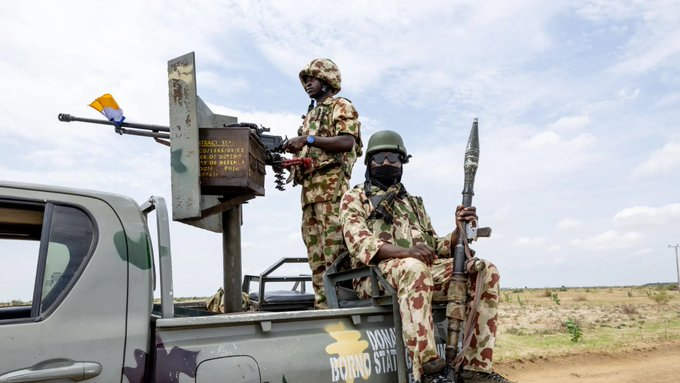
Eight Nigerian soldiers have been killed after their patrol vehicle struck a landmine allegedly planted by fighters of the Islamic State West Africa Province (ISWAP) near Nigeria's border with Cameroon in Borno State. The explosion killed all eight military personnel travelling in the vehicle, while a member of a local militia supporting counterinsurgency operations sustained injuries.
The incident occurred on Saturday, October 17, 2026, near Kinuba village, approximately 25 kilometres from Gamboru, a border town in Borno State. According to military and local security sources who spoke to Agence France-Presse (AFP) on Sunday, the soldiers were monitoring members of an anti-insurgency militia engaged in clearing thick vegetation along a highway when their patrol vehicle encountered the explosive device.
A military officer familiar with the incident confirmed that all eight soldiers aboard the vehicle died in the explosion. The officer attributed the attack to ISWAP, an armed group affiliated with the Islamic State that operates in parts of northeastern Nigeria, particularly around the Lake Chad region.
Ibrahim Liman, a member of the local militia assisting military operations against insurgents, also confirmed the reported death toll. He explained that the explosive device had been positioned along a dusty road and was allegedly detonated remotely as the military vehicle approached. Liman further disclosed that a militia member supervising the vegetation-clearing exercise sustained injuries from fragments released by the explosion.
The troops had reportedly been overseeing efforts to remove dense vegetation along the highway, where armed groups have been known to exploit roadside cover to conduct ambushes against security personnel and travellers. The exercise was intended to improve visibility along the route and reduce opportunities for insurgents to conceal themselves near areas used by military patrols and civilian vehicles.
The circumstances surrounding the explosion have raised further concerns about the threat posed by roadside explosive devices to military operations in Borno State. Unlike direct armed confrontations, concealed explosives can endanger personnel travelling through areas where insurgents operate, including during routine patrols and activities intended to improve road security.
Although security sources attributed the attack to ISWAP, no independently verified evidence identifying those who planted or detonated the device has been made public. The Nigerian Army had also not issued a detailed official statement confirming the circumstances of the explosion in the reports available at the time of publication.
The attack occurred on the same day that the Chief of Army Staff, Lieutenant General Waidi Shaibu, visited Maiduguri, the Borno State capital, following another deadly assault on a military formation earlier in the week. That separate incident reportedly claimed the lives of 15 soldiers and five members of an anti-insurgency militia, according to accounts cited by international news agencies.
During his visit, the Army chief met military personnel involved in counterinsurgency operations against Boko Haram and ISWAP. His presence in Borno came amid continuing attacks on security formations and patrols, highlighting the challenges confronting troops deployed to communities affected by the prolonged insurgency.
The latest explosion adds to concerns about the use of landmines and other improvised explosive devices along roads in northeastern Nigeria. Both ISWAP and Boko Haram have been linked to attacks involving roadside explosives, which pose dangers to military personnel, local security volunteers and civilians travelling through vulnerable areas.
The insurgency in northeastern Nigeria began in 2009 and has resulted in extensive loss of life, destruction of property and displacement. The violence has also affected communities across the Lake Chad Basin, including areas of Cameroon, Chad and Niger, where regional security cooperation has remained an important component of counterinsurgency efforts.
As of October 19, the identities of the eight soldiers killed in the Kinuba explosion had not been publicly disclosed in the available reports. There was also no confirmed information about arrests, the recovery of additional explosive devices or the outcome of any investigation into the incident.
The deaths represent another loss of military personnel during operations against armed insurgent groups in Borno State, while the reported injury to a local militia member underscores the risks faced by civilians assisting security forces.
📩 Stone Reporters News | 🌍 stonereportersnews.com
✉️ info@stonereportersnews.com | 📘 Facebook: Stone Reporters News | 🐦 X (Twitter): @StoneReportNew | 📸 Instagram: @stonereportersnews
Add comment
Comments