

Reported by: Oahimire Omone Precious | Edited by: Oravbiere Osayomore Promise.
ABUJA, Nigeria – The Chairman of the Independent National Electoral Commission, Professor Joash Amupitan, has told leaders of political parties that the Commission appealed two recent Federal High Court judgments on its 2027 election timetable because a coherent and harmonised electoral calendar is essential to the conduct of credible elections, and that allowing conflicting judicial pronouncements to stand could create chaos, uncertainty, and constitutional crisis.
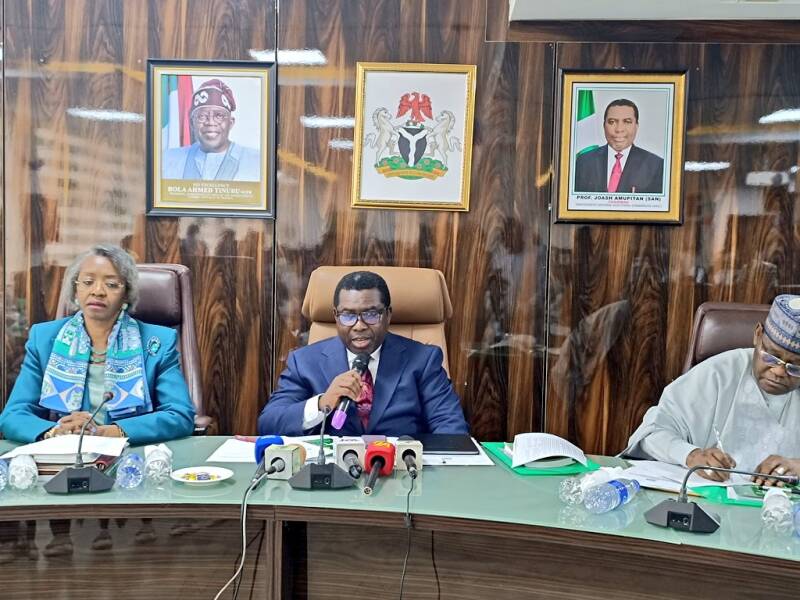
Prof. Amupitan made the disclosure on Tuesday, June 9, 2026, while delivering his opening remarks at the Second Quarterly Consultative Meeting with Leaders of Political Parties held at the Commission's headquarters in Abuja. The meeting was convened to brief party chieftains on preparations for the Ekiti State Governorship Election scheduled for June 20 and to address growing concerns over the legal battles surrounding the 2027 election timeline.
The INEC Chairman told party leaders that in Suit No. FHC/ABJ/CS/517/2026 — Youth Party v. INEC, delivered on May 20, 2026, the Federal High Court questioned certain timelines in the Commission's timetable. In a subsequent judgment in Suit No. FHC/ABJ/CS/720/2026 — Social Democratic Party (SDP) v. INEC, delivered on May 26, 2026, a separate court affirmed the Commission's authority to issue an electoral timetable but nullified certain timelines relating to the nomination and substitution of candidates. According to Prof. Amupitan, these rulings, if left unchallenged, would disrupt the seamless sequence of electoral activities that INEC is constitutionally mandated to coordinate.
“These judgments raise important legal questions concerning the extent of the Commission's constitutional and statutory powers in coordinating and regulating electoral activities,” Prof. Amupitan said. He explained that the activities contained in the timetable are not isolated events but interrelated operational processes essential to the orderly conduct of elections. He listed critical electoral activities for which the Electoral Act prescribes no express statutory timelines but which must nonetheless be accommodated within the overall electoral calendar. These include the submission and verification of party membership registers, the monitoring of party primaries across the Federation, the pre‑upload of primary results on the Commission's portal, the printing of ballot papers and result sheets, quality assurance procedures, the configuration of BVAS machines, and compliance with statutory obligations such as inviting political parties to inspect election materials pursuant to Section 42 of the Electoral Act 2026.
Prof. Amupitan argued that the absence of coordinated electoral timelines would create uncertainty and undermine the Commission's constitutional mandate. “The Commission therefore considers it imperative that all electoral activities be harmonised within a coherent and workable framework that promotes certainty, transparency, administrative efficiency and equal treatment of all political parties,” he said. He assured the public that notwithstanding the pending appeals, the Commission remained firmly committed to conducting the 2027 General Election in strict compliance with the Constitution and the Electoral Act.
Turning to preparations for the Ekiti State Governorship Election scheduled for Saturday, June 20, 2026, the Chairman said the Commission's Register of Voters for the election contained 1,059,360 registered voters, reflecting the addition of 66,664 new registrants from the Continuous Voter Registration (CVR) exercise to the 2023 base register of 987,647. He disclosed that 2,103 double registrations had been invalidated to protect the integrity of the register. Prof. Amupitan said logistics arrangements, technology deployment and the training of election officials were all proceeding according to schedule. He reaffirmed the Commission's commitment to the simultaneous opening of all 2,445 Polling Units across the 16 Local Government Areas of Ekiti State at 8:30 a.m. on Election Day.
The INEC Chairman’s remarks came at a time of heightened legal uncertainty following the two conflicting court rulings. The Commission had filed appeals against both decisions on May 25 and May 28, seeking an authoritative pronouncement from the Court of Appeal on the extent of INEC’s powers to set timelines. The Commission has argued that the Electoral Act 2026, which repealed the 2022 Act, did not strip INEC of its constitutional power to fix dates for elections and other activities incidental thereto.
In its notice of appeal filed in the Youth Party case, INEC argued that the trial judge erred by declaring that the Commission could not lawfully prescribe a shorter timeframe than that provided by the Electoral Act, even though the Act itself did not specify any particular number of days for the activities in question. In the SDP case, INEC appealed the portion of the judgment that nullified specific deadlines for candidate nomination and substitution, arguing that such timelines are administrative in nature and essential for the efficient conduct of elections.
While the appeals are pending, the Commission has continued preparations for the Ekiti election, where 16 political parties are fielding candidates. The election will be the first major electoral test since the enactment of the Electoral Act 2026 and the adoption of the new constitutional amendments. Observers will be watching closely to see whether the legal battles over the 2027 timetable will distract the Commission from its immediate task of delivering a free and fair election in Ekiti.
Political party leaders at the meeting expressed mixed reactions. Some supported INEC’s decision to seek clarity from the appellate courts, arguing that a fragmented electoral calendar would favour incumbents and disadvantage smaller parties. Others expressed concern that the litigation could delay preparations for the 2027 election, which is scheduled to begin with party primaries in April 2027.
The Commission has assured Nigerians that it will abide by whatever decisions the Court of Appeal and the Supreme Court ultimately reach. But for now, the INEC Chairman’s message to party leaders was clear: the Commission will not allow its constitutional mandate to be eroded piecemeal by lower court rulings that threaten to pull apart the intricate machinery of election administration. The timetable, he insisted, is not merely a schedule. It is the skeleton on which the entire democratic process hangs.
📩 Stone Reporters News | 🌍 stonereportersnews.com ✉️ info@stonereportersnews.com | 📘 Facebook: Stone Reporters News | 🐦 X (Twitter): @StoneReportNew | 📸 Instagram: @stonereportersnews
Add comment
Comments