

Reported by: Puis Althea | Edited by: Oravbiere Osayomore Promise.
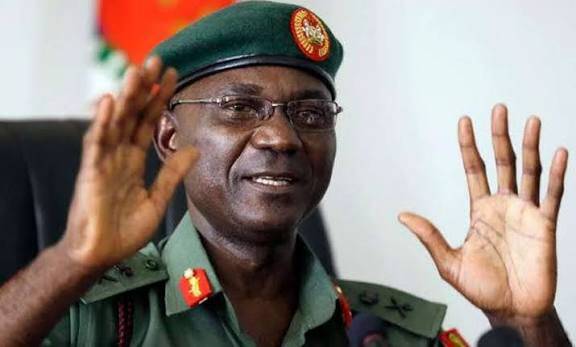
Retired Major General John Eneche, a former Director of Defence Information and renowned military strategist, has called for a significant upward review of soldiers' remuneration, declaring that no Nigerian soldier should earn less than ₦250,000 per month given the unique sacrifices, 24-hour service demands, and rising cost of living that define military life. Speaking in an interview on ARISE TV on Sunday, July 25, 2026, Eneche argued that the current minimum monthly salary of ₦100,000, which was recently increased from ₦49,000 by the Federal Government, remains inadequate and fails to reflect the economic realities facing troops and their families.
The retired general, who served as the military's chief spokesman under former President Goodluck Jonathan, justified his proposal by breaking down the daily costs that soldiers must bear even while in service. "Because if you prorate it against expectations, look at how much they spend on feeding. That is feeding alone. That is just a baseline for me," he said. He further argued that the proposed ₦250,000 figure is modest when transport fares in Abuja alone average between ₦1,000 and ₦2,000 per trip. "Even this ₦250,000 I'm talking about is modest," he stressed.
Eneche drew a sharp distinction between soldiers and other public servants, emphasising that military personnel make sacrifices that set them apart from civilian workers. "A soldier is somebody that has sacrificed all. You have bought his time. A soldier is not a mercenary. So how can he go and buy his gun? It's only a mercenary that will go and buy his gun and come and fight for you," he said. He noted that soldiers remain on duty round the clock and are required to respond whenever called upon, even after retirement. "No soldier is ever off-duty, even as I'm retired now. Chief of Defence Staff calls me now, 'General Eneche, sir, we want you to…' I would do it, even in retirement," he said.
The retired general also challenged arguments that soldiers already receive government-provided accommodation, uniforms, and equipment, noting that unlike some public servants, military personnel are not entitled to dedicated days for personal economic activities. "A soldier does not go to farm… where is the time to go to farm?" he asked. He further argued that the proposed salary adjustment should apply across the military hierarchy in line with the existing remuneration structure, covering soldiers, airmen, and ratings. "That is my recommendation, my suggestion," he affirmed when asked if he was proposing a minimum salary of ₦250,000.
Eneche's intervention comes amid ongoing debate over military welfare and follows a recent announcement by Defence Minister Christopher Musa that the Federal Government had increased the minimum monthly salary of Nigerian soldiers from ₦49,000 to ₦100,000. The minister, however, acknowledged that the military remained underfunded despite the salary review. The retired general's recommendation aligns with demands by groups of military veterans who have urged the Federal Government to implement what they describe as an earlier-approved higher pay structure, maintaining that a minimum of ₦250,000 for the lowest ranks was contemplated in legislative and executive processes and should be prioritised to boost morale and operational effectiveness.
Eneche's remarks have intensified discussions on military welfare as the government continues efforts to expand and modernise the armed forces. His argument that soldiers are not mercenaries and should not be expected to provide their own equipment resonates with broader concerns about the welfare and compensation of Nigeria's military personnel, who continue to face significant challenges in the fight against insurgency, banditry, and other security threats across the country. The statement is expected to fuel further debate on whether the government can meet the ₦250,000 benchmark and whether such an increase would be sufficient to address the deeper welfare concerns facing Nigeria's armed forces.
📩 Stone Reporters News | 🌍 stonereportersnews.com
✉️ info@stonereportersnews.com | 📘 Facebook: Stone Reporters News | 🐦 X (Twitter): @StoneReportNew | 📸 Instagram: @stonereportersnews
Add comment
Comments