

Reported by: Ijeoma G | Edited by: Oravbiere Osayomore Promise.
The University of Lagos has withdrawn a controversial sexual harassment advisory poster following widespread public criticism, with the institution issuing a firm statement rejecting all forms of victim-blaming and reaffirming its zero-tolerance stance on sexual misconduct. The poster, produced by the university's Student Affairs Division and displayed on a roll-up banner across campus premises, came under intense fire after it advised female students against actions such as shaking hands with men, accepting gifts from men, staying alone with a man in a secluded place, and watching pornographic content. Critics argued that the publication placed the burden of preventing sexual harassment on women rather than addressing the conduct of perpetrators.
The advisory, titled "Counselling Tips for Ladies to Avoid Sexual Harassment/Rape," contained several directives that many found troubling. Among the most criticised messages were "Do not dress to kill," "Do not shake hands anyhow with any man," "Do not mingle carelessly with men," and "Do not stay alone with a man in a hidden place". Other tips urged female students not to seek unnecessary favours from men, not to watch pornographic films or pictures, not to accept intoxicants, and to be vigilant when served with drinks. The banner also encouraged students to "learn to say no" and warned that "one-time sex can cause you pregnancy; if you don't want it, don't try it". The Student Affairs Division had said the advisory formed part of its counselling efforts to educate female students on personal safety and ways to reduce the risk of sexual harassment and rape on campus.
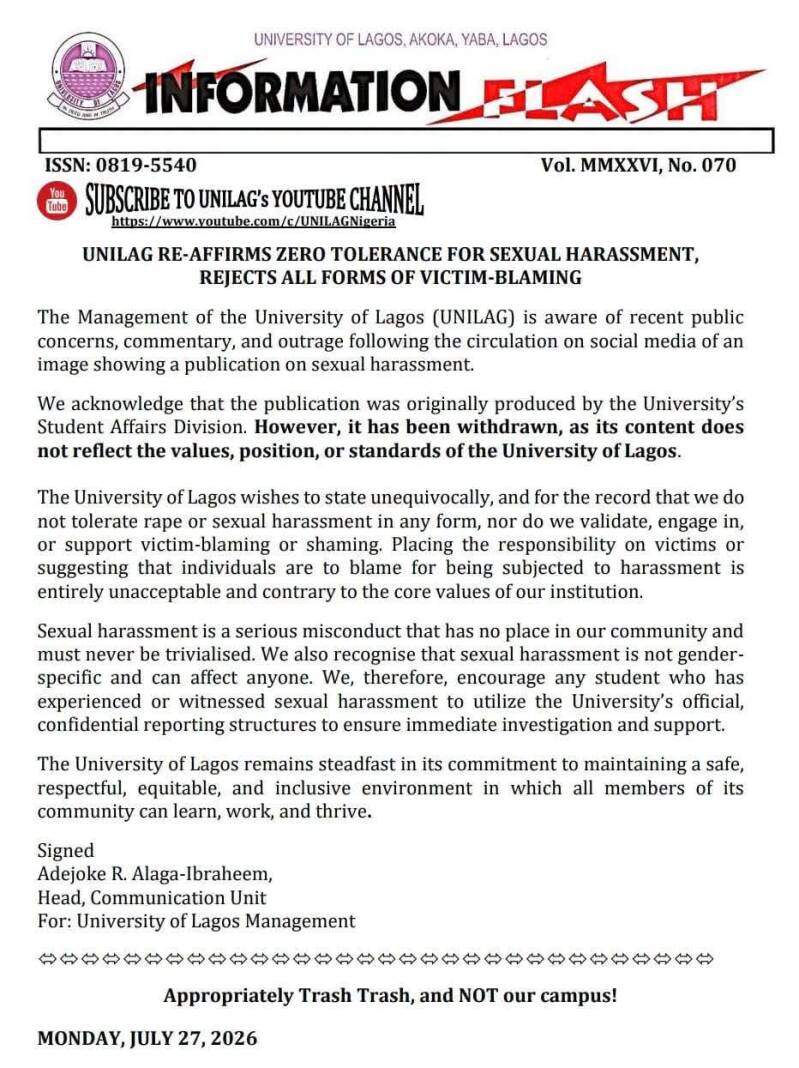
The publication triggered a wave of outrage on social media, with many questioning why the responsibility for preventing sexual harassment appeared to be placed on potential victims rather than perpetrators. In response to the growing backlash, the university's management issued a statement on Monday, July 27, 2026, acknowledging the public concerns and confirming that the publication had been withdrawn. The statement, signed by Adejoke R. Alaga-Ibraheem, Head of the University's Communication Unit, on behalf of the management, explained that although the advisory originated from the Student Affairs Division, it no longer represented the university's position. "We acknowledge that the publication was originally produced by the University's Student Affairs Division. However, it has been withdrawn, as its content does not reflect the values, position, or standards of the University of Lagos," the statement read.
Reaffirming its stance on sexual misconduct, the university issued a strong condemnation of victim-blaming. "The University of Lagos wishes to state unequivocally, and for the record, that we do not tolerate rape or sexual harassment in any form, nor do we validate, engage in, or support victim-blaming or shaming," the statement declared. The institution stressed that placing the responsibility on victims or suggesting that individuals are to blame for being subjected to harassment was "entirely unacceptable and contrary to the core values of our institution". UNILAG described sexual harassment as a serious form of misconduct that has no place within the institution and emphasised that it affects people of all genders. "Sexual harassment is a serious misconduct that has no place in our community and must never be trivialised. We also recognise that sexual harassment is not gender-specific and can affect anyone," the statement added.
Beyond withdrawing the poster, the university encouraged students who have experienced or witnessed sexual harassment to utilise its official and confidential reporting channels to ensure prompt investigation and support. The institution also reiterated its commitment to fostering a safe, respectful, and inclusive learning environment for all members of the university community. "The University of Lagos remains steadfast in its commitment to maintaining a safe, respectful, equitable, and inclusive environment in which all members of its community can learn, work, and thrive," the statement concluded.
The controversy comes in the wake of recurring allegations of sexual assault and misconduct within the institution. Earlier in April 2026, a 20-year-old undergraduate testified before an Ikeja High Court, accusing a university lecturer, Dr Samuel Ojogbo, of raping her in his underground office on August 22, 2025. During proceedings led by State Counsel Owolabi Azeez, the student testified that the alleged assault occurred after the lecturer requested to see her following an academic examination. The university has previously faced public scrutiny over similar issues; in 2019, the Lagos State Government prosecuted five UNILAG undergraduates over the alleged gang rape of a 17-year-old female student.
The swift withdrawal of the advisory and the university's unequivocal rejection of victim-blaming represent a significant reversal following the public outcry. While the institution maintains that the original advisory was intended to foster personal vigilance, critics had argued that placing the onus of prevention on female students risked deflecting accountability from perpetrators of sexual violence on campus. The university's management has now made clear that such messaging does not align with its values, and that responsibility for sexual harassment must rest squarely with perpetrators, not victims. As the institution moves forward, it has pledged to strengthen its support structures for survivors and ensure that all members of its community can learn and work in an environment free from harassment and fear.
📩 Stone Reporters News | 🌍 stonereportersnews.com
✉️ info@stonereportersnews.com | 📘 Facebook: Stone Reporters News | 🐦 X (Twitter): @StoneReportNew | 📸 Instagram: @stonereportersnews
Add comment
Comments