

Reported by: Ijeoma G | Edited by: Oravbiere Osayomore Promise.
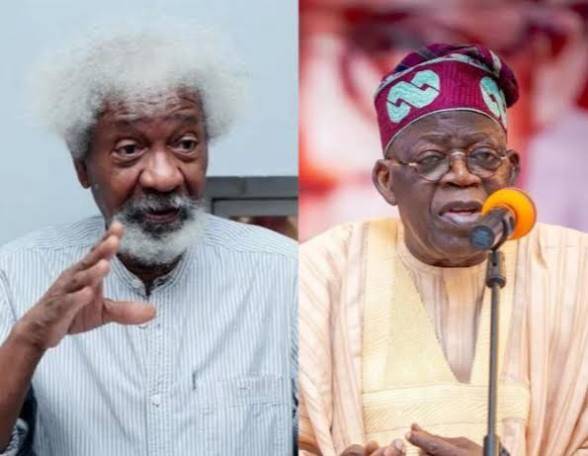
Nobel Laureate Professor Wole Soyinka has issued a stirring challenge to President Bola Ahmed Tinubu, demanding that he fulfil his 2023 campaign promise to reopen files on unresolved assassinations and extrajudicial killings across the country, warning that Nigeria risks institutionalising a culture of impunity if perpetrators continue to evade justice. Soyinka made the call on Friday, July 31, 2026, during the 28th Wole Soyinka Lecture Series organised by the National Association of Seadogs (Pyrates Confraternity) in Port Harcourt, Rivers State, under the theme "Reclaiming the Nigerian State through Accountability, Justice and Civic Courage".
Addressing a gathering that included former Managing Director of the Niger Delta Development Commission, Chief Timi Alaibe, who chaired the session, and former Minister of Aviation, Chief Osita Chidoka, who delivered the keynote address, Soyinka dedicated the lecture to victims of avoidable killings and state excesses. He declared that the nation's greatest failure was not only the murders themselves but the collective silence that allows perpetrators to walk free. "Through these remarks, I pay honour to those who have lost their lives because of the deficiencies of the state which have led to the devaluation of human life," Soyinka said.
The literary icon specifically called for justice for victims of unresolved killings, including Deborah Samuel, a student of Shehu Shagari College of Education in Sokoto State who was lynched and burnt alive by her classmates in 2022 after being accused of blasphemy, and Mene Ogidi, a 28-year-old man allegedly shot dead by a policeman in Delta State. Soyinka recalled that President Tinubu, upon assuming office, had requested all files relating to unsolved assassinations and extrajudicial killings. "When there was a government retreat, you remember? The incoming president said, 'I want all the files of all the unsolved assassinations, killings, extra-judicial killings.' What has happened to those files?" Soyinka asked. He urged Nigerians to join him in demanding that the President "dig up those files. We want to know what happened, why it happened, who is of value as a human being, and who is there for casual disposition".
Soyinka condemned what he described as selective justice, pointing to the stark contrast between the swift arrest of the policeman accused of killing Mene Ogidi and the lack of progress in the case of Deborah Samuel's killers. He expressed particular outrage that one of Deborah's classmates had publicly displayed the matchstick used to set her ablaze without facing justice years after the incident. "The crime is the silence of the rest of us, that such a thing is possible, and that the killers of that girl can actually go on television, hold up a match, and say this is the match with which I set her on fire," he said. "And there the system of justice fails us completely."
The Nobel Laureate also lampooned the judiciary for failing to stand for the truth and for Nigerians in the face of clear injustice, insisting that perpetrators of crimes anywhere in the country must be identified and punished according to the law. He argued that every unresolved case sends a signal that some lives are expendable, thereby encouraging further acts of violence. "The human being is the basic unit of every community and every system of governance," he stressed, adding that the protection of life must remain the primary responsibility of the state.
Soyinka dedicated the session to victims of some of Nigeria's most disturbing cases of violence, including the 18 Ughelli residents allegedly killed by state agencies, a young man reportedly shot dead by a policeman in broad daylight, the six traders killed by police in Apo, Abuja, in 2025, and residents of Ogoni. He maintained that the country's justice system had repeatedly failed victims and their families by allowing perpetrators to evade accountability. Soyinka also dismissed critics who accused him of provoking religious tensions whenever he speaks against injustice, insisting that defending human life transcends religious, ethnic, or political divides.
In his keynote address, former Minister of Aviation Chief Osita Chidoka argued that justice begins long before cases get to court, noting that it starts with how complaints are handled by security agencies. Chidoka revealed that 64 per cent of inmates in custodial centres, including more than 50,000 Nigerians, are awaiting trial and have not been convicted of any crime. "Each of these 50,000 is a life in suspension, a job lost, a family destabilised," he said. "When the state causes that delay, and the citizens pay for it in lost liberty. The delay is not inefficiency. It is a form of violence carried out by the state itself."
The chairman of the occasion, Chief Timi Alaibe, urged Nigerians to match civic courage with accountability, insisting that institutions must be stronger than individuals. Soyinka's challenge to President Tinubu comes as the country prepares for the 2027 general elections, with the Nobel Laureate framing the demand for justice as a moral imperative that transcends partisan politics. "Watch with me so that we can force the government to bring up all the files," he declared. "That is the essence that I understand from this lecture. That is why I took the trouble, as a Seadog. This was a duty, and this is a message to the nation, to you as citizens, as human beings, to put an end to this casual butchery, no matter what the causes are."
As the nation reflects on Soyinka's impassioned call, the question remains whether the Tinubu administration will act on the request to reopen investigations into the unresolved killings that have haunted Nigeria's conscience for decades. For Soyinka, the answer is clear: silence in the face of brutality is itself a form of complicity, and the time for justice is now.
📩 Stone Reporters News | 🌍 stonereportersnews.com
✉️ info@stonereportersnews.com | 📘 Facebook: Stone Reporters News | 🐦 X (Twitter): @StoneReportNew | 📸 Instagram: @stonereportersnews
Add comment
Comments