

Reported by: Ijeoma G | Edited by: Oravbiere Osayomore Promise.
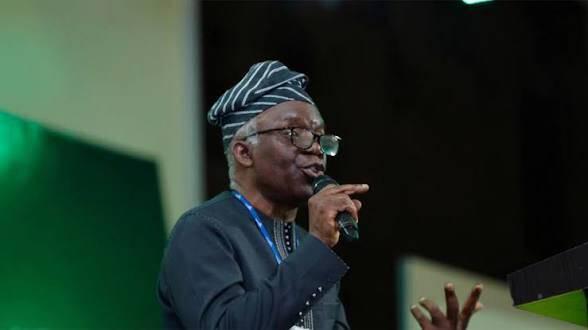
Human rights lawyer and Senior Advocate of Nigeria, Femi Falana, has called on the Federal Government to impose sweeping economic sanctions on South African companies operating in Nigeria, including telecommunications giant MTN, in response to the recurring xenophobic attacks on Nigerians and the destruction of their businesses in South Africa. Falana made the call on Saturday, August 2, 2026, while speaking with journalists at his country home in Ilawe-Ekiti after a thanksgiving Mass and reception held in honour of the late Alawe of Ilawe-Ekiti, Oba Adebanji Ajibade Alabi. The senior advocate argued that mere diplomatic protests would not compel the South African government to take decisive action against the attacks targeting Nigerians, and that Nigeria must adopt measures based on the principle of reciprocity in international relations.
Falana expressed scepticism about the Federal Government's plan to seek the intervention of the African Union over the attacks, noting that South Africa wields considerable influence within the continental body and that any complaint could end with the adoption of a resolution without concrete enforcement. He maintained that Nigeria has a responsibility to respond firmly if its citizens are being driven out of South Africa and their businesses destroyed. "International diplomacy is about reciprocity. If they chase out Nigerians and destroy their businesses, Nigeria has a duty to act. South African companies here should be sanctioned where there are alternatives," Falana said. He specifically urged Nigerians to patronise alternatives to South African-owned businesses, including MTN, saying such actions would send a strong message to the South African authorities. "Where there are alternatives, Nigerians should be encouraged to migrate from MTN because there are alternatives. That is one way South Africa will know that Nigeria is serious," he declared.
The senior lawyer also advocated the revocation of mining licences granted to South African companies operating in Nigeria, insisting that stronger economic measures would demonstrate Nigeria's commitment to protecting its citizens abroad. He drew a historical parallel to the 1970s, when Nigeria nationalised British Petroleum in response to apartheid in South Africa, arguing that it should be possible today to nationalise some South African investments in Nigeria if necessary. Falana further faulted the Nigerian government for failing to adequately protect its citizens from harassment and human rights violations across Africa, specifically pointing to Nigeria's refusal to recognise the jurisdiction of the African Court on Human and Peoples' Rights for individual petitions. He lamented that Nigeria has denied its citizens access to an important legal avenue by failing to deposit the necessary instruments to allow individual access to the court. "If Nigerians could approach the African Court in the same way citizens can approach the ECOWAS Court in Abuja, South Africa would have been dragged before the court by victims of xenophobic attacks," he said. "I challenge the government of Nigeria to allow citizens access to the African Court without any further delay. Victims of gross human rights violations in African countries should have the opportunity to seek justice before the continental court, just as they can at the ECOWAS Court."
Falana's call for economic retaliation comes amid heightened tensions between Nigeria and South Africa over the treatment of Nigerian nationals, following a wave of xenophobic violence that has forced the federal government to repatriate 1,490 Nigerians from South Africa this year alone. The attacks have also prompted the Federal Government to demand a transparent investigation into the death of Ibeh Chika Simon, a Nigerian who died during a South African police operation in Bellville, Cape Town, and to document the deaths of 98 Nigerians in South Africa since 2022. Nigeria has also insisted that South Africa ratify the Memorandum of Understanding on the Early Warning Mechanism signed in October 2025 to monitor threats of violence and protect citizens. President Bola Tinubu recently declined to personally receive a South African delegation sent by President Cyril Ramaphosa, directing them instead to meet with a junior minister, a diplomatic snub that underscored Nigeria's frustration. Falana's proposal to sanction South African companies and revoke mining licences adds a new dimension to the ongoing diplomatic standoff, and his call for Nigerians to boycott MTN and other South African-owned businesses has sparked debate about the effectiveness of economic measures in compelling the South African government to protect foreign nationals. Whether the federal government will act on Falana's recommendations remains to be seen, but his intervention has ensured that the question of reciprocity will remain at the forefront of public discourse as Nigeria-South Africa relations continue to sour.
📩 Stone Reporters News | 🌍 stonereportersnews.com
✉️ info@stonereportersnews.com | 📘 Facebook: Stone Reporters News | 🐦 X (Twitter): @StoneReportNew | 📸 Instagram: @stonereportersnews
Add comment
Comments