

Reported by: Oahimire Omone Precious | Edited by: Oravbiere Osayomore Promise.
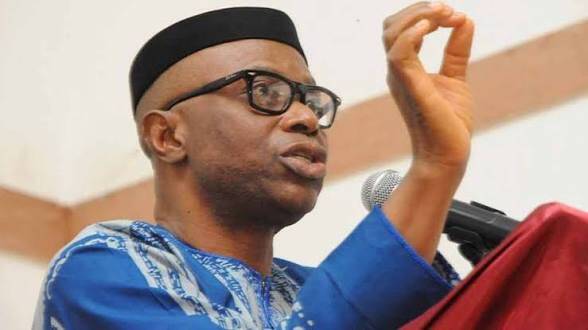
Former Ondo State Governor, Dr. Olusegun Mimiko, has issued a powerful call for the urgent adoption of what he described as the "Jethro Principle" as a structural solution to Nigeria's governance challenges, arguing that the excessive concentration of authority at the centre has fuelled inefficiency, insecurity, and administrative gridlock across the country. Mimiko made the appeal on Tuesday, August 4, 2026, while speaking on the topic "The Government and Politics Mountain" during the Pastors' Seed Event at the 74th Annual Convention of the Redeemed Christian Church of God (RCCG), which was themed "Mountain Movers." The former governor anchored his message on the biblical account in Exodus 18, where Moses' father-in-law, Jethro, advised him to delegate authority to capable leaders over thousands, hundreds, fifties and tens to prevent burnout and ensure effective administration.
Mimiko noted that Moses nearly suffered a breakdown while trying to govern millions from the centre alone, and he drew a direct parallel to Nigeria's current predicament. "The Jethro Principle teaches us that effective governance must be built on merit, capacity and capability. Power and responsibility must be pushed closer to the people so local issues can be handled locally, while only national matters rise to the centre. That is the template for true federalism," he declared. He stressed that Nigeria's diverse, multi-ethnic, multi-cultural, and multi-religious composition makes centralised governance not only inefficient but counterproductive. "The centre cannot and should not do everything. In a nation like Nigeria, centralized power breeds inefficiency, frustration and insecurity," he warned.
While acknowledging the ongoing efforts of the Tinubu administration to decentralise policing, resource management, and decision-making to sub-national governments, Mimiko insisted that broader structural reforms are needed to address systemic governance failures. He identified what he called the five major "mountains" hindering Nigeria's political development: ethnocentrism, corruption, insecurity, poverty, and poor leadership. According to him, these challenges are direct consequences of excessive centralisation. "Centralised government cannot effectively manage a multi-ethnic, multi-cultural and multi-religious nation like Nigeria. Leaders closest to the people must be empowered to solve problems closest to the people," he said.
The former governor also used the platform to challenge Christians and Nigerians of all faiths to actively participate in politics and governance, describing government as a critical sphere of influence that shapes national development. He urged believers to see public service as a calling rather than a retreat from faith. "We cannot pray for God to bless our nation on Sunday, and then abandon the seats of power on Monday. When responsible citizens avoid public service, less competent individuals take over," he warned. Citing biblical and historical examples of faith-driven leaders—including Joseph, Daniel, Nehemiah, William Wilberforce, and Desmond Tutu—Mimiko argued that faith should redeem power rather than retreat from it. He concluded by urging Nigerians to combine prayer with responsible civic engagement for national renewal, declaring that "the goal is not power for power's sake, but a nation where righteousness exalts the people."
📩 Stone Reporters News | 🌍 stonereportersnews.com
✉️ info@stonereportersnews.com | 📘 Facebook: Stone Reporters News | 🐦 X (Twitter): @StoneReportNew | 📸 Instagram: @stonereportersnews
Add comment
Comments