

Reported by: Oahimire Omone Precious | Edited by: Oravbiere Osayomore Promise.
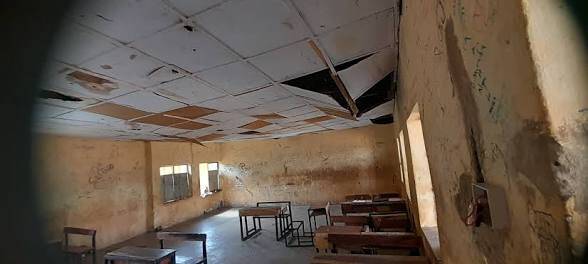
At least 65 primary and secondary schools across northern Nigeria have been shut down or rendered non‑functional by worsening insecurity, with the closures spanning 40 local government areas in Sokoto, Benue, Plateau, Borno, Kaduna and Kebbi states, while academic activities have also been disrupted in parts of Katsina, Adamawa and other northern states. The wave of shutdowns, triggered by terrorist and bandit attacks, abductions of pupils and teachers, mass displacement of communities and pervasive fear of further violence, has left thousands of children without regular access to classroom education. In some communities, schools have remained shut for prolonged periods; in others, authorities have merged affected schools with institutions in safer locations or relocated students to alternative centres.
Sokoto State has recorded one of the most extensive disruptions. Schools in 20 of the state’s 23 local government areas have been shut indefinitely following a directive from the Federal Government, according to the Commissioner for Basic and Secondary Education, Professor Ahmad Ladan Ala. Only Sokoto North, Sokoto South and Wamakko local government areas were exempted. The President of the All Nigerian Conference of Principals of Secondary Schools, Muhammad Ikililu, disclosed that boarding schools had been moved to the state capital during the administration of former Governor Aminu Tambuwal because of insecurity in the North‑West, and some of those schools remain closed to this day. Sunday Vanguard identified 14 affected schools in Sokoto, including Government Secondary School in Tureta, Government Girls Secondary School in Bodinga, Government Technical College in Goronyo, and Government Secondary School in Shagari, among others.
In Benue State, insecurity has forced the closure of numerous primary schools across Kwande, Gwer West, Guma and Logo local government areas. Repeated attacks and displacement have made several communities unsafe for teaching and learning, forcing families to flee to safer locations. A total of 35 affected schools were identified in Benue, including LGEA NKST Science Primary School in Anyiin, LGEA RCM Primary School in Anyiin, LGEA Primary School in Anyiin, LGEA RCM Primary School in Igbur, LGEA Primary School in Chembe, LGEA Primary School in Iorza, LGEA NKST Primary School in Abeda‑Shitile, and LGEA RCM Primary School, among others. Plateau State has also seen significant closures, with schools in Riyom and Barkin Ladi local government areas affected. In Borno State, institutions in Askira‑Uba have been shut, while isolated cases have been reported in Kaduna and Kebbi states.
The closures come despite more than a decade of government and donor‑backed interventions aimed at protecting schools from attacks, including the Safe Schools Initiative launched in 2014 after the abduction of 276 schoolgirls from Government Girls Secondary School in Chibok, Borno State. That initiative was established as a partnership involving the Federal Government, the United Nations and the private sector to protect schools in high‑risk communities and ensure that children could continue their education despite insecurity. According to the Global Business Coalition for Education, more than $30 million has been mobilised for the Safe Schools Initiative since its establishment. The Federal Government later introduced the National Plan on Financing Safe Schools for 2023 to 2026, with a projected investment of N144.86 billion, allocating N32.58 billion in 2023, N36.98 billion in 2024, N37.15 billion in 2025 and N38.03 billion in 2026. Yet, more than a decade after the Safe Schools Initiative was launched, attacks continue to drive children away from classrooms.
Education and security experts warn that prolonged disruptions are worsening Nigeria’s already severe out‑of‑school crisis, estimated at 18.3 million children, while increasing risks of child labour, early marriage, functional illiteracy, psychological trauma and potential recruitment into criminal or extremist groups. Analysts describe the targeting of schools as a tactic designed for maximum psychological impact, underscoring weak protection in vulnerable communities. They are calling for stronger early‑warning systems, alternative learning options such as radio lessons, and genuine implementation of school safety measures. Federal authorities have responded by restructuring the Safe Schools programme under a dedicated department in the Ministry of Education, coordinating with security agencies on a broader framework that includes fencing, lighting, personnel and technology. The Senate has also launched a probe into the initiative’s effectiveness.
Education specialists stress that every closed school represents a setback not only to individual futures but to national human capital and security, urging urgent action to reopen institutions and protect the next generation before an entire cohort is lost to the cycle of insecurity and lost opportunity. For the thousands of children now roaming the streets instead of sitting in classrooms, the promise of education has become a distant memory. And until the guns fall silent and the bandits are driven from their communities, that promise will remain brutally out of reach.
📩 Stone Reporters News | 🌍 stonereportersnews.com
✉️ info@stonereportersnews.com | 📘 Facebook: Stone Reporters News | 🐦 X (Twitter): @StoneReportNew | 📸 Instagram: @stonereportersnews
Add comment
Comments