

Reported by: Oahimire Omone Precious | Edited by: Oravbiere Osayomore Promise.
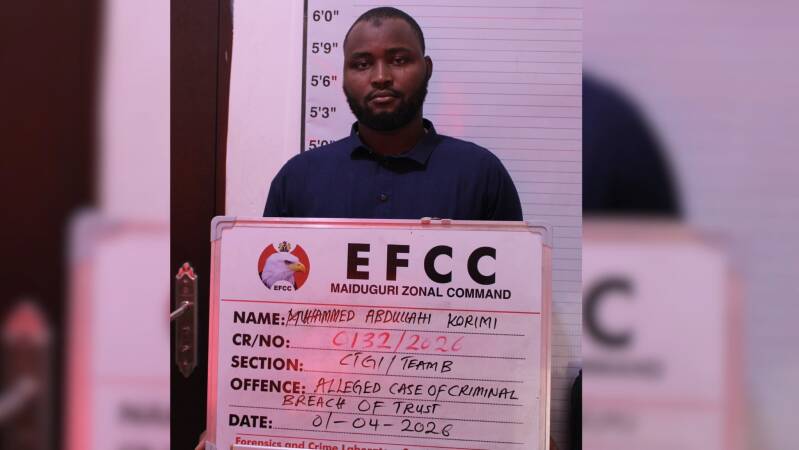
The Economic and Financial Crimes Commission has arraigned a Maiduguri-based businessman, Muhammad Korimi Abdullahi, before the Borno State High Court in Maiduguri over an alleged N186 million criminal breach of trust, marking the latest in a series of high-profile fraud cases being prosecuted by the anti-graft agency in Nigeria's troubled North-East region. Abdullahi was brought before Justice Maina Lawan on Tuesday, August 11, 2026, by the Maiduguri Zonal Directorate of the EFCC to answer a six-count charge bordering on criminal breach of trust, an offence that carries severe penalties under the Borno State Penal Code Law. The defendant pleaded not guilty to all charges, but the court ordered his remand at the Maiduguri Maximum Correctional Centre as the case was adjourned to September 7, 2026, for trial.
The charges against Abdullahi stem from allegations that he was entrusted with a total sum of N186 million for safekeeping but dishonestly diverted the funds for his personal use. According to the EFCC, one of the counts specifically alleged that on or about February 14, 2024, Abdullahi received N30 million via electronic transfer into his bank account and converted the money to his own use, thereby committing criminal breach of trust. The charge reads in part: "That you, Muhammad Korimi Abdullahi 'M' on or about the 14th day of February, 2024 at Maiduguri, Borno State, within the jurisdiction of this honourable court, having been entrusted with the sum of N30,000,000.00 only via electronic transfer to your bank account dishonestly converted same to your own use and thereby committed an offence to wit: criminal breach of trust contrary to section 299 of the Borno State Penal Code Law and other Matters Connected therewith Law, 2023 and punishable under Section 300 of the same Law." The prosecution alleges that the total amount involved in the alleged fraudulent transactions is N186 million, a sum that was purportedly transferred to Abdullahi for safekeeping but was instead diverted for personal benefit.
When the six counts were read and explained to him in court, Abdullahi pleaded not guilty to all charges, setting the stage for a full trial. Following his plea, the EFCC counsel, N.T. Iko, urged the court to grant a trial date and remand the defendant in a correctional facility pending the determination of the case. Justice Lawan granted the prosecution's request and ordered that Abdullahi be remanded at the Maiduguri Maximum Correctional Centre. The judge subsequently adjourned the matter to September 7, 2026, for further proceedings, effectively moving the case into the trial stage, where the prosecution will be required to establish its allegations against the defendant beyond reasonable doubt.
The EFCC's case against Abdullahi is part of a broader crackdown on financial crimes in Borno State, where the anti-graft agency has intensified its operations in recent months. The Maiduguri Zonal Directorate, which filed the charges, has been at the forefront of the commission's efforts to combat corruption and financial malfeasance in the North-East. The case also highlights the growing use of electronic banking channels in fraudulent schemes, as the prosecution's allegations centre on electronic transfers that were allegedly diverted for personal use. The EFCC has repeatedly warned the public about the dangers of misappropriating funds entrusted to individuals, stressing that such offences carry severe penalties under Nigerian law.
Abdullahi's legal team has not yet commented publicly on the case, but his not-guilty plea indicates that he intends to challenge the allegations in court. The trial, scheduled to begin on September 7, 2026, will be closely watched by legal observers and members of the public, as it will test the strength of the EFCC's evidence and the defendant's ability to mount a credible defence. The case also raises questions about the adequacy of safeguards for funds entrusted to individuals for safekeeping, and the extent to which financial institutions and regulatory bodies can protect against such breaches of trust. As the case moves to trial, the EFCC has reiterated its commitment to prosecuting financial crimes and ensuring that those who abuse positions of trust are held accountable.
The EFCC's Head of Media and Publicity, Dele Oyewale, confirmed the development in a statement on Tuesday, August 11, 2026, providing details of the arraignment and the charges against Abdullahi. The statement also emphasised the commission's determination to pursue justice in all cases of financial misconduct, regardless of the status or location of the accused. The case serves as a reminder that the EFCC is actively monitoring financial transactions and will not hesitate to prosecute individuals who engage in fraudulent activities, particularly where large sums of public or private funds are involved.
For Abdullahi, the road ahead is uncertain. If convicted, he faces a lengthy prison sentence under the Borno State Penal Code Law, which prescribes severe penalties for criminal breach of trust. The case also underscores the broader challenges facing Nigeria's financial system, where allegations of fraud and misappropriation continue to undermine public confidence and impede economic development. As the trial approaches, the people of Maiduguri and the wider Borno State will be watching closely to see whether justice is served and whether the EFCC can secure a conviction that sends a strong deterrent message to would-be fraudsters. For now, Abdullahi remains in custody, awaiting a trial that will determine his fate and, perhaps, set a precedent for future cases of financial misconduct in the region.
📩 Stone Reporters News | 🌍 stonereportersnews.com
✉️ info@stonereportersnews.com | 📘 Facebook: Stone Reporters News | 🐦 X (Twitter): @StoneReportNew | 📸 Instagram: @stonereportersnews
Add comment
Comments