

Published by Osasere Edomwonyi Ikpoba
After days of desperately searching shelters, hospitals, and overflowing morgues, hundreds of Nepali families gathered at temples and riverbanks on Tuesday to perform a final, heartbreaking act of love—symbolic funeral ceremonies for loved ones who have vanished in the catastrophic flash floods that devastated the Himalayan nation. With nearly 4,000 people still missing and hope fading with each passing hour, these rituals marked a painful acceptance that those swept away by the tsunami-like wall of freezing water and debris may never be found.
At Kathmandu's sacred Pashupati temple, perched on the banks of the Bagmati river, 12-year-old Rozel Shrestha set fire to a tiny effigy made of straw and barley, representing his missing father, 37-year-old Krishna Shrestha. The father was in the worst-hit Rasuwa district when the disaster struck on Wednesday, August 26, and has not been heard from since. "We searched everywhere, went to morgues across the country, but could not find his body," Krishna's brother, Jeevan Shrestha, told AFP. "So the family sat down and decided we have to do our traditional rituals to liberate his soul".
The family of Chandra Bahadur Newar, a 35-year-old truck driver who was in the border town of Timure en route to China when the floods hit, conducted a similar ceremony. His wife, Dolma Newar Tamang, recalled the last time she heard his voice—a routine call after dinner the night before the calamity. "He had said he would be back in not more than a week," she said. When she did not receive his customary morning call, she thought he must have been busy. "But then I saw the news and called him. I called repeatedly, but he never picked up". After multiple visits to hospitals and morgues in Kathmandu, Tamang finally made peace with the possibility that her husband might never return. "We had to do this to set his soul free, so that he is at peace and happy wherever he is," she said, flanked by her sobbing son.
The disaster was triggered by the collapse of a Himalayan glacier on the border with China, unleashing a catastrophic wall of freezing water, rocks, and debris that carved a trail of destruction through northern and central Nepal. Scientists have since pieced together satellite imagery and seismological data, concluding that a high-altitude landslide coinciding with a glacial collapse likely caused the flash flooding. So powerful was the force that the U.S. Geological Survey registered the landslide as a magnitude 5.2 seismic event. The Bhotekoshi River carried the floodwaters southward, sweeping away homes, vehicles, roads, bridges, and entire settlements while damaging critical hydropower projects. Nepal's Foreign Minister Shisir Khanal has described the catastrophe as a "warning signal" of the growing risks climate change poses to the Himalayan nation.
The scale of the tragedy is almost incomprehensible. As of Tuesday, the death toll in Nepal had crossed 1,050, while Chinese state media confirmed 16 fatalities in Tibet, bringing the total to 1,066. Nearly 4,000 people remain missing in Nepal, with some reports indicating the number could be as high as 4,500. More than 12,000 have been rescued. The missing include at least 592 foreign nationals from more than 30 countries, including tourists on Himalayan treks and Hindu pilgrims bound for Tibet's sacred Mount Kailash. Among the missing are also 93 workers associated with the Rasuwagadhi Hydropower Project, whose tunnel search has ended without locating them.
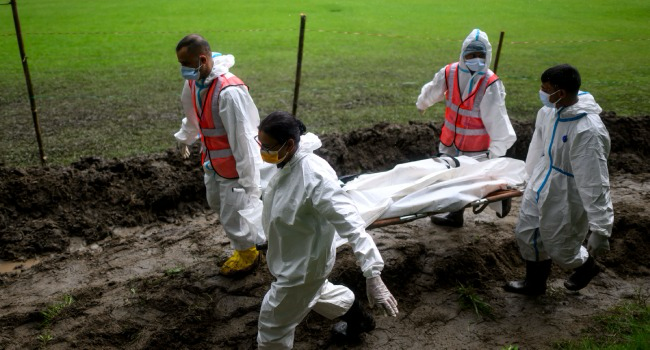
The recovery efforts have been overwhelmed by the sheer number of casualties. Only a handful of the more than 1,000 bodies recovered so far have been identified, stretching Nepal's already limited morgue capacity. With mortuaries overflowing and bodies decomposing rapidly in the floodwaters, authorities have been forced to begin temporary burials after collecting DNA samples, photographs, and other identifying details so families can later claim their loved ones for proper funeral rites. In Chitwan district, officials have already buried about 100 victims temporarily, while another 50 bodies were being processed for DNA sampling ahead of likely burial. The decision has sparked controversy in predominantly Hindu Nepal, where the dead are traditionally cremated on funeral pyres.
At a cremation site in Kathmandu, the family of Mahesh Dangol, 30, prepared to bid him farewell after delaying his funeral for several days. Dangol was one of the few people rescued from the almost wiped-out town of Betrawati, but he died of a lung infection in a hospital two days later. His family had held off the cremation hoping for news of his missing parents, wife, and daughter, who were all swept away when the floods came roaring down. But hospital authorities told them on Tuesday they could no longer keep his body due to space constraints. "It is unlikely anybody else will be found, so we have decided to go ahead with the rituals for the entire family," said his cousin, Sunil Dangol.
The devastation has left entire communities homeless, with families stringing up plastic sheeting for shelter in the ruins of their villages. Roads and dozens of bridges have been smashed, power plants destroyed, and rescue efforts hampered by heavy rain lashing the affected regions. Nepal's Prime Minister Balendra Shah has called the catastrophe "unimaginable and heartbreaking", while the government has warned that reconstruction costs could run into the billions of dollars. There is growing anger in Nepal, a nation of 30 million people that has contributed little to the greenhouse gas emissions driving global warming, yet now finds itself on the front lines of a climate-induced disaster.
For the families who gathered at temples on Tuesday, however, the larger political and environmental debates are distant echoes. Their grief is immediate, personal, and profound. In the face of an unimaginable loss and the agonising uncertainty of never knowing what happened to those they loved, they turned to ancient rituals to find a measure of peace. As Dolma Newar Tamang said, she needed to set her husband's soul free. In doing so, she and countless others have begun the long, painful journey of letting go—not because they have stopped hoping, but because they have found the strength to say goodbye.
📩 Stone Reporters News | 🌍 stonereportersnews.com
✉️ info@stonereportersnews.com | 📘 Facebook: Stone Reporters News | 🐦 X (Twitter): @StoneReportNew | 📸 Instagram: @stonereportersnews
Add comment
Comments