

Reported by: Oahimire Omone Precious | Edited by: Oravbiere Osayomore Promise.
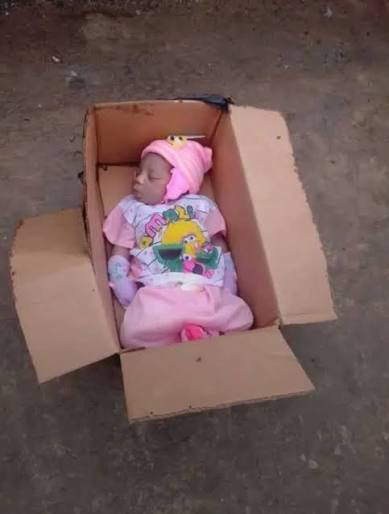
On a rainy Tuesday morning in Ikeja, sanitation workers made a grim discovery. Tucked inside a carton by a roadside drain was a newborn, still with the umbilical cord attached and wrapped in a thin cloth. Three days later, in Alimosho, a four-month-old baby was found abandoned outside a church gate. In Ikorodu, another infant was rescued from a refuse dump. These are not isolated incidents. They are the face of a growing child abandonment crisis that has turned Lagos, Nigeria's wealthiest state, into a battlefield for the survival of its most vulnerable citizens.
The Lagos State Government recorded 1,437 child protection cases and carried out more than 5,708 interventions across the state within the review period. The Commissioner for Youth and Social Development, Mobolaji Ogunlende, disclosed that the ministry's Child Protection Unit handled 1,437 reported cases involving abuse, trafficking, abandonment, neglect, and other welfare-related concerns. A total of 520 cases were successfully concluded through various disposition pathways. But behind these official figures are individual stories of children who, through no fault of their own, have been left without the protection and care they need at the very beginning of their lives. For every child rescued, officials and residents fear there may be others whose fate remains unknown.
The scale of the crisis is staggering. In the last year alone, no fewer than 497 abandoned babies were rescued from various streets in Lagos State. Eighty-two were released for adoption. These numbers represent real children—newborns discarded like refuse, infants left to die in the elements, toddlers abandoned over superstition. In March 2026, a newborn boy was reportedly found abandoned near the Ladoje Canal in Agege. Market women and residents who discovered the baby provided immediate assistance before handing him over to government authorities. In April, neighbours in Ipaja raised the alarm over a three-year-old girl who was allegedly abandoned in a malnourished and unhygienic condition after her mother accused her of witchcraft. The incident sparked outrage among residents, who described the child's condition as heartbreaking and called for stronger action against abandonment rooted in superstition.
The most disturbing cases have emerged from the city's illegal dumpsites. In August, operatives of the Lagos State Environmental Sanitation Corps, popularly known as KAI, rescued four nursing mothers and their babies, including a nine-day-old infant, from an illegal dumpsite in Agboju, along the Lagos-Badagry Expressway. The women and children were reportedly living in unhygienic conditions surrounded by refuse and other environmental hazards before receiving medical assistance and shelter. Then, on August 26, another vulnerable baby was rescued at the Alakija junkyard in Amuwo-Odofin Local Government Area during an operation to clear illegal structures. A video of the rescue showed enforcement officers and members of the public attending to the distressed baby, giving the child water and offering reassurance. The Corps Marshal of LAGESC, Major Olaniyi Cole (retd.), confirmed that the baby was taken to One Life Hospital by their office in Bolade, Oshodi.
These rescues reveal the depth of the crisis. Women are giving birth in dumpsites. Newborns are being left in cartons by drains. Children are being abandoned over accusations of witchcraft. The drivers of this crisis are well-documented: poverty, teenage pregnancy, stigma, family breakdown, and other social pressures. Professor Edamisan Temiye, a Professor of Paediatrics at the University of Lagos, identified poverty and displacement as the primary drivers. "When people are displaced, living in camps, hungry and unable to care for themselves, they cannot care for children," he said. "Remove people from poverty, and you will reduce child abandonment," he added.
The National Human Rights Commission recorded about 7,000 cases of child abandonment in 2024. Its 2025 report showed 1,054 cases, with high incidents recorded in the Northern region, as well as Lagos and Oyo States. Poverty, economic hardship, stigma, teenage pregnancy, disability, divorce, insecurity, and conflict have been identified as the primary drivers. Consultant Paediatrician Dr Ayodele Renner highlighted the absence of structured social welfare systems as a major gap, noting that many parents lack safe alternatives when they cannot care for their children. "Social safety nets are not optional," he said.
The Lagos State Government has ramped up its response. The Child Protection Unit provided more than 5,708 services, including rescue operations, investigations, counselling, rehabilitation, legal interventions, placement services, and psychosocial support. The government rescued a child with special needs who was allegedly being exploited online by a social media influencer. Two boys who had been locked indoors for more than two months by their father and stepmother without adequate feeding or access to education were rescued after a whistleblower alerted the ministry. A three-year-old child who was seen in a viral video drinking dirty water while living in severe neglect was traced, rescued, and placed in an approved orphanage.
But experts warn that rescue alone is not enough. They advocate public education, women's empowerment, stronger enforcement of child protection laws, government-funded child support schemes, improved access to contraception, and policies that hold absent fathers accountable. The Lagos State Commissioner for Youth and Social Development warned that the government would continue to pursue decisive legal action against parents, guardians, caregivers, and institutions found culpable in cases of child abuse, trafficking, exploitation, and neglect. The question remains: will it be enough to stop the crisis?
For now, the babies keep coming. They come from dumpsites, from church gates, from roadside drains. They come wrapped in thin cloth, umbilical cords still attached, left to die by those who could not keep them. The state rescues them, shelters them, and gives them a chance at life. But every rescue is a reminder of a failure—a failure of the state, of the community, of the systems meant to protect the most vulnerable. As one official put it, "Behind every statistic lies a child's story". And too many of those stories are beginning in the rubble.
📩 Stone Reporters News | 🌍 stonereportersnews.com
✉️ info@stonereportersnews.com | 📘 Facebook: Stone Reporters News | 🐦 X (Twitter): @StoneReportNew | 📸 Instagram: @stonereportersnews
Add comment
Comments