

Reported by: Oahimire Omone Precious | Edited by: Oravbiere Osayomore Promise.
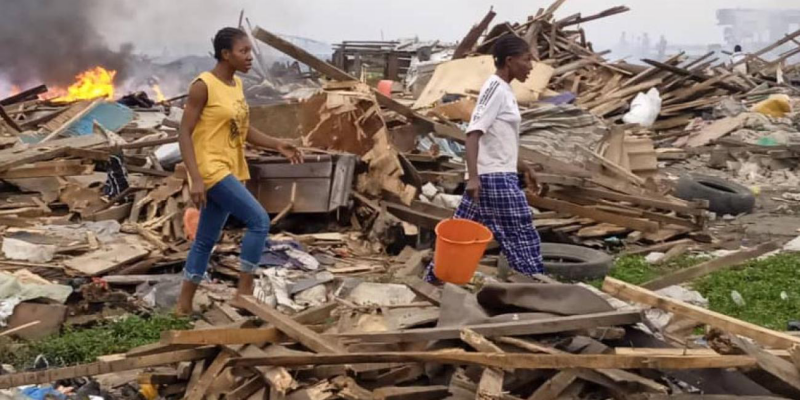
On a September night in 2025, the low rumble of heavy machinery broke the silence of Oworonshoki. Within hours, bulldozers were tearing through homes, shops and schools as heavily armed security operatives looked on. Panic spread through the narrow streets as residents scrambled to rescue whatever they could carry. Some fled with mattresses balanced on their heads, others ran clutching babies in one arm and bundles of clothing in the other. Many escaped with nothing at all.
This was not the first time the bulldozers had come. In July 2023, the Lagos State Task Force demolished about 250 houses in Oke Eri, Odun-Ifa and Precious Seed communities, displacing more than 12,000 people in a single day. Six communities – Oke-Eri, Oluwaseyi, Cornerstone, Ogo-Oluwa and others – were affected. An estimated 7,000 buildings were reduced to debris.
Three years later, the destruction remains visible across Oworonshoki. But while the broken walls and shattered concrete are impossible to ignore, another kind of devastation lies hidden beneath the rubble: the collapse of livelihoods, the interruption of childhoods, and the quiet despair of hundreds of people abandoned in the ruins of the only home they had ever known.
The tiled floor where Joke Olowu once welcomed visitors into her home now serves as a bed for her and her five children. Her two houses are gone, her children have turned to scavenging for survival, while school has become a distant memory. Across Oworonshoki, hers is just one of hundreds of stories emerging from a demolition that residents say robbed them not only of their homes, but also of their dignity and future.
The demolitions have continued in waves. After the initial July 2023 exercise, the Lagos State Government carried out more mass forced evictions between September 2025 and January 2026. In December 2025, bulldozers tore down Precious Seeds, a waterfront settlement in Oworonshoki. In October 2025, demolition squads, accompanied by heavily armed security personnel, razed hundreds of homes in the middle of the night. Some who resisted were beaten and detained. A court injunction obtained by human rights lawyer Femi Falana (SAN) stopping demolitions in Oworonshoki was reportedly ignored. The government denied any wrongdoing and insisted that due process was followed, with the Permanent Secretary for Urban and Regional Planning, Gbolahan Oki, stating that landlords had ignored notices and amnesty opportunities to regularise their buildings.
Residents told a different story. Daniel Ayomikun, a youth leader in the community, recalled the night demolitions that began at Ojileri axis, towards the Third Mainland Bridge, at about 11:30 p.m. "They started evicting people, gave them five minutes to pack out their belongings," he said. He alleged that the task force came with thugs and hooligans who would sell people's valuables and home appliances. Entire lives were reduced to debris before their eyes, with families separated in the confusion, children crying, and the elderly struggling to move.
The humanitarian toll has been severe. Civil society organisations have highlighted hunger, disease and the collapse of basic services. Many residents were rendered homeless overnight, with families forced to sleep in canoes, under bridges and in open spaces. In one case, a 36-year-old man blamed the demolition of his apartment for the death of his pregnant wife. The Lagos State government argued the demolitions were necessary to clear distressed buildings blocking drainage channels and posing security threats.
But for the displaced residents, the government's justification rings hollow. They have protested at the Lagos State House of Assembly, demanded compensation, and pointed fingers at traditional rulers they accused of being behind the illegal demolition of properties. The council chairman denied any involvement and presented a letter he had sent to Governor Babajide Sanwo-Olu on August 3, 2023, highlighting the ongoing demolitions and calling for urgent government intervention.
In October 2025, the government began disbursing compensation to some verified residents. But victims say the payments have been sporadic, inadequate and have not reached everyone. Three years on, the displaced residents of Oworonshoki are still waiting – for justice, for shelter, for the government to acknowledge that their lives mattered.
📩 Stone Reporters News | 🌍 stonereportersnews.com
✉️ info@stonereportersnews.com | 📘 Facebook: Stone Reporters News | 🐦 X (Twitter): @StoneReportNew | 📸 Instagram: @stonereportersnews
Add comment
Comments