

Published by Osasere Edomwonyi Ikpoba
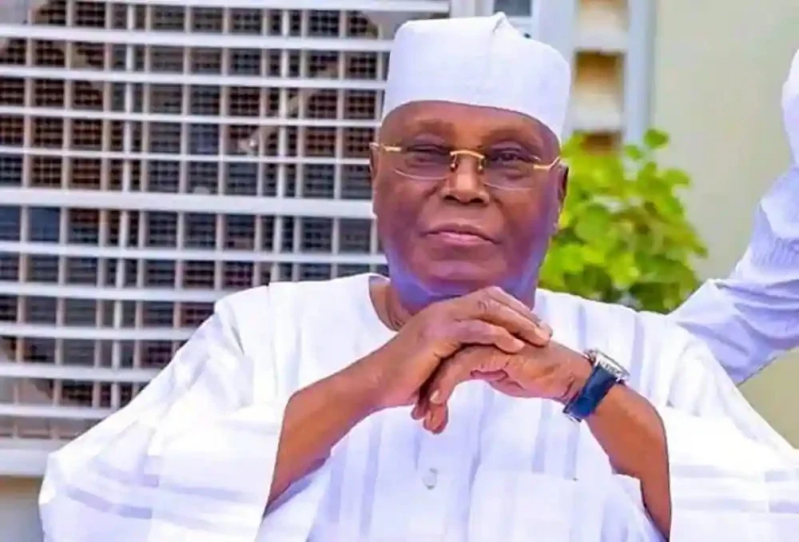
Former Vice President and 2027 presidential candidate Atiku Abubakar has mounted a spirited defence of his educational legacy, insisting that the American University of Nigeria (AUN) was established not for personal profit but as a strategic investment in the development of the North-East. Atiku’s intervention came in response to a social media critic who questioned his contribution to addressing the Almajiri crisis and the scourge of out-of-school children during his eight-year tenure as Vice President.
The exchange, which played out on X on Friday, September 4, 2026, began when a user, @Oluwabunmi63697, posted a photograph of children carrying begging bowls and challenged the former Vice President directly. “Have you ever addressed this, sir? You were VP for 8 years, these innocent children are in your region and you couldn’t do anything to stop this calamity,” the user wrote.
Atiku, who is the presidential candidate of the African Democratic Congress (ADC) for the 2027 general elections, responded with a characteristically measured but pointed reply. “I understand your concern. The sight of children begging on our streets should trouble every Nigerian,” he wrote, before pivoting to the American University of Nigeria, the institution he founded in Yola, Adamawa State, in 2005.
The former Vice President argued that if profit had been his primary motivation, he would have sited the university in commercially advantaged cities such as Lagos or Abuja. “I established the American University of Nigeria as a practical investment in education and the development of the North. If profit had been my primary motivation, I could easily have located the university in Abuja or Lagos, where the commercial advantages would have been greater,” Atiku stated. “I chose Yola because I wanted to invest in my people, create opportunities, and bring world-class education closer to a region that had long needed greater access and development,” he added.
Beyond the location of the university, Atiku addressed the contentious issue of ownership. The former Vice President disclosed that he had already signed a deed of gift formally transferring the university to the community, insisting that it was no longer his personal or family property. “And as I have publicly stated before, this university is not my personal property or that of my family. I have already signed a deed of gift transferring it to the community. AUN belongs to the community it was established to serve,” he declared.
The statement, however, has been met with scepticism in some quarters. Critics have pointed out that the deed of gift has not been made public, and questions remain about the precise nature of the transfer and the governance structure that would make the institution genuinely community-owned. Supporters, however, have hailed the move as a rare act of philanthropy by a Nigerian politician, noting that few public figures have taken such a step with an asset of that magnitude.
Atiku also used the opportunity to highlight AUN’s social impact programmes, which he said were designed to reach the most vulnerable children in the region. He cited the Feed and Read programme, which provides daily meals to Almajiri children while teaching them literacy and numeracy. He also pointed to the Technology-Enhanced Learning for All initiative, which has helped more than 20,000 internally displaced children learn to read through educational radio programmes.
The former Vice President further recalled AUN’s intervention following the 2014 Chibok schoolgirls’ abduction, noting that the university awarded scholarships to young women who escaped Boko Haram. “Following the Chibok tragedy in 2014, seven years after I left office, AUN awarded scholarships to young women who had escaped Boko Haram, giving them an opportunity to rebuild their lives through education,” he said.
Atiku’s robust defence of his record comes at a critical juncture in Nigeria’s political calendar. With the 2027 presidential election on the horizon, the former Vice President is seeking to position himself as a credible alternative to the ruling All Progressives Congress (APC). His emphasis on education and regional development is clearly aimed at shoring up support in the North, a region that has historically been his political base.
Yet the exchange also exposed the enduring contradictions in Nigeria’s political discourse. While Atiku pointed to AUN as evidence of his commitment to the North, his critics argued that a single university, however well-intentioned, could not address the systemic failures that have left millions of children out of school. The Almajiri system, which has been criticised for perpetuating poverty and illiteracy, remains a deeply entrenched challenge that successive governments have struggled to tackle.
Atiku, however, was unyielding in his conviction. “My conviction remains simple: every child belongs in a classroom, not on the street with a begging bowl. Whether in government or outside it, I have always sought to turn that conviction into practical action,” he said.
The American University of Nigeria, which celebrated its 20th anniversary in 2025, has carved a niche for itself as a development-focused institution in the North-East. Its American-style liberal arts curriculum and emphasis on community service have distinguished it from many conventional Nigerian universities. However, its impact on the broader educational landscape of the region remains a subject of debate.
The exchange on X has also drawn attention to the broader question of political accountability. The critic who challenged Atiku was not merely questioning his record on education but was implicitly asking a question that many Nigerians are asking of their leaders: what have you done for the ordinary citizen? Atiku’s response, while detailed and specific, may not satisfy those who believe that the scale of Nigeria’s educational crisis requires more than individual philanthropy.
As the 2027 elections draw closer, such exchanges are likely to become more frequent and more intense. Atiku, who has run for president on multiple occasions, is no stranger to scrutiny. His defence of AUN is unlikely to be the last word on his educational legacy. But for now, the former Vice President has made his position clear: AUN was built to serve, not to profit. Whether the Nigerian electorate accepts that narrative remains to be seen.
📩 Stone Reporters News | 🌍 stonereportersnews.com
✉️ info@stonereportersnews.com | 📘 Facebook: Stone Reporters News | 🐦 X (Twitter): @StoneReportNew | 📸 Instagram: @stonereportersnews
Add comment
Comments