

Reported by: Oahimire Omone Precious | Edited by: Oravbiere Osayomore Promise.
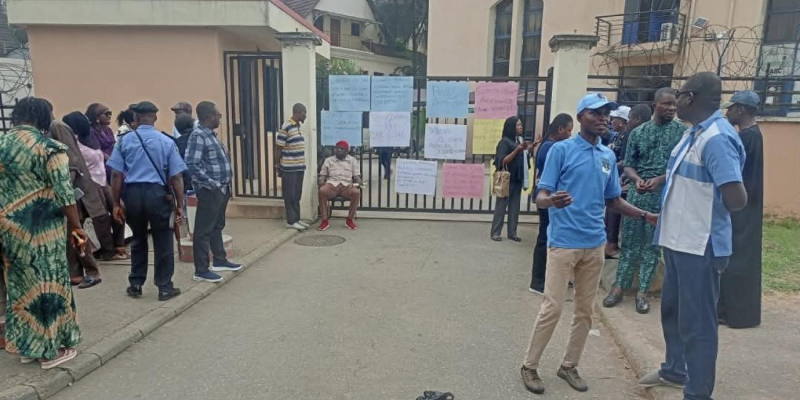
The main entrance to the National Assembly Service Commission in Abuja was blocked on Wednesday morning, September 10, 2026, as staff of the commission staged a protest over what they described as poor welfare, unpaid allowances, and neglect by the management. The demonstration, organised by the leadership of the Parliamentary Staff Association of Nigeria, NASC chapter, was ongoing as of the time of this report. Workers carried placards with inscriptions that left little room for interpretation: “Our Saviour is choking us,” “Pay our allowances,” “Senate President, please save National Assembly Service Commission from collapse,” and “Tinubu, your children are hungry in NASC.” The message was directed at the commission’s Executive Chairman, Dr Saviour Enyiekere, and other commissioners, who the protesters accused of failing to prioritise the well-being of staff.
The grievances are not new. They are the same grievances that brought NASC staff to the streets in September 2025, when they barricaded the commission’s headquarters over worsening hunger, economic hardship, and neglect. They are the same grievances that echoed through the National Assembly complex in June 2026, when workers protested the non-implementation of the national minimum wage, unpaid housing and wardrobe allowances, inadequate Sallah bonuses for Muslim staff, and salary shortfalls. The commission’s leadership has changed since then, but the problems have not. The staff are still waiting for the allowances they were promised, the wage adjustments that have been approved but not implemented, and the basic dignity of being paid what they are owed.
What makes this protest particularly painful is the human reality behind it. The workers said some of their colleagues are struggling to pay their children’s September school fees. The new academic session has just begun, and parents across Nigeria are grappling with rising tuition, textbook, and transportation costs. For NASC staff, the hardship is compounded by the fact that their employer has not paid them what they are due. The protesters also alleged that the commission’s leadership frequently travels while neglecting the welfare and interests of workers. The contrast between the comfort of the commissioners and the desperation of the staff was not lost on anyone watching. The placard that read “Our Saviour is choking us” was a play on the chairman’s first name, but it was also a cry of betrayal. The person who was supposed to save them, they say, is the one squeezing the life out of them.
The National Assembly Service Commission is not an obscure agency. It is the body responsible for appointing, promoting, and disciplining staff of the National Assembly. It is the institution that is supposed to ensure that the people who serve the legislature are treated fairly and compensated adequately. When the commission cannot pay its own staff, it raises a fundamental question about its capacity to fulfil its mandate. The workers who are protesting are the same people who process appointments, manage records, and support the administrative functions of the National Assembly. Their welfare is not a fringe issue. It is central to the functioning of the legislature. A commission that is choking its own staff cannot credibly claim to be serving the institution it was created to support.
The timing of the protest is also significant. It comes almost a year after a similar demonstration in September 2025, when staff demanded that the then Executive Chairman address their grievances before they would end their protest. It comes three months after the June 2026 protest, when workers accused the management of failing to implement the minimum wage and pay outstanding allowances. The repetition of these protests is a damning indictment of the commission’s leadership. It suggests that the promises made after previous protests were not kept, and that the workers’ patience has been exhausted. The staff have moved from appealing to protesting, from asking to demanding. The placards they carried on Wednesday were not polite requests. They were declarations of frustration from people who feel they have been abandoned by the very institution that is supposed to protect them.
The protest also fits into a broader pattern of labour unrest across Nigeria’s public sector. University lecturers have declared indefinite strikes over unpaid salaries. Medical lecturers have threatened nationwide action over welfare and allowances. Pensioners have been tear-gassed while demanding their entitlements. Workers across the country are struggling with the rising cost of living, the removal of fuel subsidies, and an economy that has made survival a daily battle. For NASC staff, the situation is especially galling because they work directly for the National Assembly, the institution that appropriates funds for the entire federal government. If the legislature cannot take care of its own administrative staff, what does that say about its commitment to the welfare of ordinary Nigerians?
The commission has not issued an official response to the protest or the allegations raised by the staff. The Senate President, Godswill Akpabio, has not publicly commented on the placard that called on him to save the commission from collapse. The silence from the leadership is itself a statement. It suggests that the workers’ grievances are not being taken seriously, or that the management believes it can wait out the protest until the workers run out of energy and go back to their desks. But the workers have made it clear that they are not going anywhere. They have done this before, and they are prepared to do it again. The question now is whether the commission’s leadership will address their demands or continue to ignore the people who keep the National Assembly running.
The staff of the National Assembly Service Commission are not asking for charity. They are asking for what they are owed. They are asking for the minimum wage that has been approved but not paid. They are asking for the allowances that have been promised but not delivered. They are asking for the dignity that comes with being able to pay their children’s school fees and put food on their tables. These are not unreasonable demands. They are the bare minimum that any worker in any institution should expect. The fact that they have to protest to get them is a failure of leadership. The fact that they have to protest again, after protesting last year and earlier this year, is a failure of accountability. The commission’s leadership has had multiple opportunities to make things right. It has chosen not to. The workers are now choosing to make their voices heard. The question is whether anyone is listening.
📩 Stone Reporters News | 🌍 stonereportersnews.com
✉️ info@stonereportersnews.com | 📘 Facebook: Stone Reporters News | 🐦 X (Twitter): @StoneReportNew | 📸 Instagram: @stonereportersnews
Add comment
Comments