

Reported by: Oahimire Omone Precious | Edited by: Oravbiere Osayomore Promise.
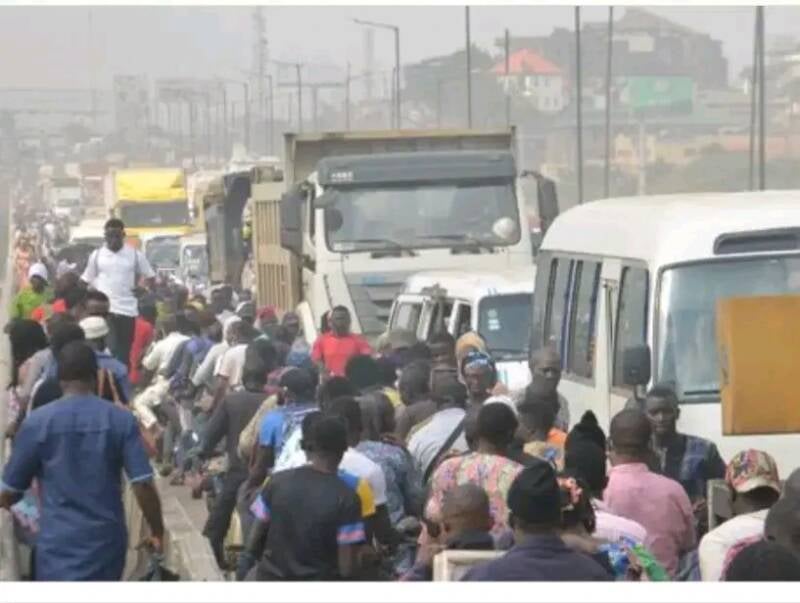
The Kara Bridge on the Lagos-Ibadan Expressway is not just a bridge. It is the artery that connects Nigeria's commercial capital to the rest of the country, the road that carries the trucks, the traders, the students, the workers, and the dreamers who keep Lagos alive. When it fails, the city does not just slow down. It stops. On Tuesday, September 8, 2026, the Federal Ministry of Works began replacing the bridge's damaged expansion joints, a two-week intervention that was supposed to make the road safer. Instead, it turned one of Africa's busiest highways into a parking lot, leaving thousands of motorists and commuters stranded for hours, burning fuel they could barely afford, missing appointments they could not reschedule, and wondering why a single bridge could hold an entire city hostage.
The numbers tell only part of the story. The gridlock stretched from the Kara Bridge in Ogun State to the 7Up Junction in Lagos State and beyond, with reports indicating that by Tuesday afternoon, traffic had extended past the Secretariat Bus Stop, and motorists coming from Ikeja and Agege heading towards the Otedola underpass were caught in congestion stretching beyond Otunba Jobi Fele Way. By Wednesday morning, the situation had barely improved. Commercial drivers resorted to one-way routes to convey passengers, while security and traffic management personnel from the police, military, Lagos State Traffic Management Authority, Federal Road Safety Corps, and Ogun State Traffic Compliance and Enforcement Agency struggled to manage the chaos. The project, initially scheduled to begin in August, had been suspended for a traffic review following public outcry over the short notice. Despite the review, the disruption was severe.
The human cost of the gridlock was immediate and visceral. Mrs Modinat Lawal, a Lagos State civil servant, said she had been unable to make progress on the road since 4 p.m. on Tuesday. "No movement at all. This is not too good as I have been on the road since 4 p.m. and I am now locked around the office due to traffic," she said. "There was no adequate notice. We ought to have been adequately briefed on this development before we put our cars on the road. Time and money are being lost. This is coming at a time a litre of petrol is N1,300 and here we are struggling with our vehicles in traffic, burning petrol". Another commuter, Abel, found himself stranded in Ojodu Berger with no extra money to continue his journey. "I am stranded and don't have enough money, the bus I took from Ikeja is at a standstill in traffic gridlock," he said. "If I had enough money, I would have trekked to the Expressway to take another vehicle, but the commercial driver has refused to refund my transport fare". A resident of Ibaafo, Ogun State, Mr Desoye Oloyede, said he had to remain in his office because his vehicle could not withstand the pressure of the gridlock.
The repairs themselves are necessary. The Acting Controller of Works in Ogun State, Richard Adeleye, explained that the damaged expansion joints had contributed to accidents on the bridge, making the intervention essential despite the temporary inconvenience. "Who is saying the pace of work is slow? We are almost done with one side. We started yesterday," Adeleye said on Wednesday, insisting that the first side of the bridge had already been completed. But rainfall on Wednesday forced the suspension of the next phase of concrete and stone works, while workers continued drilling the expansion joint in preparation for its installation. The lane reduction created a bottleneck: only two lanes were available to motorists heading towards the OPIC Turning, forcing the four lanes from the Secretariat towards Kara Bridge to merge into two about 10 metres before the bridge. Traffic lights were used to alternate vehicles approaching from Isheri-Olowora and River Valley with those coming from Otedola Bridge.
What the Kara Bridge crisis has exposed, however, is not just the fragility of a single bridge. It is the fragility of Nigeria's entire road infrastructure. For years, motorists and commuters have warned that the Lagos-Ibadan Expressway is a single point of failure for the entire South-West. There is no viable alternative route. There is no rail service capable of absorbing the traffic. There is no ferry system, no efficient mass transit, no contingency plan. When the Kara Bridge is repaired, the traffic backs up to Ojota. When it is closed, the city of Lagos grinds to a halt. The government's response has been to urge patience. The Ogun State Traffic Compliance and Enforcement Agency spokesperson, Babatunde Akinbiyi, appealed to motorists to bear with the authorities, noting that the agency had anticipated potential gridlock and issued a traffic advisory. "Anyone who does not have an important business along the axis should stay away," he said.
But patience is not a policy. The commuters who spent four hours travelling from 7Up to Otedola on Tuesday, the civil servants who slept in their offices because their cars could not survive the gridlock, the traders whose goods spoiled in the heat, the students who missed their lectures, the workers who lost their daily wages. These are not people who can afford to be patient. They are people who are paying the price for decades of infrastructure neglect, for a transport system that was never designed to cope with the volume of traffic it now carries, and for a government that fixes bridges only when they are on the verge of collapse. The first phase of the repairs was completed on Wednesday. The second phase is still to come. The rains have already slowed the work. And the question that no one in authority seems willing to answer is the one that matters most: what happens next time?
📩 Stone Reporters News | 🌍 stonereportersnews.com
✉️ info@stonereportersnews.com | 📘 Facebook: Stone Reporters News | 🐦 X (Twitter): @StoneReportNew | 📸 Instagram: @stonereportersnews
Add comment
Comments