

Reported by: Oahimire Omone Precious | Edited by: Oravbiere Osayomore Promise.
Peter Obi was supposed to travel with an entourage of 30 people. That is the standard for a Nigerian governor—a convoy of aides, security details, protocol officers, and personal assistants, all ferried at public expense to events where only the governor was actually invited. But Obi, the presidential candidate of the Nigeria Democratic Congress and former governor of Anambra State, chose a different path. He travelled alone. And in doing so, he saved the state a fortune that would have otherwise vanished into the bottomless pit of official waste.
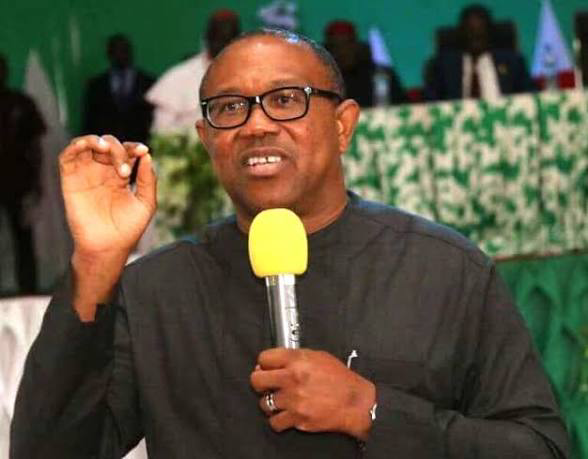
Speaking in Washington, D.C., on Monday, September 14, 2026, Obi recounted the measures he adopted to reduce the cost of governance during his tenure as governor, offering a blueprint that stands in stark contrast to the lavish spending culture that has become the hallmark of Nigeria's political class. He disclosed that he rejected inflated budgets for the renovation of his official facilities, completing projects for significantly less than the amounts originally allocated. "When I was governor, the budget for refurbishing my office was ₦298 million, but I did everything with ₦48 million," he said. "There was also a budget of ₦486 million to refurbish my house, but I completed everything with ₦81 million." The savings were staggering: ₦250 million saved on the office renovation alone, and ₦405 million on the residence, bringing the total savings on those two projects to ₦655 million.
But it was his approach to official travel that truly set him apart. "As a governor, you are supposed to travel with 30 people to several places," Obi said. "Over the years I was governor, I didn't use 16 percent of my travel allowance because I wasn't travelling with anybody. I was the only person invited; nobody invited them." His logic was as simple as it was devastating to the culture of waste: if only the governor is invited, why should the state pay for 29 other people to tag along? The savings from this single decision, accumulated over eight years, would have run into hundreds of millions of naira—resources that Obi redirected towards productive sectors capable of improving the living conditions of Anambra citizens.
Obi's Washington address was not just a trip down memory lane; it was a pointed critique of the governance culture that has become entrenched at the federal level. He has consistently argued that Nigeria's limited resources should be channelled into education, healthcare, infrastructure, and other productive sectors rather than being frittered away on the perks and privileges of public office. His position has centred on the belief that the cost of running government must be drastically reduced if the country is to have any hope of addressing its developmental deficits. In April 2026, he took aim at the existence of certain government offices he believes are not essential, including the office of the First Lady at the state level, and highlighted what he described as an excessive entourage culture among public officials.
The contrast between Obi's frugality and the spending habits of the current federal administration is stark. In January 2024, the Federal Government announced a 60 per cent reduction in the size of official travel entourages for domestic and international trips, a move that Obi welcomed but described as merely scratching the surface. He argued that more substantial reductions in governance costs were needed to impact the economy. His Washington remarks suggest that he believes the political class has still not grasped the gravity of the situation. While the Federal Government tinkers with travel allowances, the underlying culture of waste—the inflated budgets, the unnecessary entourages, the obsession with perks—remains firmly intact.
Obi's record as governor, however, offers a counter-narrative. He left office in 2014 with about $150 million in Anambra's treasury, a feat he has repeatedly claimed no other governor has matched. He recently stated that the funds would have appreciated significantly if they had remained intact, estimating that the value could now be close to $1 billion. His critics, including Minister of Works David Umahi, have questioned the wisdom of saving such sums while citizens went hungry. But Obi's defenders argue that his frugality was precisely what enabled him to invest in the state's future without mortgaging it to debt.
As the 2027 elections approach, Obi's message is clear: Nigeria cannot continue to spend like a wealthy nation while its people live in poverty. The ₦298 million budget for an office renovation, the ₦486 million for a governor's residence, the 30-person entourages to events where only one person is invited—these are not the trappings of a serious government. They are the symptoms of a political class that has lost touch with the people it is supposed to serve. Obi's Washington address was a reminder that another way is possible. The question is whether anyone in Abuja is listening.
📩 Stone Reporters News | 🌍 stonereportersnews.com
✉️ info@stonereportersnews.com | 📘 Facebook: Stone Reporters News | 🐦 X (Twitter): @StoneReportNew | 📸 Instagram: @stonereportersnews
Add comment
Comments