

Reported by: Ijeoma G | Edited by: Oravbiere Osayomore Promise.
Journalists and bloggers in Kwara State are facing a chilling campaign of intimidation, with suspected political thugs threatening them and their families to force them to stop reporting on the worsening security situation in the state. Several media practitioners who have consistently covered cases of kidnapping, banditry and other criminal activities have received threatening messages and phone calls warning them to scale down their coverage of insecurity, according to a SaharaReporters investigation published on Monday, September 14, 2026.
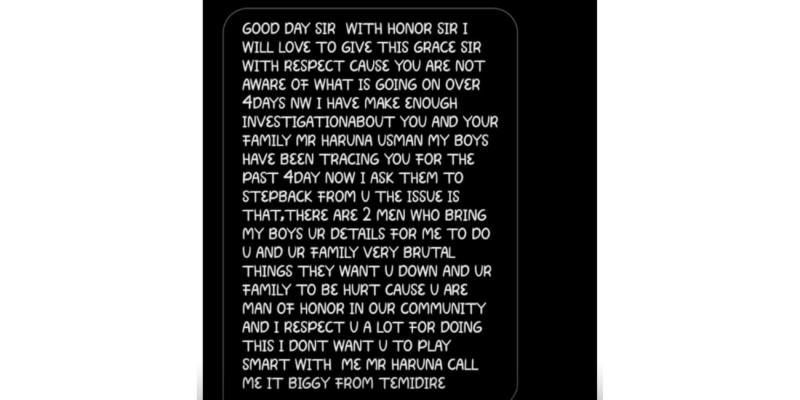
The threats are not vague warnings. Haruna Usman, the Editor-in-Chief of Nupeko TV, received a detailed text message that contained his personal information, the address of his father's residence, and a chilling claim that two men had hired assassins to attack him and his family. The message, signed by someone identifying himself as "Biggy from Temidire," claimed that the sender had been investigating Usman for four days and that his "boys" had been tracing him. "There are 2 men who bring my boys ur details for me to do u and ur family very brutal things they want u down (killed) and ur family to be hurt," the message read in part. The sender claimed he decided to spare Usman because of his standing in the community but warned him against trying to outsmart him. Usman told SaharaReporters that he could not conclusively link the threat to any particular report, but he believed it was connected to the nature of Nupeko TV's work covering issues affecting communities in the state.
The threat has forced Usman and his colleagues to take additional security precautions. He said he deliberately refrained from publicly accusing any political party or individual because he did not want to prejudice investigations by security agencies or potentially trigger further attacks. His caution is understandable. In Kwara State, the line between political actors and criminal elements has become dangerously blurred, and journalists who report on insecurity often find themselves caught in the crossfire.
Other journalists and bloggers who spoke to SaharaReporters described a coordinated effort to suppress coverage of insecurity, particularly as the 2027 general elections approach. One journalist said local media practitioners had come under increasing pressure from political figures and influential stakeholders because opposition parties were using insecurity as a major campaign issue against the state government. "There have been a lot of pressures from political figures and stakeholders because the opposition parties are now using insecurity as one of the major campaign issues against the government," the journalist said. Some reporters were specifically warned to reduce their coverage until after the elections.
The pressure appears to be driven by a calculation that is as cynical as it is dangerous: if the full scale of the insecurity crisis is reported, it could damage the political fortunes of the ruling All Progressives Congress in the state. Kwara has been ravaged by banditry and kidnapping in recent months, with communities in Baruten, Kaiama, Edu, Patigi and Ifelodun facing constant attacks. In June 2026, elders and stakeholders from Kwara North raised the alarm over an unprecedented wave of killings, kidnappings and terrorist attacks, warning that the worsening insecurity had made political mobilisation for the APC nearly impossible ahead of the 2027 elections. The Kwara North Development Commission disclosed that more than 1,200 people had been killed in the region, a staggering figure that the state government has been accused of downplaying.
The intimidation of journalists is not new in Kwara. In September 2025, the Emir of Lafiagi, Alhaji Muhammad Kudu Kawu, summoned journalists and warned them to cease reporting on terrorist and bandit attacks, allegedly to avoid embarrassing Governor AbdulRahman AbdulRazaq. In July 2026, residents who publicly criticised the governor's handling of insecurity during a visit by activist Sunday Igboho were reportedly threatened, and traditional rulers were ordered not to receive Igboho again. In August 2026, three journalists were suspended by the state council of the Nigeria Union of Journalists over their alleged involvement in a legal action against the union, a move that critics described as an attempt to silence dissent within the media community.
The pattern is clear: those who report on insecurity in Kwara are being systematically targeted, whether through direct threats of violence, political pressure, or internal union disciplinary action. The journalists who spoke to SaharaReporters said the pressure fell hardest on local news platforms and social-media-based journalists, who often amplify security incidents from communities that receive little coverage from national media. These are the reporters who live and work within the communities they cover, and they are the ones who face the greatest risk when they publish stories that powerful interests want buried.
The implications of this campaign of intimidation extend far beyond the individual journalists who have been threatened. When reporters are forced to choose between reporting on issues affecting their communities and protecting themselves and their families from reprisals, the entire society suffers. Residents of Kwara North depend on local journalists and bloggers to bring security concerns to public attention. If those voices are silenced, the violence will continue in the dark, and the victims will have no one to tell their stories.
The journalists have called on the Nigeria Union of Journalists, the Nigeria Police Force, and other relevant authorities to investigate the threats and ensure the safety of media practitioners in the state. They have also urged their colleagues not to be intimidated, stressing that the public's right to know must not be sacrificed on the altar of political expediency. As the 2027 elections approach, the battle for the truth in Kwara is no longer just about journalism. It is about whether the people of the state will be allowed to know the full extent of the crisis that is consuming their communities, or whether they will be kept in the dark while those in power protect their political interests at any cost.
📩 Stone Reporters News | 🌍 stonereportersnews.com
✉️ info@stonereportersnews.com | 📘 Facebook: Stone Reporters News | 🐦 X (Twitter): @StoneReportNew | 📸 Instagram: @stonereportersnews
Add comment
Comments