

Reported by Ariajegbe Sylvia Esezobor
South Africa's presidency has been plunged into an extraordinary and deeply unsettling moment after both of the country's top leaders were declared medically unfit to carry out their official duties, leaving the nation's highest executive offices effectively vacant at one of the most politically charged moments in recent memory.
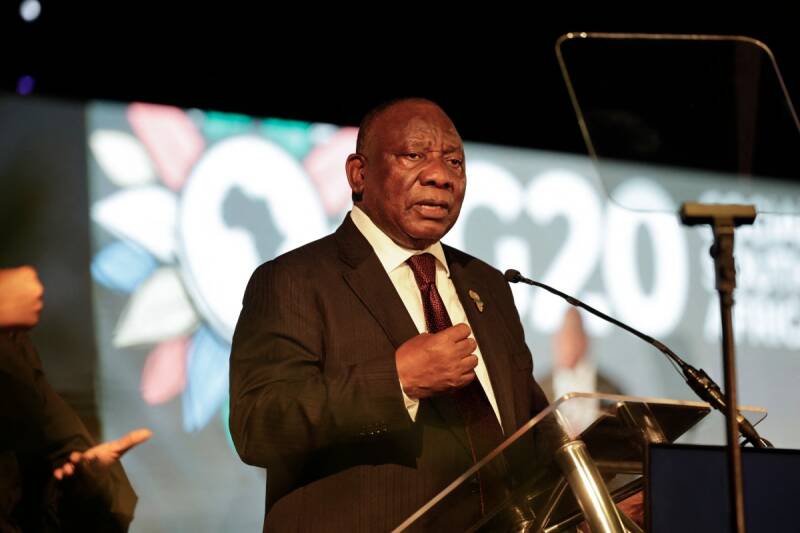
President Cyril Ramaphosa, 73, was booked off from all public engagements on Wednesday after returning from the BRICS summit in India, his office confirmed. The presidency said Ramaphosa had been advised by his medical team to rest and recover, and that where possible he had asked the respective ministers to represent him at scheduled engagements. No details were provided about the nature or severity of his illness, and the statement did not indicate how long his absence might last. The official announcement was characteristically terse, leaving South Africans to fill the silence with questions, speculation and a quiet undercurrent of alarm.
What makes this moment so unusual is that Ramaphosa is not alone in his convalescence. Deputy President Paul Mashatile has been on medical leave for more than a month, recovering from what the presidency has described only as a minor medical procedure. His office has declined to disclose his diagnosis or the nature of the procedure, citing his right to medical privacy and cautioning against speculative or unverified claims about his health. On Tuesday, Mashatile issued a statement saying his recovery was progressing well and that he was regaining strength each day, but he confirmed he would continue resting until his doctors advised otherwise. The simultaneous absence of the president and his deputy has no recent precedent in South Africa's democratic history, and it has exposed a structural vulnerability that the country's constitution was never designed to fully address.
The timing could hardly be more delicate. South Africa is entering an increasingly busy political season ahead of local government elections scheduled for November 4, a contest that will be fought across every municipality in the country and will serve as a crucial midterm verdict on the governing party's standing. Ramaphosa had only just declared the election date a public holiday, a routine but symbolically important act that underscored his engagement with the electoral calendar. Now, with both the president and deputy president off duty, the day-to-day management of government falls to cabinet ministers who have been asked to cover public engagements where possible, and to the civil service machinery that keeps the state running regardless of who occupies the highest offices.
On the international stage, the consequences are already visible. Foreign affairs minister Ronald Lamola will lead South Africa's delegation to this year's United Nations General Assembly in Ramaphosa's absence, according to the South African Broadcasting Corporation. That decision places Lamola, a relatively low-profile figure on the global diplomatic circuit compared to his president, at the helm of South Africa's engagement at the world's most important multilateral gathering. He will arrive in New York at a time of renewed diplomatic tensions with Washington, after the United States imposed visa restrictions on some South Africans over what it called race-based discrimination. President Donald Trump's administration has made false claims that South Africa's white Afrikaner minority is being persecuted, a narrative that South Africa firmly rejects, insisting there is no evidence of discrimination against whites and that it has every right to implement policies addressing the legacy of centuries of racial injustice.
Ramaphosa's illness comes in the wake of an intense period of international travel and engagement. He arrived in New Delhi on September 11 for the 18th BRICS summit, held under India's chairship, where leaders of Brazil, Russia, India, China and South Africa gathered for two days of discussions focused on inclusive global growth, resilience, innovation and the situation in the Middle East. The summit concluded with the adoption of the New Delhi Declaration, and Ramaphosa was publicly praised for his participation and for South Africa's role in helping bring member countries together. On the sidelines, he held a bilateral meeting with Indian Prime Minister Narendra Modi, reviewing bilateral ties and discussing an India-Southern African Customs Union trade pact. He also thanked Modi for India's warm hospitality and for the successful organisation of the summit. He returned to South Africa on Monday, and within two days his medical team had intervened.
This is not the first time Ramaphosa's health has become a matter of public concern. In December 2021, he tested positive for Covid-19 during the Omicron wave and self-isolated in Cape Town while being monitored by the South African Military Health Service. He was treated for mild symptoms and continued to work remotely, a fact that his office emphasised at the time to reassure the public that the business of government would continue. That episode was managed with relative transparency and a clear timeline, in contrast to the current situation, where neither the president's office nor the deputy president's office has provided a clear prognosis or a sense of when either leader might return to full duties.
The presidency's statement on Wednesday offered no timeline. It said only that Ramaphosa had been advised to rest and recover, and that ministers would represent him where possible. For a country of nearly sixty million people, the absence of both the president and his deputy is not merely a logistical inconvenience. It raises constitutional questions about decision-making authority, creates uncertainty in the markets, and sends a signal to the world that Africa's most industrialised economy is, at least temporarily, without a fully functioning executive. The cabinet continues to meet, the civil service continues to operate, and the daily machinery of governance grinds on. But the political direction that only a president can provide is on hold.
South Africans are accustomed to political drama, but they are not accustomed to this. The silence from the presidency, the vagueness of the medical updates, and the simultaneous incapacitation of the two most senior office-holders have combined to create a rare moment of genuine uncertainty. The country's constitution provides for an acting president in certain circumstances, but no such designation has been announced. Until it is, or until Ramaphosa and Mashatile return to their posts, South Africa will be governed by a cabinet and a bureaucracy, waiting for the men at the top to recover, and hoping that the business of state does not require decisions that only they can make.
📩 Stone Reporters News | 🌍 stonereportersnews.com
✉️ info@stonereportersnews.com | 📘 Facebook: Stone Reporters News | 🐦 X (Twitter): @StoneReportNew | 📸 Instagram: @stonereportersnews
Add comment
Comments