

Reported by Ariajegbe Sylvia Esezobor
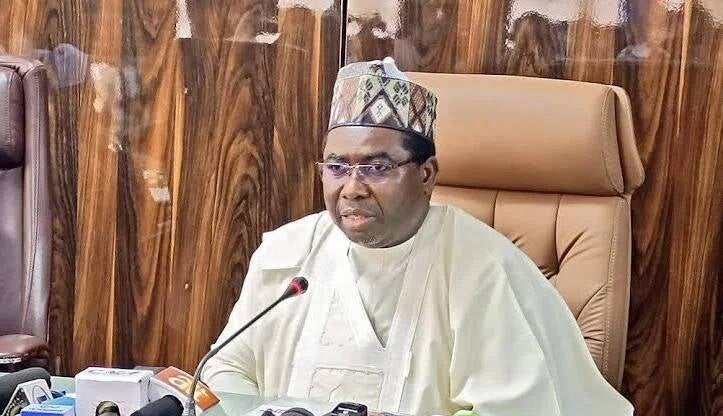
The Independent National Electoral Commission has broken its silence on the whereabouts of its chairman, Professor Joash Amupitan, after a firestorm of speculation erupted over his absence from the commission's headquarters at a critical moment in Nigeria's electoral calendar.
The controversy was ignited on Tuesday when National Commissioner Professor Rhoda Gumus appeared as Acting Chairman of INEC, receiving an African Union Pre-Election and Needs Assessment Mission at the commission's headquarters in Abuja. The AU delegation, led by former Ethiopian Foreign Minister Demeke Mekonnen, was in Nigeria to assess the country's preparations for the 2027 general elections. But it was not the delegation's visit that drew attention. It was the conspicuous absence of the man who is supposed to be leading Nigeria's electoral body, and the fact that his duties had apparently been handed to another commissioner without any public announcement.
By Wednesday morning, the Obidient Movement, the political pressure group that emerged from Peter Obi's 2023 presidential campaign, had seen enough. In a statement signed by its National Coordinator, Dr Yunusa Tanko, the group demanded an immediate explanation from INEC over Amupitan's whereabouts and official engagements. "As far as the Obidient Movement and Nigerians are concerned, there was no official communication of Professor Amupitan's handover to anyone, either in acting or substantive capacity," Tanko said. "This raises legitimate questions about the Chairman's current location, official schedule and the circumstances surrounding his absence."
The movement did not stop at asking where Amupitan was. It demanded to know when he left Abuja, the purpose of his absence, who authorised it, and whether he had travelled outside Nigeria. It also questioned whether the chairman had met, or was scheduled to meet, President Bola Tinubu, the National Chairman of the All Progressives Congress, or any representative of the ruling party. Tanko was blunt about the stakes. "As Nigeria moves closer to the 2027 general elections, the INEC Chairman cannot operate in secrecy," he said.
INEC's response, when it came, was terse. Mrs Victoria Eta-Messi, the commission's Director of Voter Education and Publicity, told journalists in a WhatsApp message that the chairman was simply away on official duty. "The Chairman is on an official assignment outside Abuja. He can delegate powers to any National Commissioner," she said. The explanation was brief and did little to satisfy critics. A separate INEC official, speaking anonymously, dismissed the Obidient Movement's concerns as "a non-issue," arguing that the chairman did not need to be physically present in Abuja to perform his duties. "Must he be in Abuja to perform his duties? So, if I were to go on leave, can't I hand over to someone until I return? The Chairman is attending a conference and even gave an address at the conference. It's just noise," the official said.
But it was not noise to those watching. Checks by journalists on INEC's official social media accounts revealed that Amupitan had indeed been engaged in activities outside the country. A post on Friday showed him in Ottawa, Canada, where he met with Google's Global Lead for Civic Responsibility, David J. Lopez, accompanied by the Director of Information and Communication Technology, Dr Lawrence Bayode. The meeting took place on the sidelines of the Global Conference on Responsible AI and Elections, held in Ottawa from 9 to 11 September 2026. Earlier, Amupitan had held strategic partnership meetings with senior officials of Microsoft and the International Foundation for Electoral Systems, engaging with Ethan Chumley, Emerging Tech and Cyber Lead, and Ariana Molina, Programme Manager, on emerging technologies, cybersecurity and responsible artificial intelligence. He also addressed the AI Conference, sharing Nigeria's experience in institutionalising responsible AI for electoral administration.
The trip was part of INEC's broader push to prepare for the 2027 elections, a contest that will test the commission's credibility after the controversies that marred the 2023 polls. The Obidient Movement, which has consistently questioned INEC's independence, made clear that it viewed the chairman's absence as part of a troubling pattern. Tanko accused Amupitan of having "antecedents and strong affection for the APC" and warned that "the era of the INEC Chairman having strategy meetings with the APC and the ruling party must be a thing of the past." He said the movement did not trust the chairman or the commission he leads, and that it was incumbent on INEC to demonstrate transparency and non-partisanship.
The context of Amupitan's appointment has fuelled some of that suspicion. President Tinubu presented Amupitan's nomination to the National Council of State in October 2025. He was confirmed by the Senate and sworn in by Tinubu on 23 October 2025. The Obidient Movement has never accepted his leadership as independent, and the current controversy has provided fresh ammunition. INEC has previously rejected allegations of partisan activity involving Amupitan, describing such claims as fabricated, and has said he does not operate a personal account on X.
The commission's defenders argue that the criticism is misplaced. Amupitan's trip to Canada was long scheduled and publicly announced. INEC had said in August that it would participate in the Global Conference on Responsible AI and Elections, organised by UNDP and Elections Canada, and had appealed to the Canadian High Commission for expedited visa processing for its delegation. The conference was part of a deliberate strategy to develop defences against AI-driven threats such as deepfakes and disinformation ahead of the 2027 polls. For INEC, Amupitan was doing exactly what he should be doing: preparing for an election that will be fought in part on the digital battlefield.
Yet the commission's communication failures have created a vacuum that its critics have rushed to fill. There was no formal announcement of the handover to Gumus, no public statement explaining Amupitan's absence, and no clear timeline for his return. In an era of heightened scrutiny and low public trust, the absence of basic transparency has consequences. The questions raised by the Obidient Movement are not unreasonable. Who is running INEC? Who authorised the handover? And why did Nigerians have to find out from a social media post that the chairman was on another continent?
For a commission that has repeatedly promised credible and transparent elections, the controversy is an unwelcome distraction. But it is also a reminder that credibility is built not just through the conduct of elections, but through the everyday management of public trust. As Nigeria inches closer to 2027, INEC will need to do more than defend its chairman's travel schedule. It will need to demonstrate that its leadership, wherever it may be, is accountable to the people it serves.
📩 Stone Reporters News | 🌍 stonereportersnews.com
✉️ info@stonereportersnews.com | 📘 Facebook: Stone Reporters News | 🐦 X (Twitter): @StoneReportNew | 📸 Instagram: @stonereportersnews
Add comment
Comments