

Reported by: Oahimire Omone Precious | Edited by: Oravbiere Osayomore Promise.
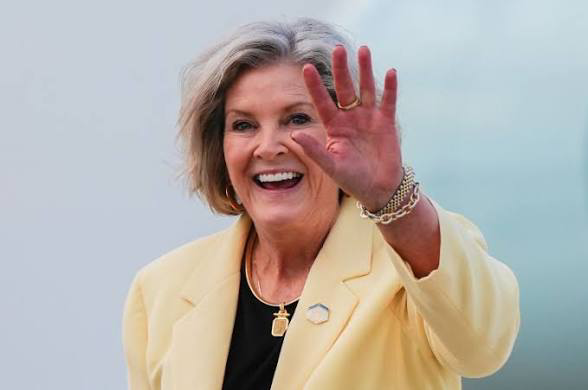
The announcement came in a single post on X, the social media platform that has become the primary channel of communication for the Trump White House. “Some personal news I’m grateful to share. After a medical appointment at the Mayo Clinic this week, my pathology results came back clear. I am cancer free,” Susie Wiles wrote on Wednesday, September 16, 2026. Six months earlier, in March 2026, the first woman to serve as White House chief of staff had disclosed that she had been diagnosed with early-stage breast cancer. She said at the time that the disease had been caught early and that her prognosis was excellent. She also made it clear that she would not be stepping back from her duties. She continued working through her treatment, often virtually, from her home in Florida and from the White House residence, remaining the gatekeeper to the President of the United States while simultaneously undergoing a course of medical care that she never fully described in public.
Wiles, who turned 69 in May 2026, is a figure of singular importance in the American political landscape. Born on May 14, 1957, she began her career in politics in the 1970s, working for Republican Jack Kemp before joining Ronald Reagan’s presidential campaign in 1980. She later worked in the Reagan White House and spent decades as a political operative in Florida, a state she helped turn into a Republican stronghold. Her relationship with Donald Trump began during his first presidential campaign in 2016, when she helped him win Florida. She went on to manage his 2020 Florida campaign, was a senior adviser to his 2024 campaign, and was named chief of staff after his victory. Her appointment made history. Never before had a woman held the position, which is widely regarded as the most powerful non-elected role in the federal government. In that role, she coordinates policy, manages the President’s schedule and political strategy, and serves as the final gatekeeper before anyone reaches the Oval Office.
Trump calls her the “Ice Maiden,” a reference to her calm, unflappable demeanor and her willingness to deliver hard truths. In a town defined by noise and self-promotion, Wiles has been a study in restraint. She rarely gives interviews, seldom appears on television, and has kept a low profile even as her influence has grown. Her approach has been described by insiders as methodical and disciplined. She is credited with imposing order on a White House that had been chaotic during Trump’s first term, and with steering the President’s political operation toward a more strategic and disciplined footing. When Trump announced her appointment in November 2024, he praised her as “tough, smart, innovative, and universally admired and respected.” He was not alone in that assessment. Even critics of the administration have acknowledged that Wiles brought a level of professionalism and stability to the West Wing that had been absent during the first term.
Her cancer diagnosis in March 2026 sent a quiet shock through Washington. Trump, speaking to reporters at the time, described her as “an amazing person, an amazing fighter” and said her prognosis was excellent. He urged her to take as much time away as she needed, but Wiles insisted on continuing to work. She managed the White House from her home in Florida during the early months of her treatment, returning to Washington when her condition allowed. Her decision to remain in the job was a signal that the administration would not be destabilised by her illness. It also reflected the depth of the trust that Trump places in her. He has described her as one of the most important people in his political life, and there is little doubt that her presence was a stabilising force during a period of intense political and legal pressure.
In her post on Wednesday, Wiles thanked her family, friends and doctors, and offered a special thank you to President Trump for his “unwavering support.” She said she was deeply grateful and would continue to work to advance his America First Agenda. The message was characteristic: brief, gracious, and immediately focused on the work. She did not disclose the details of her treatment, and her office did not provide further information. But the words “I am cancer free” carried a weight that no press release could match. For a woman who has spent her life behind the scenes, the announcement placed her briefly at the centre of national attention, not because of a political battle but because of a personal one.
The news was greeted with an outpouring of support from across the political spectrum. Republican allies and former colleagues praised her resilience. Even some of Trump’s most vocal critics acknowledged the seriousness of her illness and expressed relief at her recovery. Breast cancer affects one in eight women in the United States, according to the Centers for Disease Control and Prevention, and an estimated 300,000 new cases are diagnosed each year. Early detection, like the one that Wiles credits with saving her life, dramatically improves survival rates. Her decision to speak openly about her diagnosis, first in March and now in September, has been praised by advocacy groups who say that public figures who share their experiences help reduce stigma and encourage others to seek screening.
For the White House, the announcement is a moment of relief after a year of relentless political combat. The administration has faced legal challenges, legislative battles, and intense scrutiny from the press. Wiles has been at the centre of all of it, managing the President’s schedule, coordinating with Congress, and advising on strategy. Her recovery means that the administration retains its most experienced and trusted operator at a time when it can least afford to lose one. For the President, who has described her as indispensable, the news is personal. He has relied on her counsel for years, and her return to full health removes a cloud that had hung over the West Wing since March.
In the end, the story of Susie Wiles is a story of quiet strength. She did not seek sympathy. She did not step aside. She continued to work, continued to advise, continued to serve. And on Wednesday, she announced that the fight was over and that she had won. “I am cancer free,” she wrote. For a woman known for keeping her thoughts to herself, those four words said everything.
📩 Stone Reporters News | 🌍 stonereportersnews.com
✉️ info@stonereportersnews.com | 📘 Facebook: Stone Reporters News | 🐦 X (Twitter): @StoneReportNew | 📸 Instagram: @stonereportersnews
Add comment
Comments